Everest Base Camp Trek
Everest Base Camp Trek
Choose your Itinerary
Introduction to Everest Base Camp Trek
The Everest Base Camp Trek is a 14-day guided trek from Kathmandu to Everest Base Camp (5,364 m) and Kala Patthar that you can book with Sherpa Expedition Teams and that has two acclimatization days built into the route. The route starts in Kathmandu and passes Lukla, Phakding, Namche Bazaar, Tengboche, Dingboche, Lobuche and Gorak Shep before Everest Base Camp and Kala Patthar. Sherpa Expedition Teams ran about 250 Everest departures in Spring 2026 and roughly 97% of clients completed the full planned trip. Trekkers name this trip the EBC trek, the Everest Base Camp hike or the 14 days Everest Base Camp trek package and each name describes the same trek to Everest Base Camp.
The 14 days itinerary places the two acclimatization days at Namche Bazaar and Dingboche. The package price is listed per person with every inclusion in the price section. The departures section lists the open dates for each season. Sherpa guides lead every departure and manage the acclimatization schedule from Lukla to Kala Patthar.
Trip Highlights
Experience the best of this region - from high mountain passes to remote valleys, rich culture, and breathtaking landscapes.
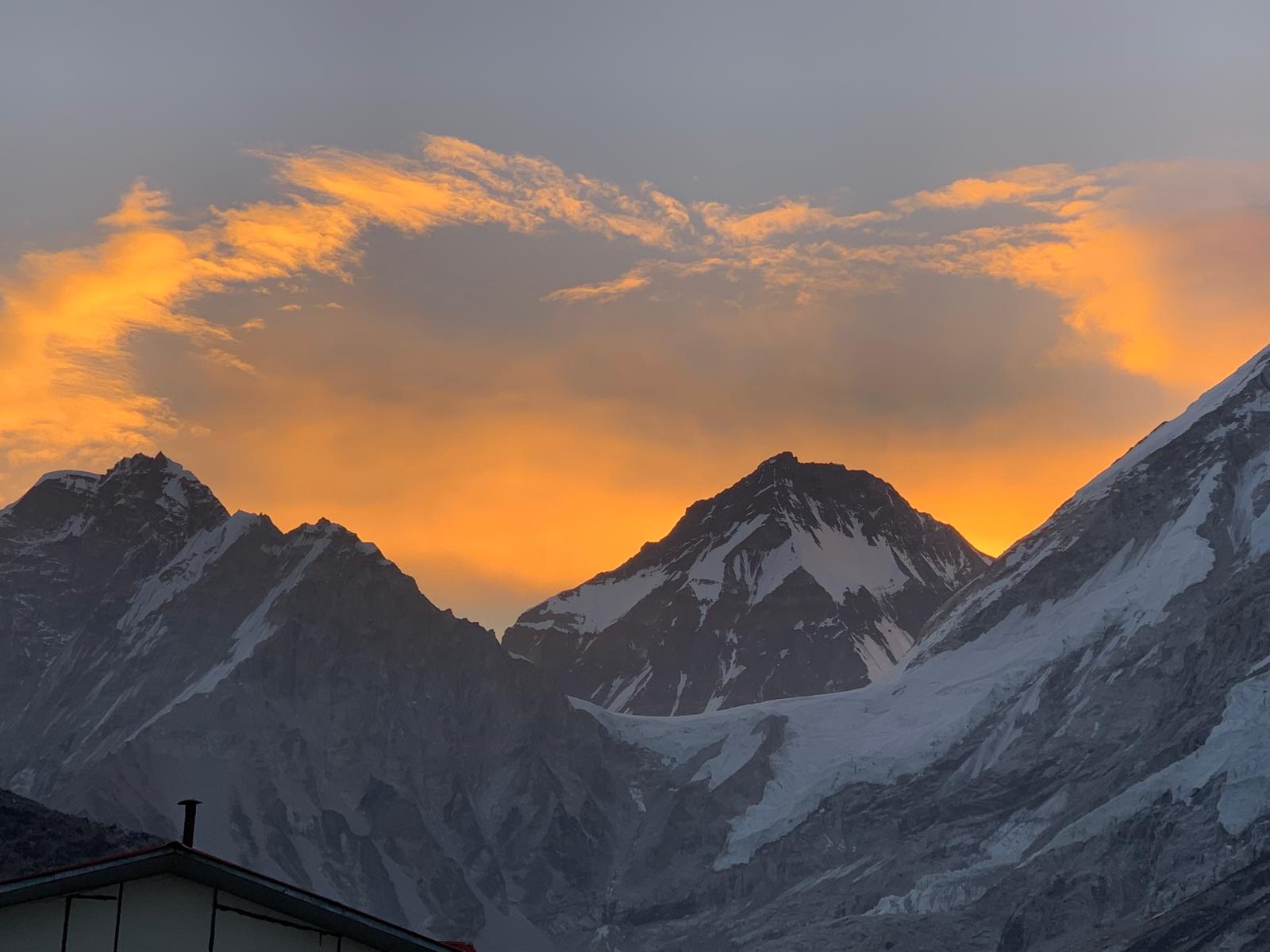
Kala Patthar sunrise
The viewpoint at about 5,545 m gives the closest Everest view of the trek on Day 11.
DISCOVER MORE →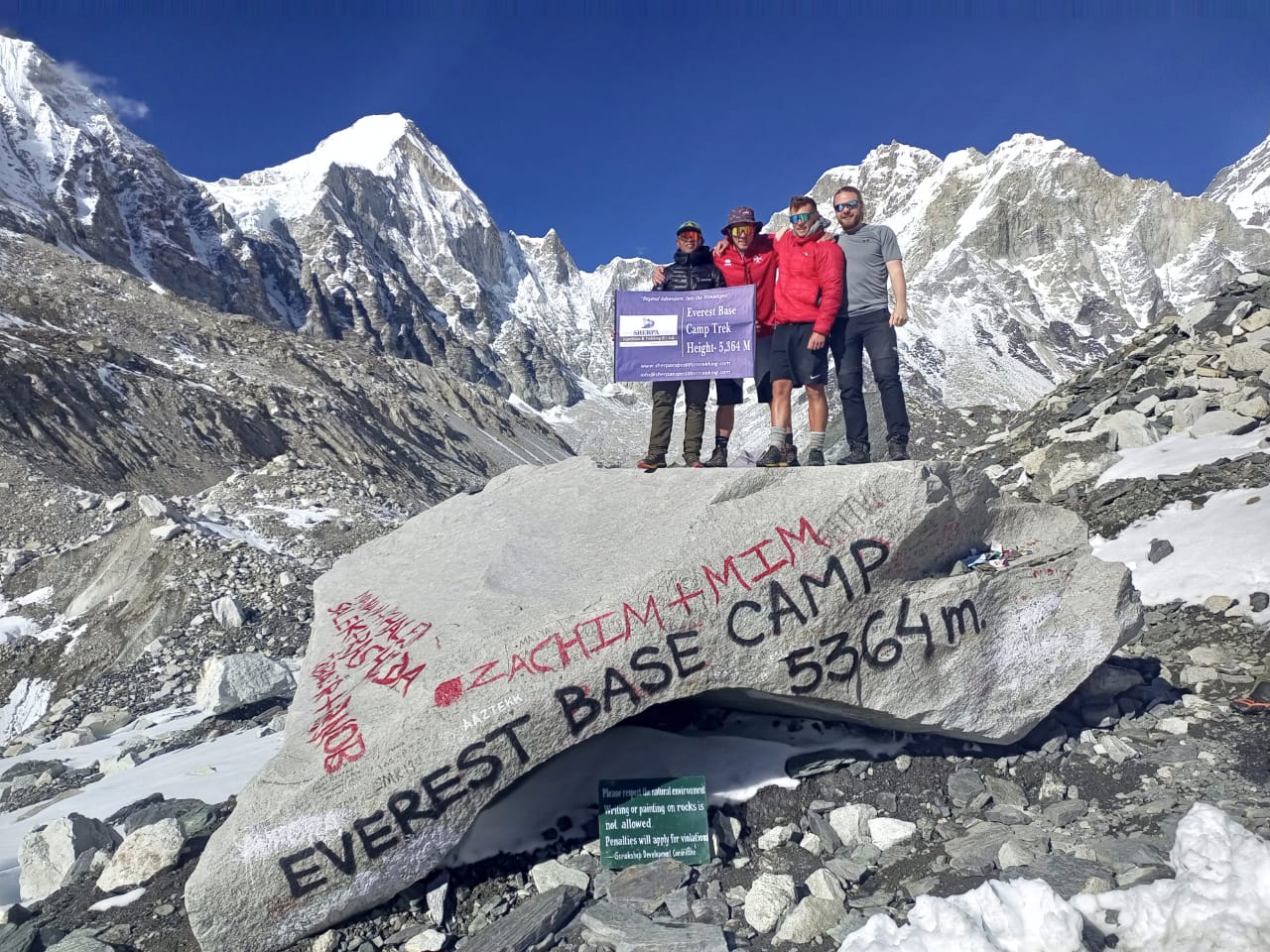
Everest Base Camp
the camp at 5,364 m sits beside the Khumbu Icefall and marks the goal of Day 10.
DISCOVER MORE →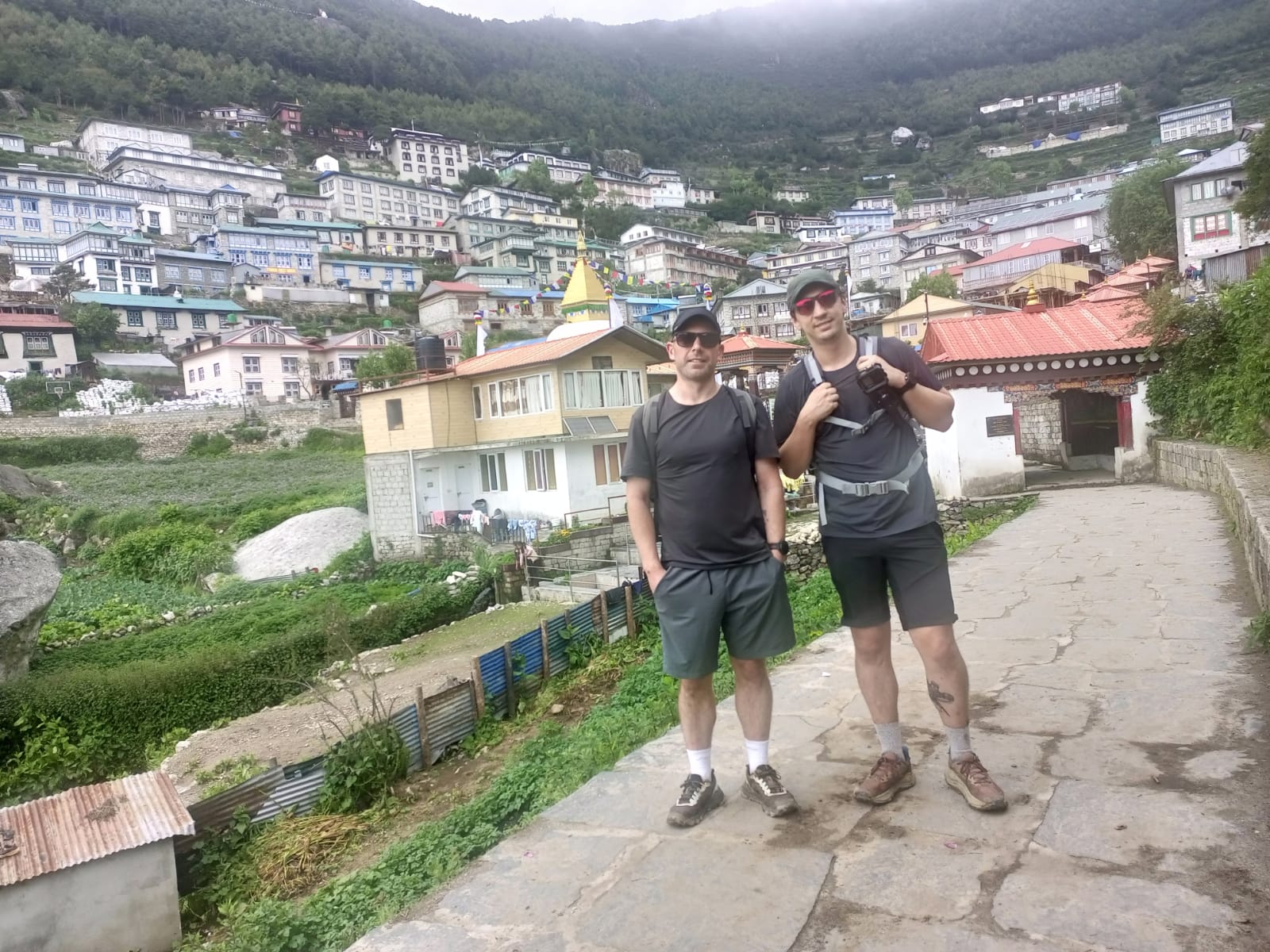
Namche Bazaar
The Sherpa trading town at 3,440 m hosts the first acclimatization day.
DISCOVER MORE →
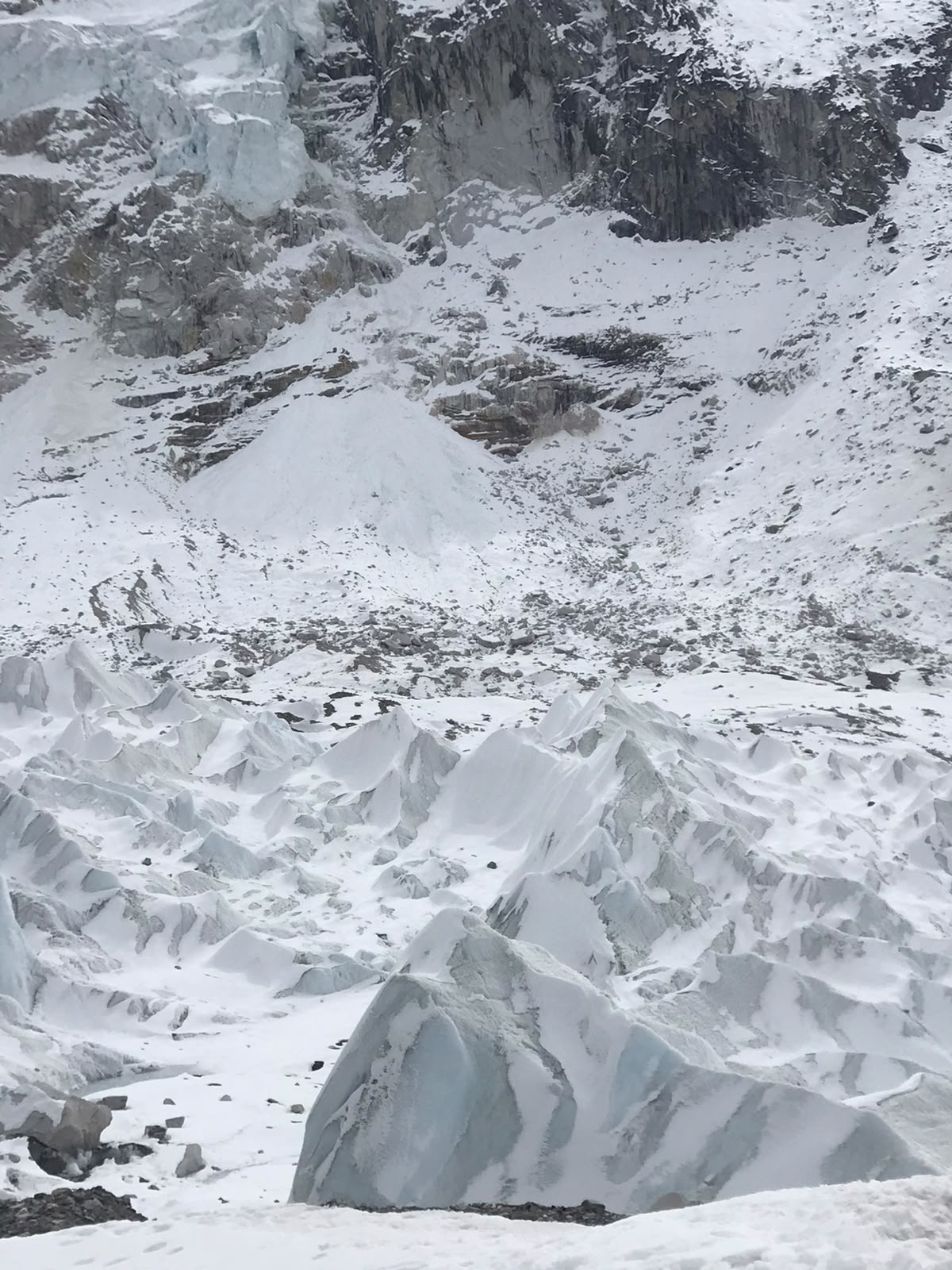
Khumbu Glacier
The glacier moraine carries the trail from Thukla to Gorak Shep on Day 9 and Day 10.
DISCOVER MORE →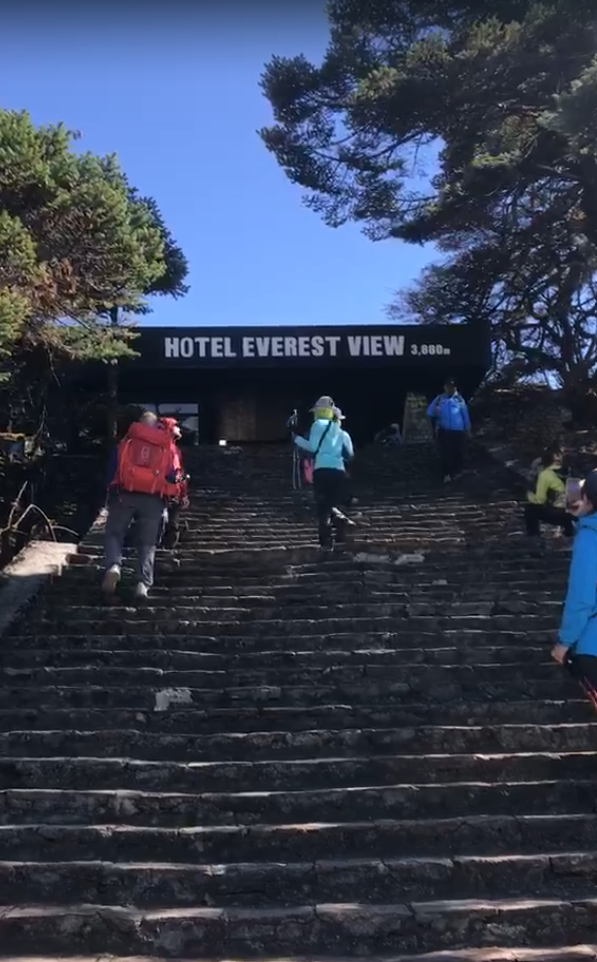
Hotel Everest View:
The hotel terrace at 3,880 m shows Everest, Lhotse and Ama Dablam on Day 5.
DISCOVER MORE →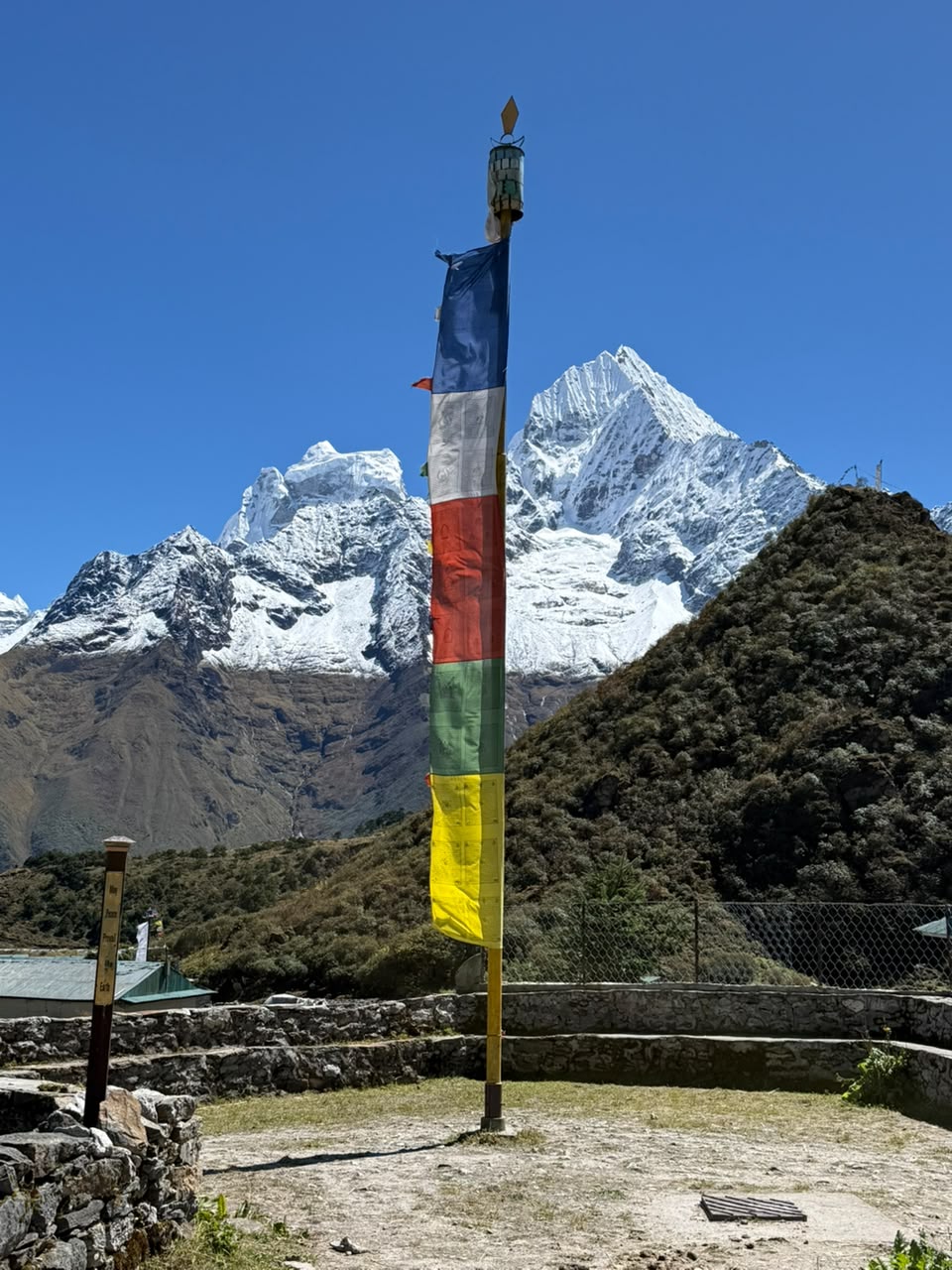
Sherpa culture
The villages show mani walls, prayer wheels and family-run teahouses on each trekking day.
DISCOVER MORE →Why 14 Days Is the Right Pace for Everest Base Camp
A 14 days schedule gives the body two full acclimatization days and keeps each night's sleeping gain close to the 300 to 500 m range that altitude doctors recommend above 3,000 m. The Wilderness Medical Society guidance limits sleeping gain to 500 m per day above 3,000 m and sets a rest day every 3 to 4 days. The nightly gain on this package stays between 224 m and 543 m above Namche Bazaar.
Yes. 14 days is enough for Everest Base Camp. Itineraries of 12 days or fewer are too fast for most first-time trekkers because they cut one acclimatization day or the Kathmandu preparation day.
The 14-day pace rests on 3 reasons:
- Acclimatization days: 2 rest days at Namche Bazaar and Dingboche hold the sleeping altitude for a second night.
- Buffer time: 1 descent day shortens if weather or health adds a day on the ascent.
- Completion rate: about 97% of Sherpa Expedition Teams clients complete the full planned trip.
- Guides refuse to skip an acclimatization day if a group asks to move faster. The two acclimatization stops follow.
Two Acclimatization Days at Namche Bazaar and Dingboche
A 14 days package rests one day at Namche Bazaar (3,440 m / 11,286 ft) and one day at Dingboche (4,410 m / 14,469 ft). Each rest day has a short hike higher before sleeping lower. Trekkers hike to Hotel Everest View (3,880 m / 12,730 ft) from Namche Bazaar and to Nangkartshang (about 5,083 m / 16,677 ft) from Dingboche. An acclimatization day is a climb high and sleep low day and not a day in bed. Guides check oxygen saturation with a pulse oximeter after dinner and in the morning above about 3,500 m. The acclimatization on the Everest Base Camp Trek page explains the science. Both rest days appear in the day-by-day plan below.
Altitude Chart
Everest Base Camp Trek Itinerary
Day 1 takes you from Tribhuvan International Airport to Hotel Thamel Park in Kathmandu (1,400 m / 4,593 ft) in 0 hours of walking and 0.5 to 1 hour by road. Arrival in Kathmandu and transfer to Hotel Thamel Park is the full program of the day. Who meets you at Kathmandu airport? A Sherpa Expedition Teams representative or driver waits outside the arrivals gate with a company placard. The driver takes you 6 km (3.7 mi) to Hotel Thamel Park in Chaksibari Marga in Thamel and the team welcomes you at the hotel.
Prepare 3 items for Day 2: the passport, the travel insurance policy and the trekking gear for the gear check. Day 2 stays in Kathmandu.
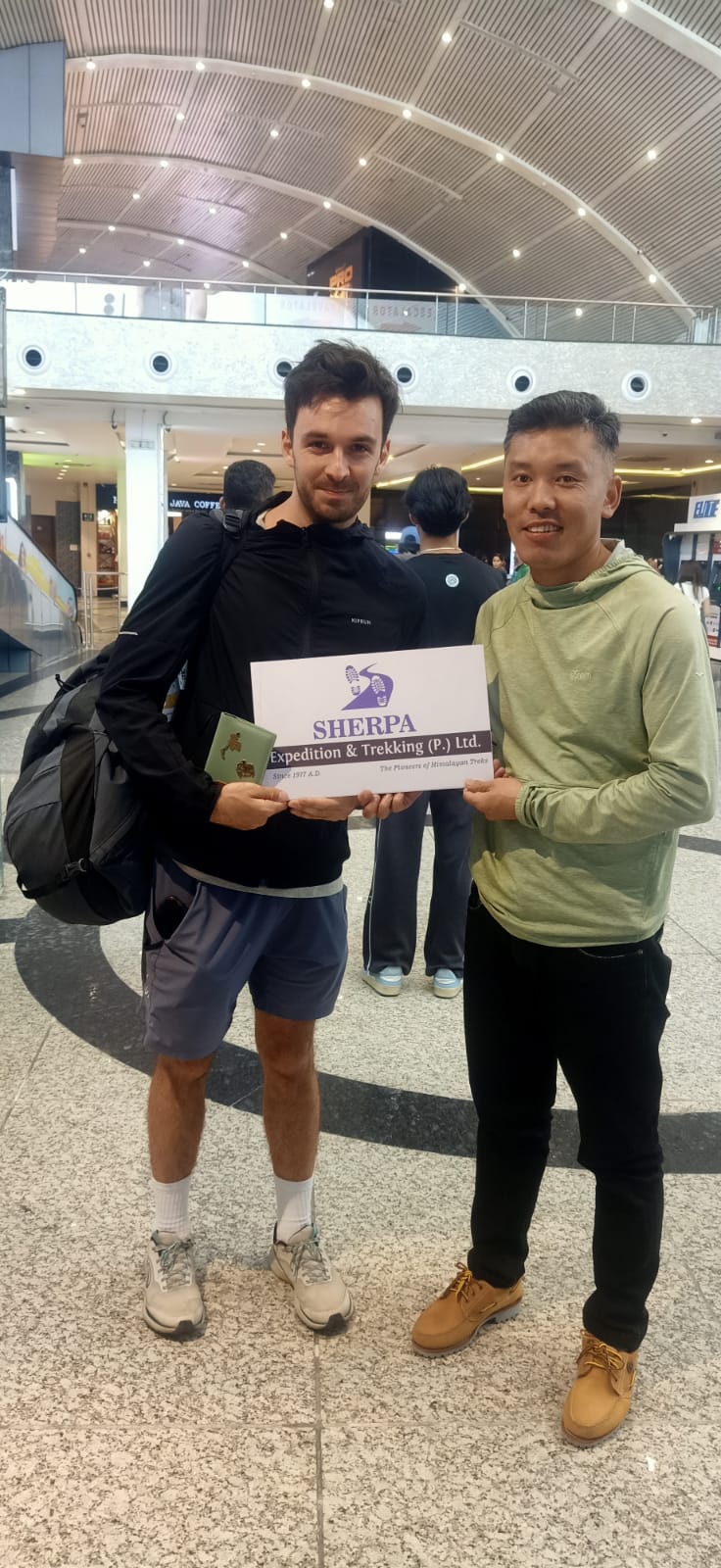
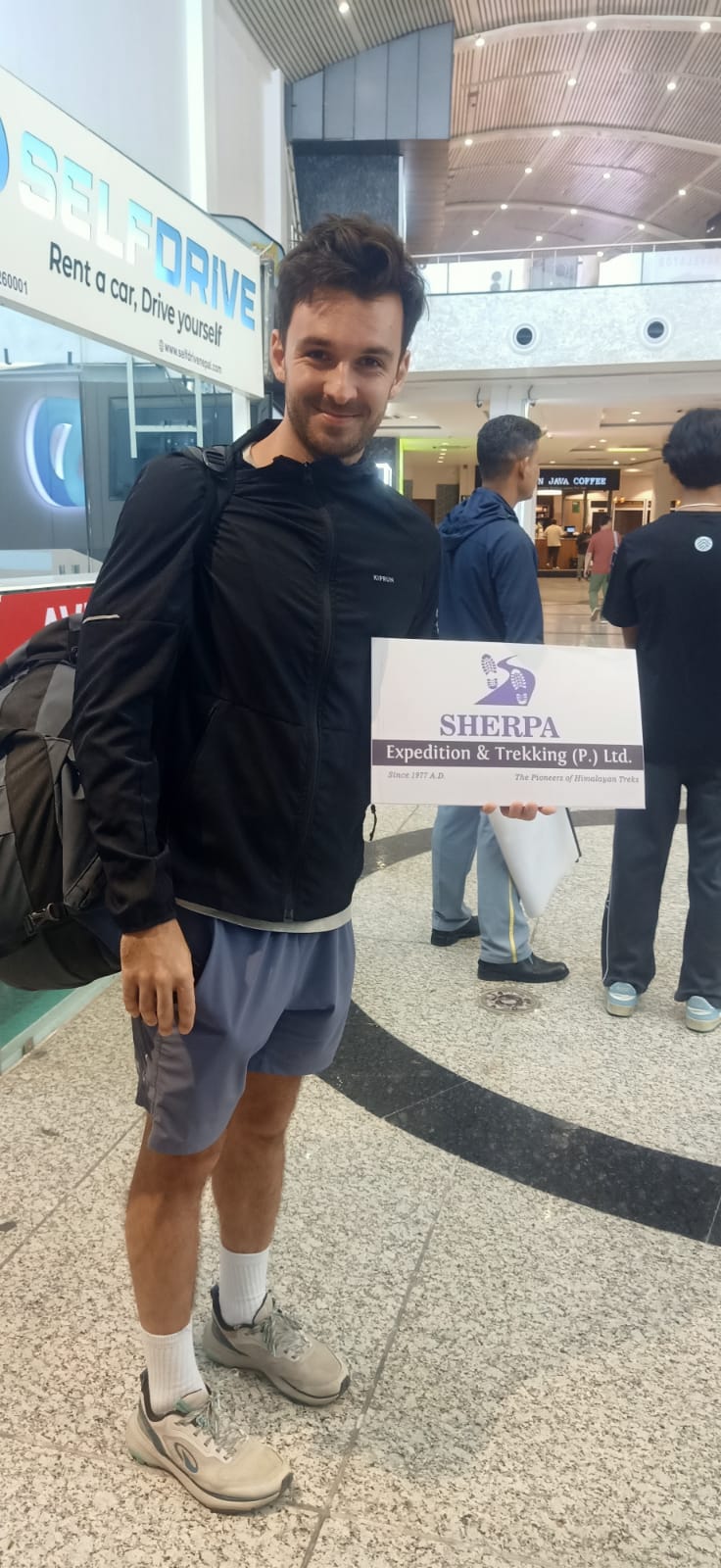
Day 2 takes you from Hotel Thamel Park to the trip briefing in Kathmandu (1,400 m / 4,593 ft) in 0 hours of walking. Trip briefing, gear check and permit preparation in Kathmandu take 1 to 2 hours with manager Ram Barakoti. Ram Barakoti runs the briefing, checks the gear of each client and prepares the permit documents. Ram Barakoti weighs the luggage and stores extra city luggage at the Kathmandu office. How much luggage goes on the Lukla flight? The flight allows 15 kg (33 lb) per person: 10 kg in the duffel bag and 5 kg in the hand bag.
Pack the duffel bag for the trek and the city bag for storage before the evening. Charge the phone, the camera and the power bank. Day 3 starts before sunrise and continues to Phakding.
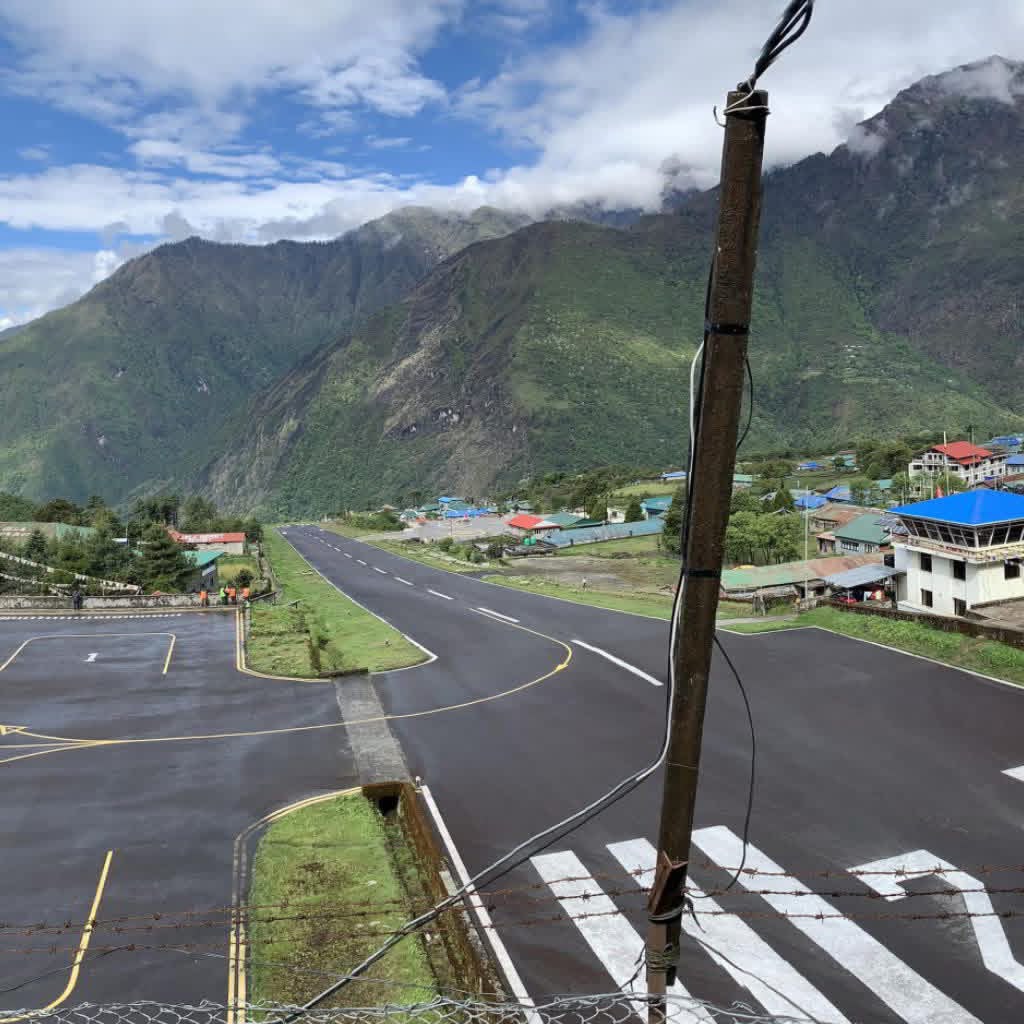
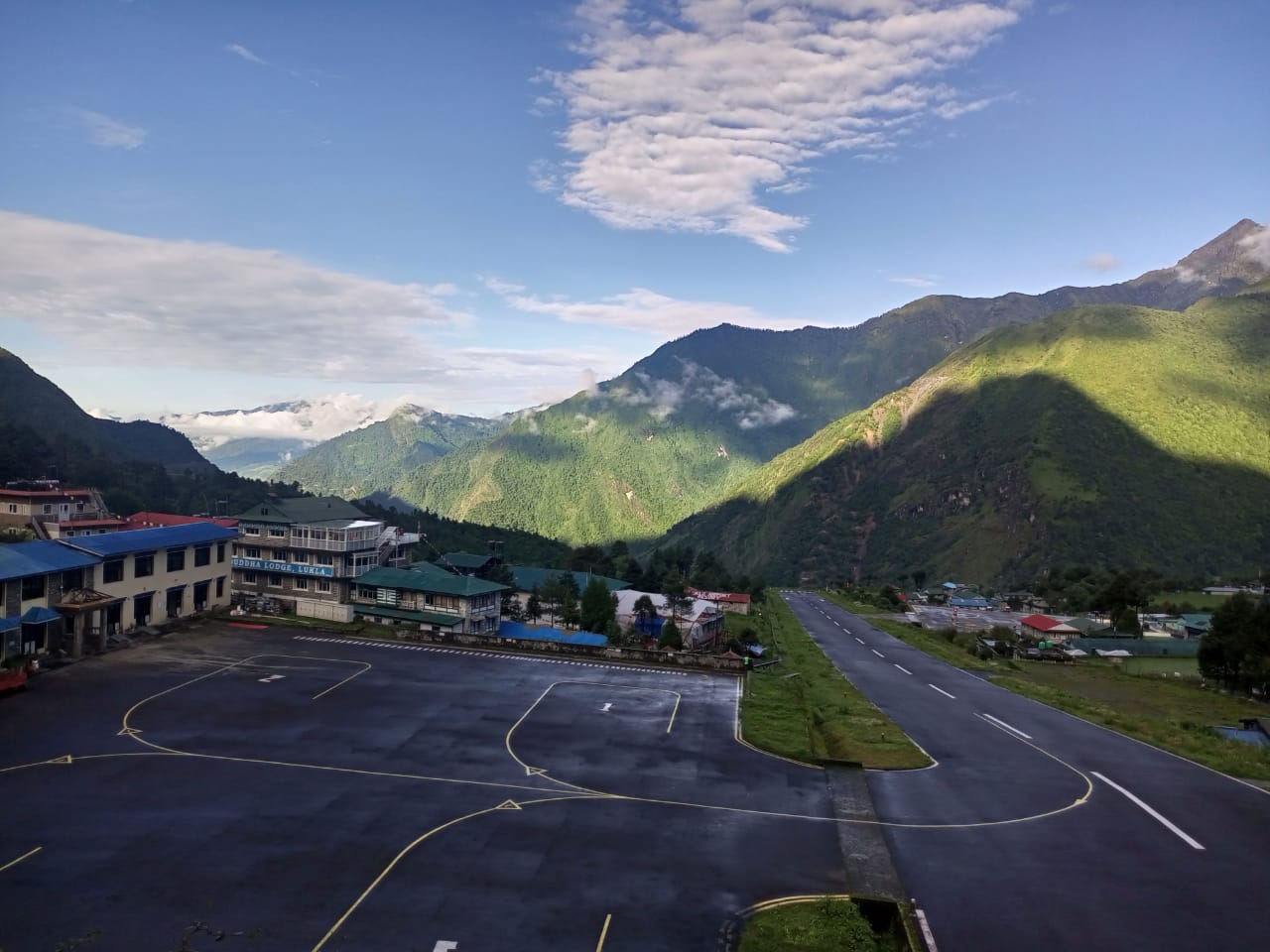
Day 3 flies from Kathmandu to Lukla (2,860 m / 9,383 ft) and walks 3 to 4 hours along the Dudh Koshi river to sleep at Phakding (2,610 m / 8,563 ft). The company tries a direct Kathmandu to Lukla flight before routing through Ramechhap. The guide clears the Khumbu Pasang Lhamu Rural Municipality permit checkpoint at Lukla. Day 4 climbs to Namche Bazaar.
Day 4 climbs from Phakding to Namche Bazaar at 3,440 m (11,286 ft) in 6 to 7 hours. The guide handles the Sagarmatha National Park permit check at Monjo. The trail crosses the Hillary suspension bridge and gives the first Everest view on the final climb. Day 5 stays in Namche Bazaar.
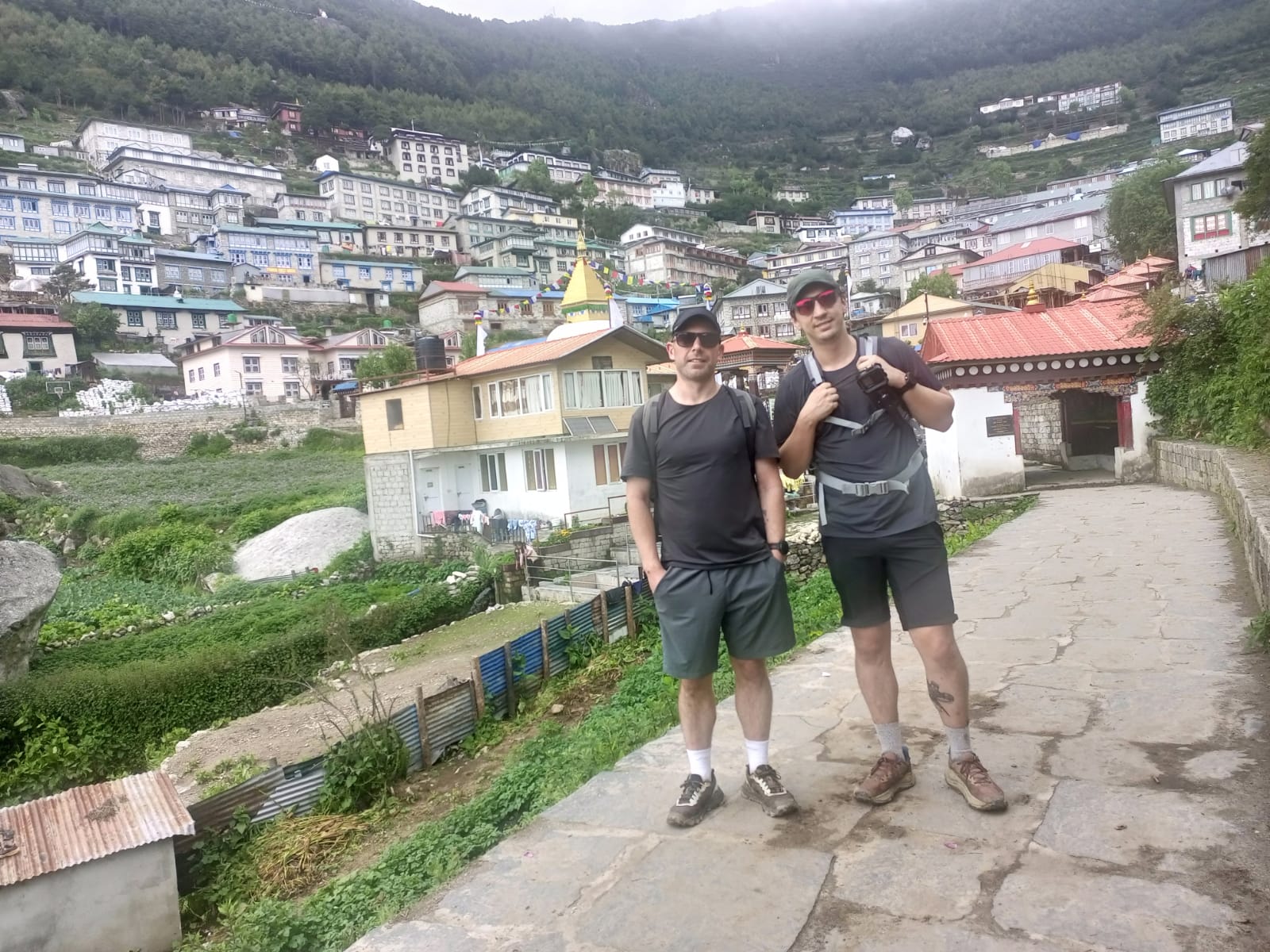
Day 5 hikes from Namche Bazaar to Hotel Everest View (3,880 m / 12,730 ft) and returns to sleep at Namche Bazaar (3,440 m / 11,286 ft). The hike takes 3 to 4 hours and applies the climb high and sleep low method. Guides start pulse oximeter checks here because monitoring matters more above about 3,500 m. Day 6 walks to Tengboche.
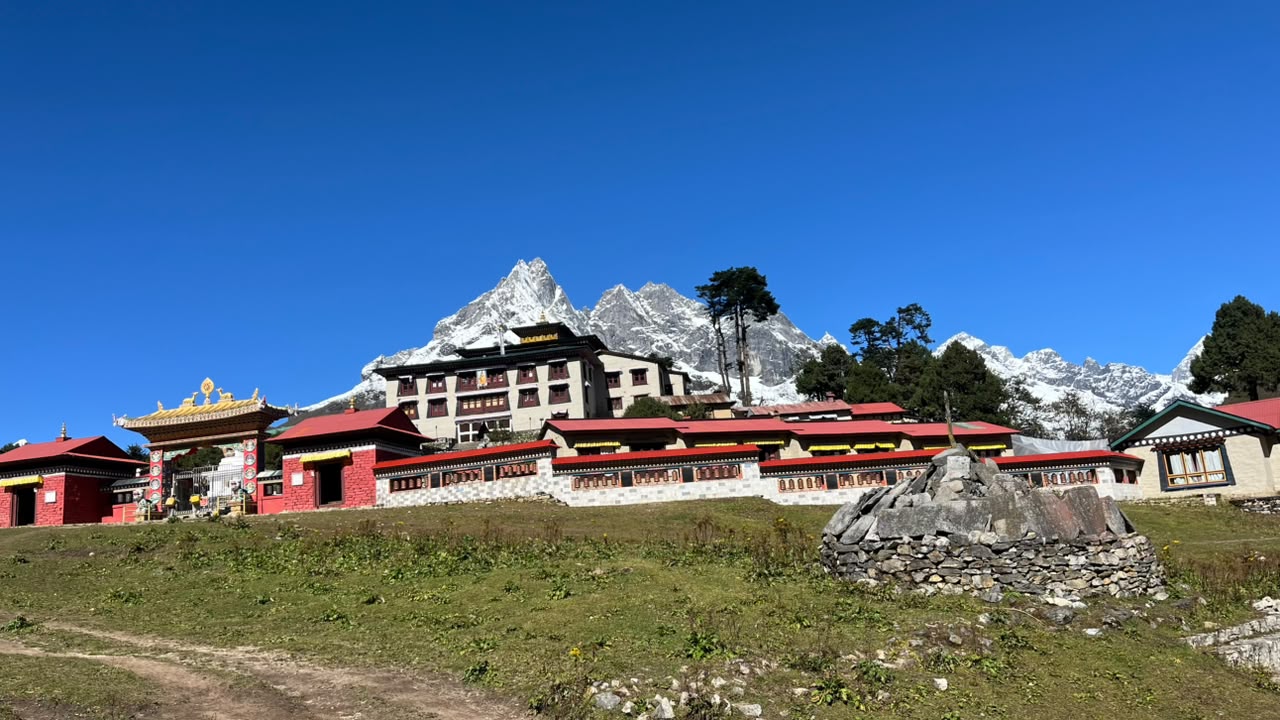
Day 6 walks from Namche Bazaar to Tengboche (3,867 m / 12,687 ft) in 5 to 6 hours. Ama Dablam (6,812 m / 22,349 ft) stays in view along the trail and Tengboche Monastery stands beside the lodges. Trekkers sleep at a lodge such as Tengboche Guest House. Day 7 continues to Dingboche.
Day 7 walks from Tengboche through Pangboche and the Imja valley to Dingboche (4,410 m / 14,469 ft) in 5 to 6 hours. The trail leaves the tree line after Pangboche. Trekkers sleep at Everest Resort or Grand Himalaya. Day 8 stays in Dingboche.
Day 8 hikes from Dingboche toward Nangkartshang (about 5,083 m / 16,677 ft) and returns to sleep at Dingboche (4,410 m / 14,469 ft). The hike takes 3 to 5 hours. The guide watches appetite, sleep and walking speed before the group goes above 4,500 m. Day 9 walks to Lobuche.
Day 9 walks from Dingboche past the Thukla memorials and along the Khumbu Glacier moraine to Lobuche (4,940 m / 16,207 ft) in 5 to 6 hours. Trekkers sleep at a lodge such as New EBC Lodge. Attached bathrooms are rare from Lobuche upward. Day 10 reaches Gorak Shep and Everest Base Camp.
Day 10 walks from Lobuche to Gorak Shep (5,164 m / 16,942 ft), continues to Everest Base Camp 5,364 m / 17,598 ft) in the afternoon and returns to sleep at Gorak Shep. The day takes 7 to 8 hours. This package has no overnight stay at Everest Base Camp. Trekkers sleep at Buddha Lodge or Snow Land Lodge. Day 11 climbs Kala Patthar.
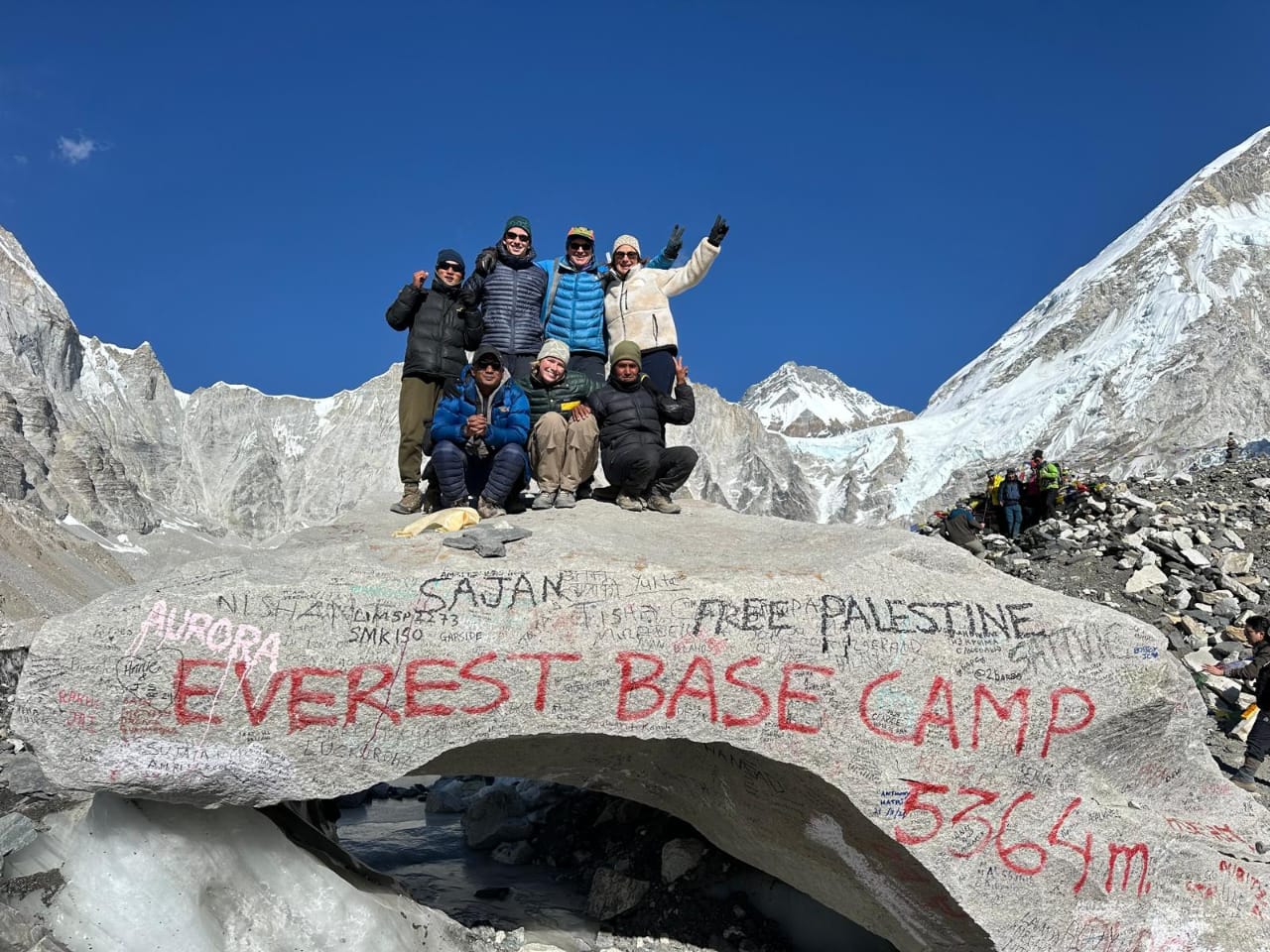
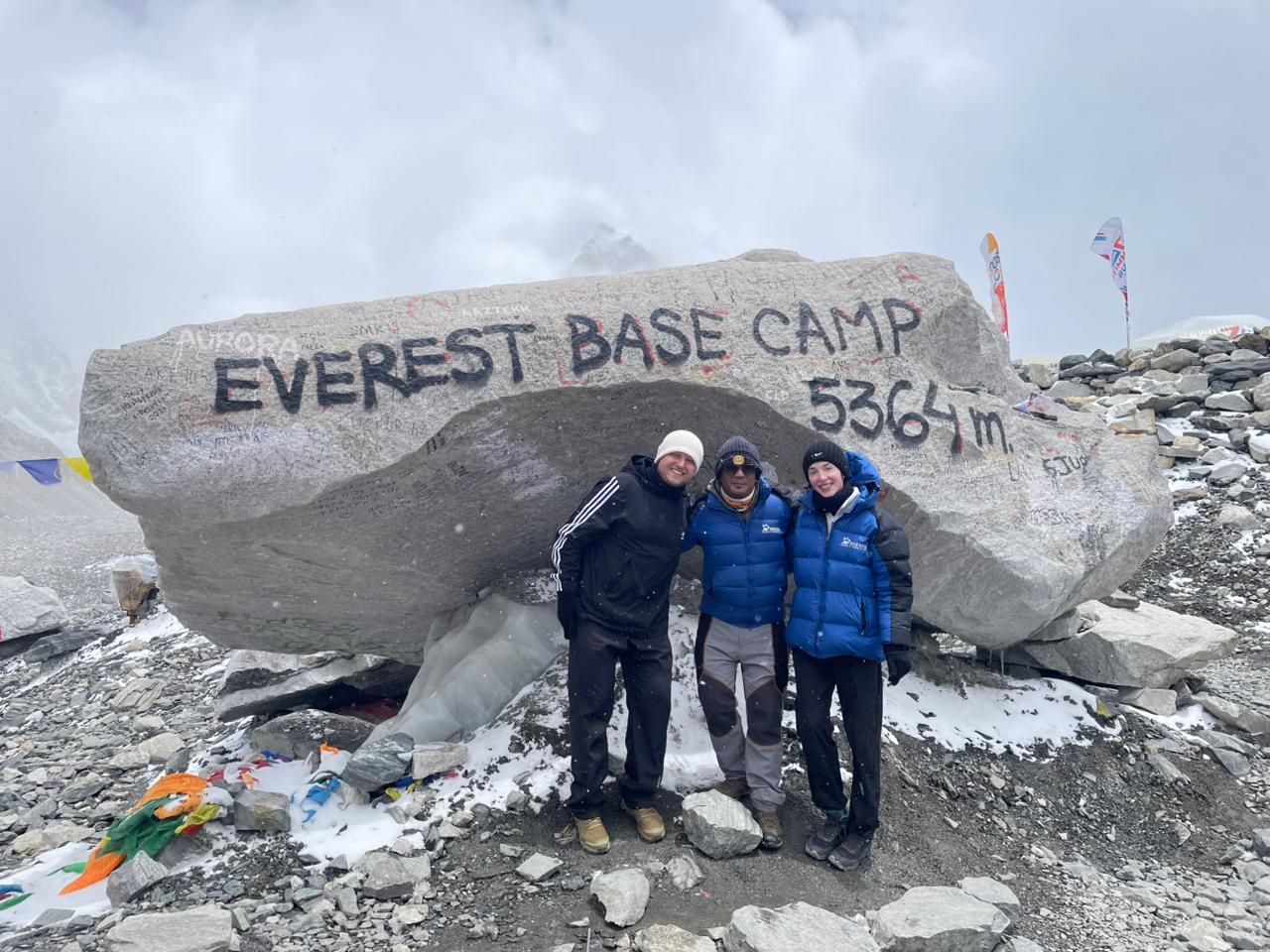
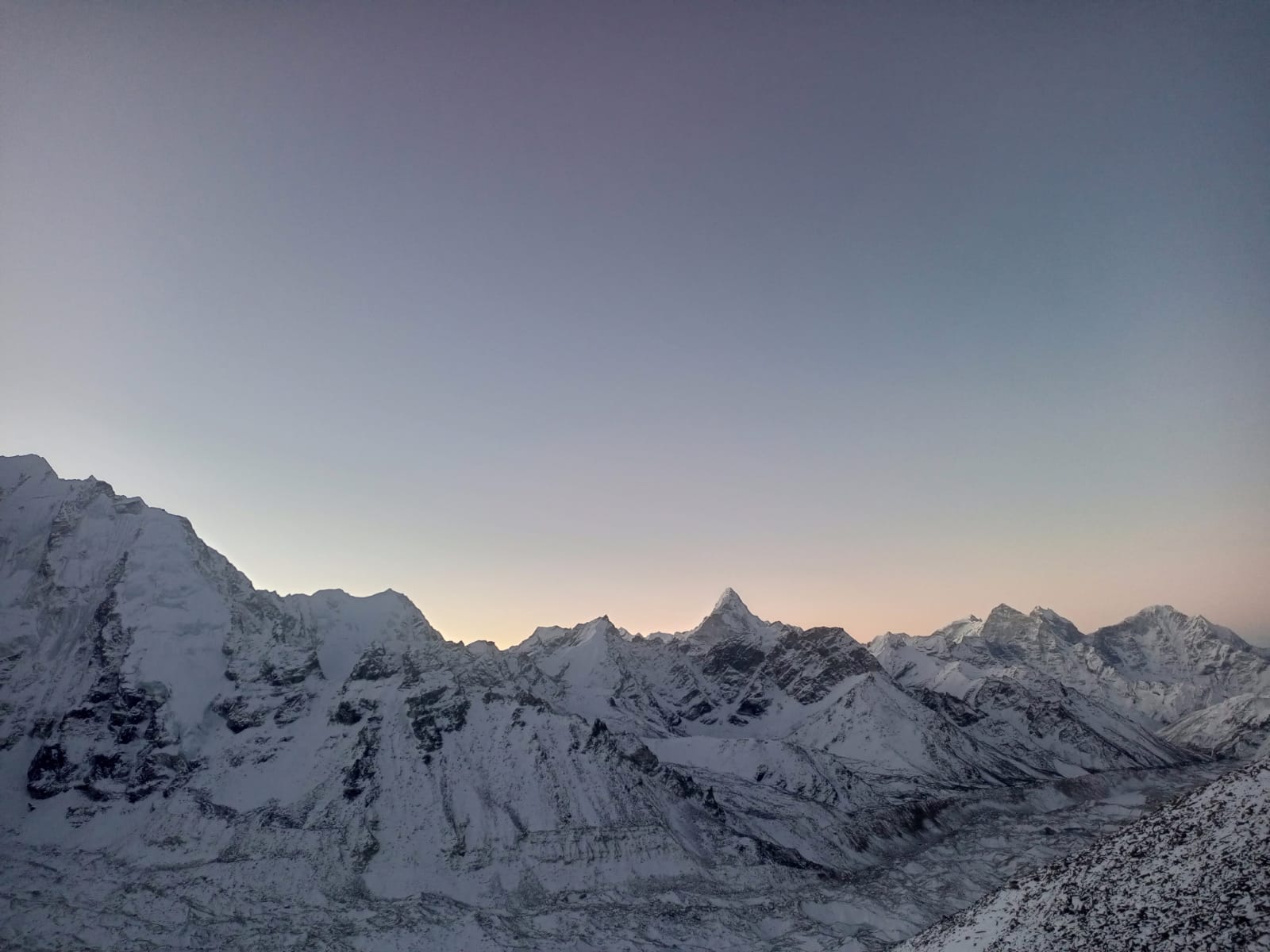
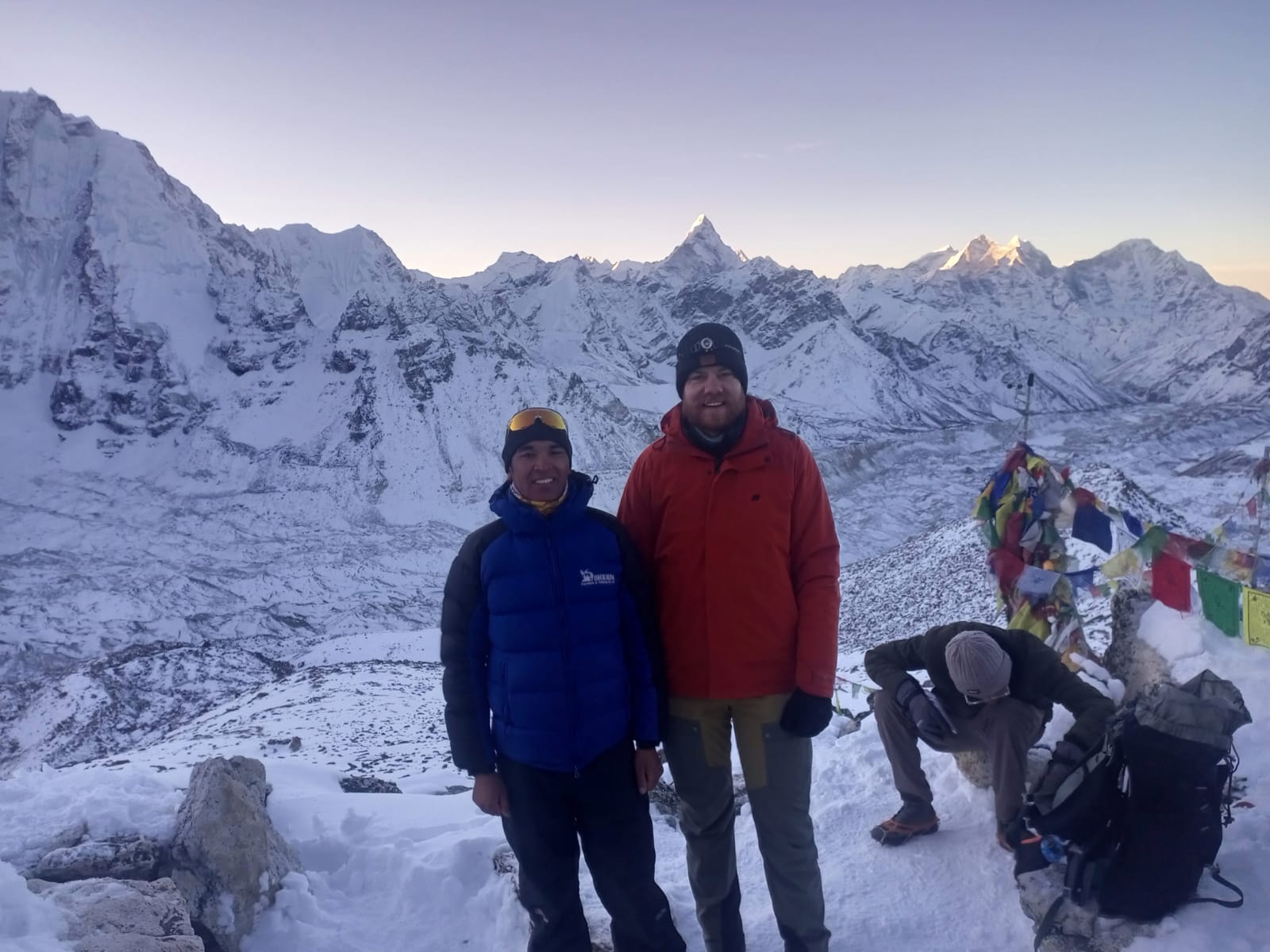
Day 11 climbs Kala Patthar (about 5,545 m / 18,192 ft) at sunrise and descends to sleep at Pheriche (4,371 m / 14,340 ft) in 7 to 8 hours. About 15% of clients skip Kala Patthar: 5% for health reasons and 10% by choice. A sunset hike is also an option from November to February. Day 12 descends to Namche Bazaar.
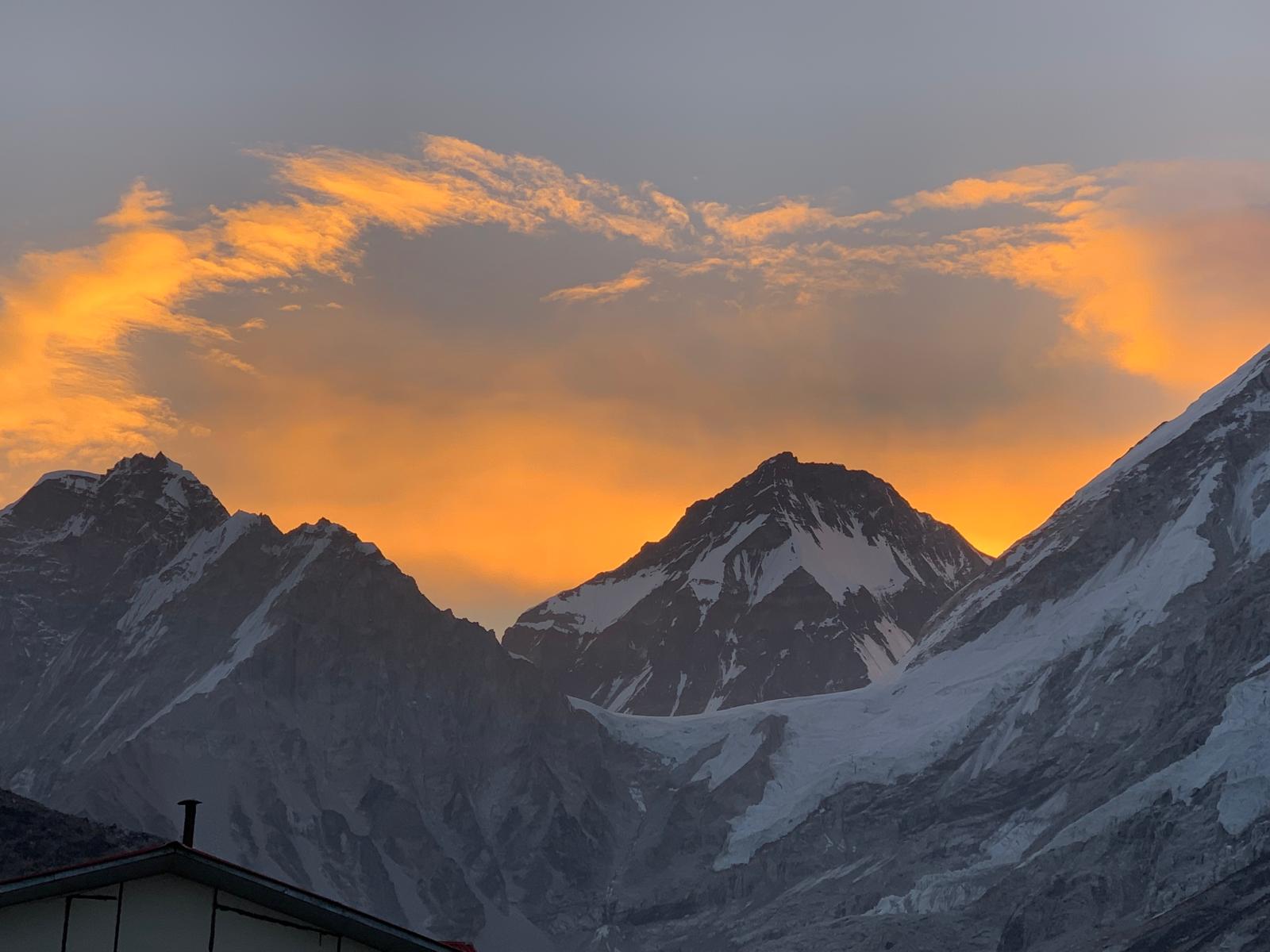
Day 12 descends from Pheriche through Pangboche and the Tengboche forest to Namche Bazaar (3,440 m / 11,286 ft) in 6 to 7 hours. The guide combines descent stages if the group used an extra acclimatization day on the ascent. Day 13 returns to Lukla.
Day 13 walks from Namche Bazaar to Lukla (2,860 m / 9,383 ft) in 6 to 7 hours and is the last trekking day. Trekkers say farewell to the porters and the guide team in Lukla. The group sleeps at a lodge such as Buddha Lodge. Day 14 flies to Kathmandu.
Day 14 flies from Lukla to Kathmandu (1,400 m / 4,593 ft) or to Ramechhap with a road transfer to Kathmandu. The driver team takes trekkers to the hotel or the airport. Drivers such as Kamal or Som Gole carry luggage to the correct terminal. The route map and altitude chart show the full 14-day line.
EBC Trek Route Map
Download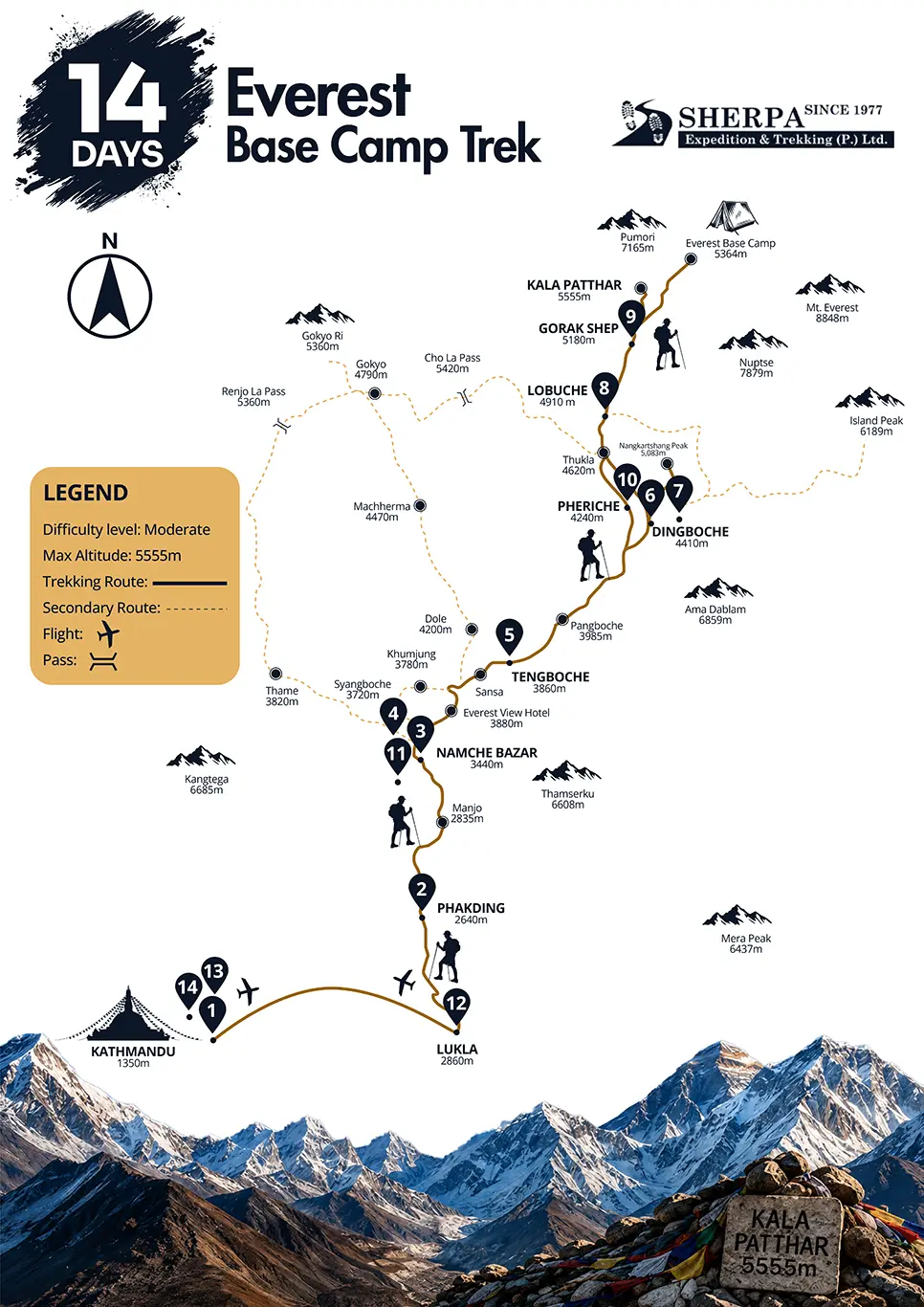
Everest Base Camp Trek Cost & Package Details
Cost Includes
Transportation
- Pick up/Drop off from Tribhuvan International Airport
- Round trip flight from Kathmandu to Lukla (Manthali-Lukla) including private transfer, domestic airport transfer and emergency helicopter service arrangement from your travel insurance company to cover the loss of days.
Accommodation:
- 2 Nights' accommodation in 3 star hotel in Kathmandu with breakfast.
- In twin sharing/double room with a private attached bathroom up to Dingboche in your trek.
- Lodging in teahouse lodges for the rest of the tour.
Trekking Permits
- Full Entry Fee of Sagarmatha National Park and Pasang Lhamu Rural Municipality Fee.
Meals
- Food (3 Meals): B- L- D and fresh fruit after supper each day.
- Fresh fruit every evening after dinner.
Licensed Guide and Porter
- (English-speaking trekking guide, Government certified) having vast experience, knowledge and professionalism.
- Salary; food & accommodation; transportation; insurance and personal clothing, etc of the guide are included.
- In the group of more than 8 people, the Assistant Guide service is included.
- A strong and experienced Sherpa porter (accustomed to high-altitude trekking).
- The salary, food and accommodation; Insurance of the porter and daily wages are included. Each porter can carry not more than 25 kg, and one porter is for two trekking guests.
Benefits
- One first-aid kit
- Sleeping bag
- Down jacket
- Duffel bag
- Walking sticks (Need to be returned after completion of trek), Sherpa Expedition Teams T-shirt (complimentary)
- Certificate of accomplishment for trek.
- Oxygen meter (to check your pulse, oxygen concentration in your blood, and heart beats twice in a day)
Government Fees and Official Expenses
- All government taxes and other official expenses.
What is not included?
- Lunch and dinner while you are in Kathmandu
- Visa fee for Nepal (at your entry at the airport at arrival and pay $30 for 15 days; $50 for 30 days, and for 90 days you will need to pay $125 USD per person.) Personal insurance (medical/travel)
- international flight
- Food, beverages & drinks: all alcoholic & non-alcoholic, soup, tea, coffee, hot chocolate, cocoa, mineral water, excess food, all sorts of hot & cold drinks, and extra food items on the way of the trek, especially during evenings at tea houses
- Dessert & snacks: All sorts of chocolate, pie, sweet pudding, etc.; toilet facilities and battery recharging at tea houses; all tipped amounts (for guide, porter, and driver
- Excess baggage more than 10kg for the Lukla flight (you are allowed a maximum of 5kg of hand luggage plus 10kg of checked luggage).
If you trek back early from the trek due to sickness or any reason, then flight cost, hotel cost, room cost (mountain room), and meal cost will not be refunded, so you yourself should arrange accommodation and food for the days remaining from the trek up to departure from Nepal.
EBC Trek Packing List
General
- Sleeping bag (rated for between -15C and -20C)
- Down jacket (high-fill-power)
- Duffel bag (to be carried by porters; this will be provided).
- Daypack (approx. 25-35 L to carry day-to-day essentials.
Head & Ears
- Beanie/woolen hat.
- Neck warmer/Fleece buff.
- UV-protection sunglasses, polarized (glacier glasses have higher SPF); can purchase before the trek or in cities like Kathmandu.
- High SPF sunscreen and lip protection.
- Headlamp and additional spare batteries or charger.
Hands
- A pair of liner gloves made of light material.
- A warmer pair of outer gloves or a waterproof pair of mittens.
Upper Body
- Quick-dry, long-sleeve trekking t-shirts (x3 or x4)
- Thermal base layers (merino or synthetics) (x2 sets top & bottoms)
- Warm fleece or comfortable jacket or pullover
- Sports Bras - Women
- Wind and waterproof outer shell/jacket
Lower Body
- Warm thermal base layers (x2)
- Quick dry walking pants (x2)
- Warm fleece or comfortable pants for around the teahouses
- Light sport pants for lazing around (x1 extra)
- Wind and waterproof outer shell/pants
Footwear
- Warm, waterproof, solid trekking boots with good ankle support and to be broken in beforehand
- Camp sandals (flip-flops are adequate)
- Warm hiking socks (wool or synthetics) made with moisture-wicking materials (x4 pairs of warm woolen socks, and maybe a lighter pair)
- Sock liners (if trekking in colder regions, winter or snow/ice)
- Light sneakers (for teahouses)
- Microspikes (needed if it has snow, ice or if going in winter)
First-Aid Kit & Medicines
- First-aid kit and Medicines
- Blister dressing/treatment
- Antiseptic or anti-itch cream
- Painkillers/Pain relievers - (paracetamol and ibuprofen are commonly recommended).
- Cough syrup, throat lozenges
- Anti-diarrhea medication
- Diamox (125 mg to 250 mg tablets for preventing high altitude sickness; you can purchase them in Nepal with a prescription in some pharmacies, or online)
- Water purification tablets/filters and
- bandages/plaster rolls & a small piece of cut strapping tape/a couple of small flexible restraints
Miscellaneous and personal items
- Passport (plus photocopies of the same; we recommend leaving one copy in Nepal with your trekking agency and keeping another one separate).
- Passport photos (you would need one copy for your permit).
- Water bottle (1 litre)
- Reusable water bottles or water bladder with water filter.
- Bathroom Kit including soap, toothbrush and toothpaste, hand wash, hand sanitizer.
- Toilet paper and some wet wipes
- Trekking poles with straps (adjustable trekking poles are very useful).
Extra Items & Electronics
- High-energy dry snacks (nuts, energy bars, chocolate, etc.) for during the trek)
- power bank(for your phone, camera etc. Batteries do deplete very rapidly in the cold)
- Music player and earphones for the trekking hours)
- Camera (with extra batteries, charger, SD Cards etc.).
Mountains You See on the EBC Route
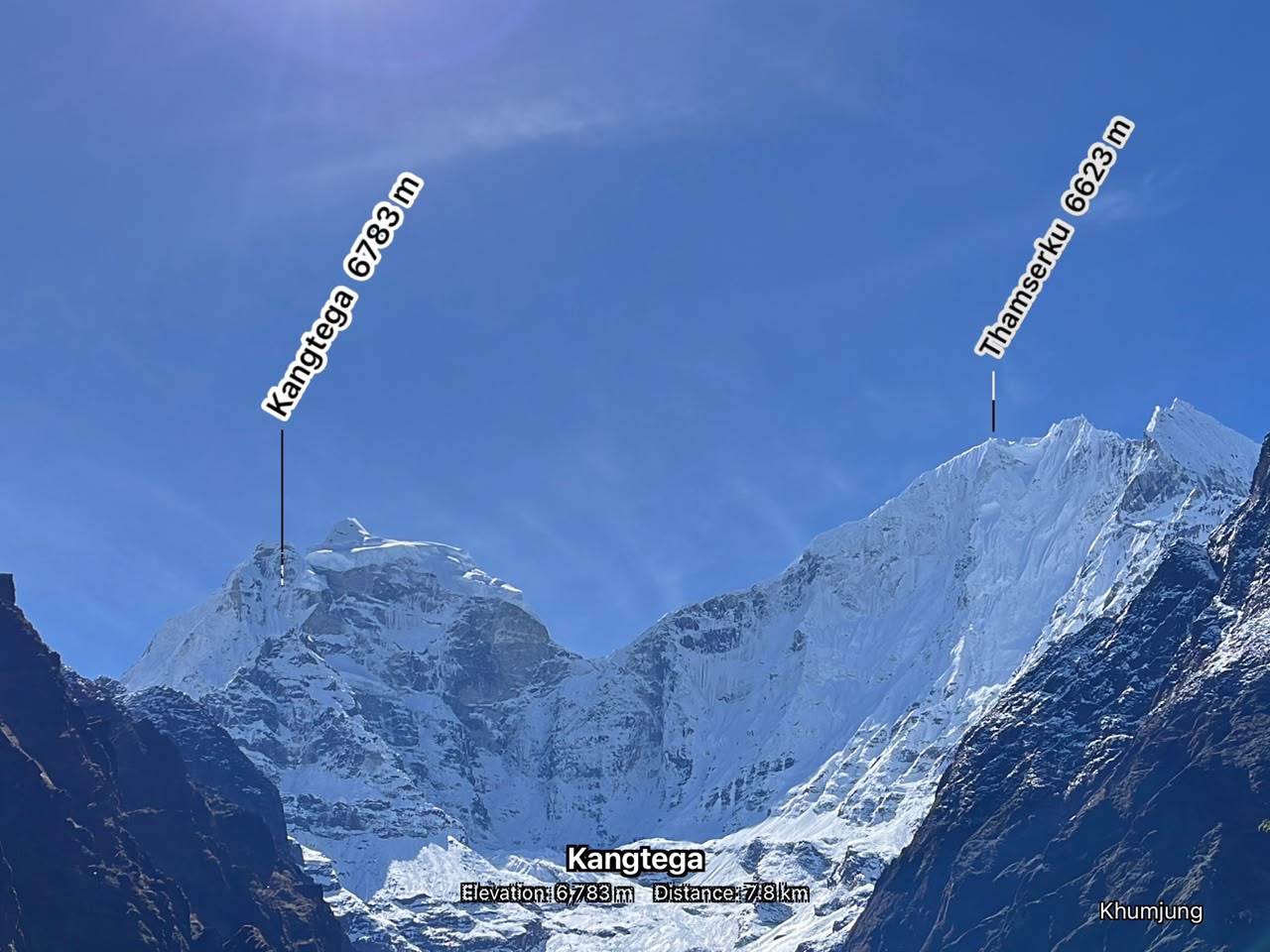
The 14-day route shows 6 named peaks: Everest, Lhotse, Nuptse, Ama Dablam, Pumori and Thamserku. The closest Everest view comes on Day 11 from Kala Patthar.
- Everest (8,848.86 m per the Survey Department of Nepal): first seen on Day 4 below Namche Bazaar.
- Lhotse (8,516 m): first seen on Day 5 from Hotel Everest View.
- Nuptse (7,861 m): first seen on Day 5 from Hotel Everest View.
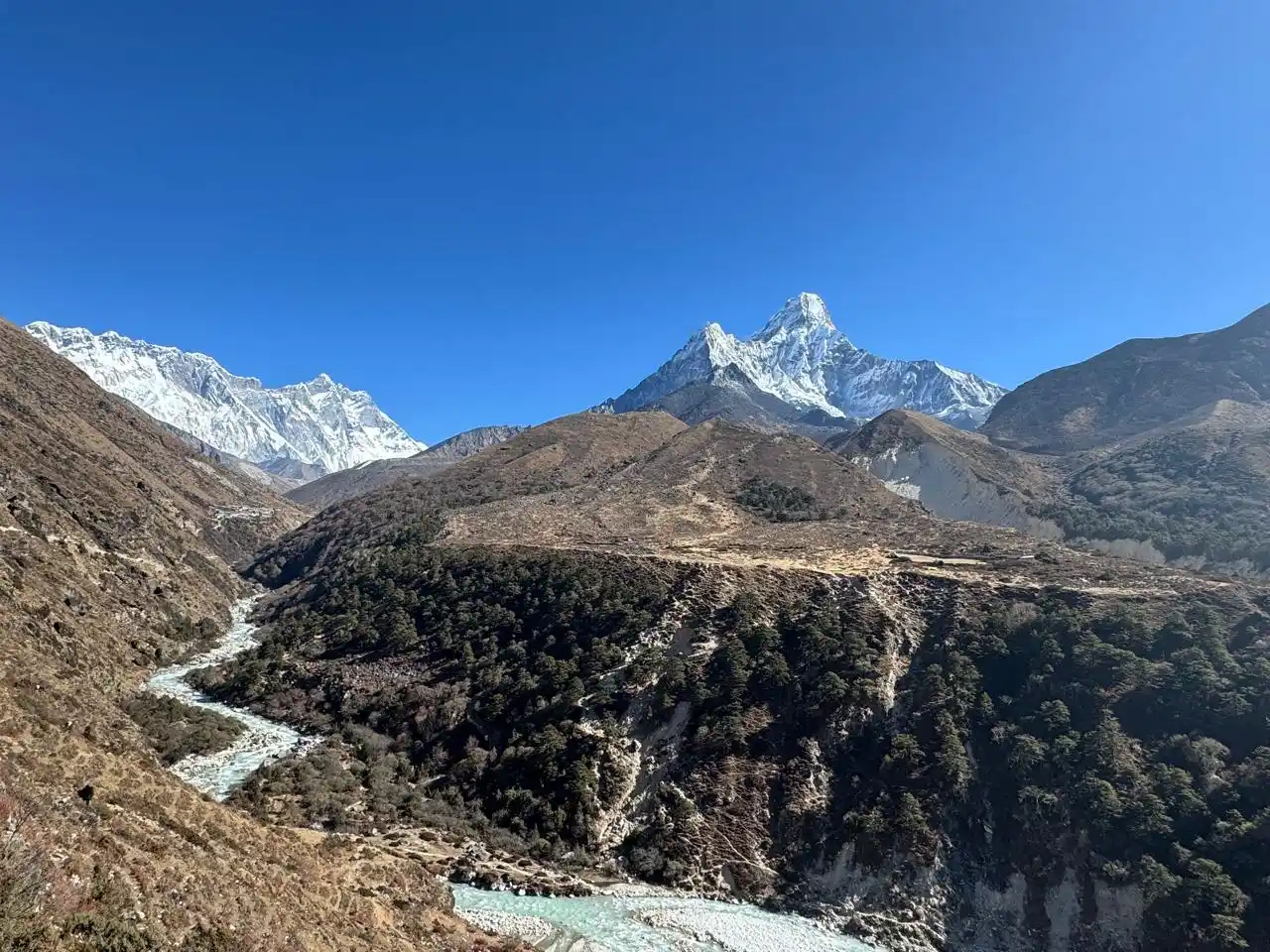
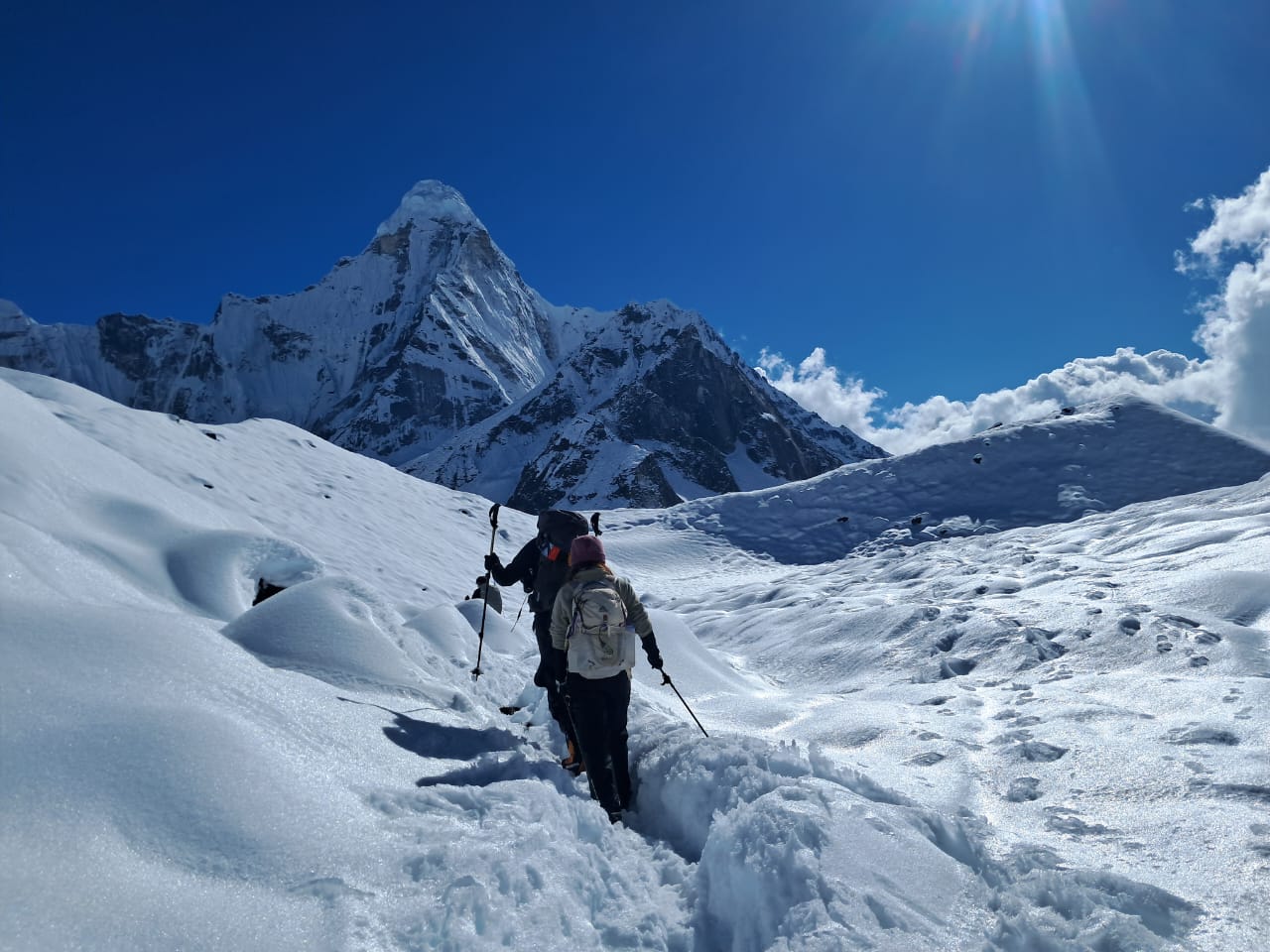
- Ama Dablam (6,812 m): first seen on Day 5 and closest on Day 6.
- Pumori (7,161 m): first seen on Day 9 near Lobuche.
- Thamserku (6,608 m): first seen on Day 4 near Monjo.
Guide Santa Bahadur Tamang picks Day 4 and Day 6 as the best photo stops. The mountains seen on the Everest Base Camp Trek page covers each peak. The team that runs these departures follows.
Gallery








Tour Dates
Every departure listed below is 100% Guaranteed — once you book, your trip will run as scheduled regardless of group size.
Loading departure dates…
Want your own personalized tour?
Everest Base Camp Trek Difficulties
Everest Base Camp trek is a moderately to difficult trip on the basis of the length of the walk, steep and rough terrain, and the altitude to which you will go. Days typically involve between 4-8 hours of trekking on most trekking days. Some longer days like our Everest Base Camp trek need around 7-8 hours. The trail continues with further up & downs on the rugged and suspension bridges trails of lower and lesser oxygen. The challenge will be mostly on height after 3,000m and some such as in neighborhood regions such as Dingboche, Lobuche, Gorakshep, and Everest Base Camp. However, there are 2 dedicated days for rest and acclimatization at Namche Bazaar and Dingboche to have our body adapt to the area. A person with some prior experience trekking at higher elevations will find it easier, but it is not compulsory to have one for all; physical condition and the discipline to walk continuously for some hours are a must with due preparedness and acclimatization.
Who is This Trek For?
The Everest Base Camp Trek is best suited to someone who is a regular hiker, active traveler or someone who has prepared their fitness level for trekking before the trip. One should be accustomed to several hours of hiking, on consecutive days, over difficult, up-and-down terrain. Given the high altitude which the trek reaches, an acclimatized and prepared body is vital to this trek.
There are definite sustained ups at this trek; however, the Everest Base Camp Trek is not recommended if altitude is a serious concern for you and easy walking is what you’re looking for, as the terrain remains a climb up from Everest Base Camp up to Kala Patthar. While previous experience is beneficial, it is not required if you are physically and mentally prepared.
Fitness Requirements
Be sure to train with a good mix of things; Cardio, strength, hiking training, endurance, etc. Cardio workouts like walking fast, jogging, biking, or stair climbing help your body cope with long climbs on an EBC trek. Core strength, including your legs, hips, lower back, and abdomen, to brace against difficult terrain will help you as well. Hike often to get your body used to the pace of hiking back-to-back days with a variety of terrains, pushing your time on your hikes and eventually hike for hours at a stretch on varied elevations to build tolerance. REI recommends training up to about a 6-hour-per-day trek, and the Nepal Tourist Board stresses gradual acclimatization, for obvious reasons, as you gain altitude quite fast.
Altitude & Acclimatization Strategy on EBC Trek
As altitude is gained, oxygen decreases; a primary issue during the Everest Base Camp trek. Since Everest Base Camp is at an altitude as high as 5,360 m, while that of Kala Patthar is at 5,550 m, an acclimatized and gradual gain to high altitude, especially when climbing up the terrain to Kala Patthar from Everest Base Camp and to Everest Base Camp from Gorakshep, will indeed be prudent.
We must be extra careful not to gain altitude in a hasty manner.
The Nepal Tourism Board recommends gradual ascent, and thus it suggests we do so, while placing Namche Bazaar and Dingboche as one of the good acclimatization halts. To tackle such situations, we have scheduled acclimatization days, where we hike up to a considerable elevation to later sleep at a lower elevation (at Namche and Dingboche, respectively). This will help us gain our strength while the body will adjust itself slowly, and walking pace, sufficient water intake, along with not gaining any elevation rapidly, will all play important roles. What oxygen meter tells you: Even though your oxygen monitor will supply vital signs of oxygen saturation, it must never alone determine your altitude health, as one must go by their own physical feeling.
Common symptoms associated with the condition include anorexia, lack of appetite, dizzy feeling and, lack of coordination, fatigue, headaches, etc. Symptoms associated with a more serious form of the condition, called High Altitude Pulmonary Edema HAPE or Acute Altitude Sickness involve breathing problems at rest, lack of appetite, coughing, nausea, vomiting, etc.
Best season to visit Everest Base Camp Trek in Nepal
The best season to visit the Everest Base Camp Trek in Nepal is Spring and Autumn. To be more specific, the best months of the year can be stated as from March to May and from September to November.
Spring: The ideal time for doing an Everest Base Camp trip in Spring is in March to May. The hills, mountains are most visible in spring; the rhododendrons can be seen in bloom while walking on the trip. This period is the extremely perfect duration for trekking in the Everest zone.
Autumn: Another best time is in September to November as it gives us stable daytime and clearest visibility for the surroundings. Especially from October to November, the region gets a crystal clear sky. And the best part is mainly during October month there is very less possibility of rain showers making our trip extra safe.
Winter: It's not appropriate for trekking during winter due to freezing temperatures at high altitude mainly. Nevertheless, winter trekkers have fewer trekkers than other seasons.
Monsoon: The best season to traverse the Everest Base Camp Trek in Nepal is definitely not in monsoon season from June to September. There is abundant rainfall in most parts of Nepal, and trekking in the Everest region is unfavorable, with the trails wet and damp, and the mountain views are obscured by the cloud cover and the disruption of the flights into/out of Lukla airstrip.
Additional Expenses
Tipping
Tipping is a normal practice for rewarding the crew in Nepal. A general guideline for tipping is about $150-250 per trekker which will be distributed to your guide and porters in a cash form during the final group dinner in Lukla.
International Flight
Airfare from/to Tribhuvan International Airport (KTM) in Kathmandu is not covered. Based on departure point, season and booking period. It can be between $800 and $1800 for the round trip to and from your home country.
Insurance
Travel insurance is required when travelling at high altitudes. It is essential to be insured for search and rescue, medical care, and helicopter rescue above 6000m as well. Generally the plan is around $80-200 USD.
Personal Equipment
Personal gear like thermal layers, walking boots, gloves, lamp and bottle are considered your personal items. Depending on whether you purchase or rent new gear for trekking, you can estimate spending $100-300 USD for those items purchased or rented in Kathmandu before the trekking.
Beverage
Beverages while travelling are usually bought personally due to the increase in altitude, which will push the price higher. The prices of purified water or boiled water are about $2-4 dollars for a liter. Hot tea, coffee or soft drinks will cost about $2-6 dollars per cup or bottle.
Accommodation During EBC Trail
During your time in Kathmandu, you would be lodged in a standard three-star hotel with attached bathroom facilities and breakfast. During your trek to Everest Base Camp, you will spend night at your accommodation (traditional teahouses) that are managed by individuals and would be basic in their setup. You would be getting your room on the basis of twin sharing, with no heater, two single beds with mattresses, a pillow and blankets and sleeping bags, which will be offered by us during your trek. There might be basic furniture like a simple wooden table and chair; the rooms would have shared central stove heating in the dining area. You can expect private toilet facilities right up until Dingboche. Above that, we use shared squat or western-style toilets without running water.
Food During Everest Base Camp Trek
Food during the Everest Base Camp Trek mainly includes filling local and international dishes served at teahouses along the route.
For breakfast most tea-houses offer a wide variety of options including porridge, boiled eggs, fried eggs, scramble eggs, butter toast, fried/plain pancakes,Tibetan breads with all sorts of toppings, tea/coffee and so on and so forth.
These are generally well tolerated even at higher altitude. The teahouse would have a vegetarian meals menu of: veg curries, Pasta, noodle soup, baked potatoes, etc on offer as well.
Safety During Everest Base Camp Trek
Licensed and experienced Guide: A government-licensed, well-experienced mountaineering guide is equipped to handle route management, pacing the trek, managing altitude sickness, change of weather patterns and logistics of the entire trip on a day-to-day basis.
First-Aid & Support: First-aid kits are carried on every trek by the company and our guides respond to mild altitude sickness and injury at all times. In the region there are medical facilities that provide assistance as well – The Himalayan Rescue Association at Pheriche and Everest ER at EBC.
Oxygen monitoring: Each trekking package would include an oxygen meter which monitors your pulse and oxygen saturation as well as heart rate and is checked twice every day. Combined, these measures would serve as indicators for managing altitude.
Emergency Rescue Evacuation: In cases of a critical altitude illness or a medical problem, you could be an emergency helicopter evacuated from anywhere with due arrangements through your travel insurance agency. Nepal Tourism Board warns that severe altitude sickness could be deadly, and an urgent descent ensures you will soon recover from any sickness related to altitude.
Weather contingencies: With extremely weather-dependent, flights into Lukla and harsh weather conditions impacting higher altitude trek, the team plans for all possibilities of weather to strike if weather disrupts flight to the planned route and trek plan by changing the logistics without obstructing the trek.
Why to Choose 14 Days Everest Base Camp Trek than Other Itineraries
The 14-day Everest Base Camp Trek is often the most suitable and well-paced duration when planning a trip to Everest. A 15-day trek comes with an extra day of additional rest and flexibility; however, the same can be said for a 14-day tour when it comes to the inclusion of rest at both Namche Bazaar and Dingboche (for acclimatization). It makes for an extra day that doesn't really take away too much from the trip in length when compared with the 13-day and 12-day itineraries.
The 10-day and 9-day itineraries, on the other hand, require very quickly timed elevation gains, which also means a rush at Everest Base Camp or Kala Patthar or, in some cases, doing some of the latter half portions a day before or later due to weather constraints and other similar circumstances.
Shorter trips simply won't cut it for many when a smooth acclimatization rate and the actual time on trek are taken into consideration. Your journey with this Everest Base Camp 7 day/6 day/5 day trek itinerary will definitely be much shorter than your 14 day journey. You also may not get proper time for adjusting and acclimatizing at high altitudes.
Everest Base Camp Trek Duration
The Everest Base Camp Trek duration is 14 days for the standard route with Kathmandu arrival and departure.
We start on an 80 mile (130 km) round trek, hiking for approx. 5 – 7 hours per day towards each overnight destination. The days at Namche & Dingboche are for rest and acclimatisation days. Later you travel up to Tengboche, Lobuche, Gorak Shep, Base Camp, Kala Patthar, Pheriche, back down to Namche, then down again.
Weather & Temperature in Everest Base Camp Trek
Everest Base Camp daytime temperature ranges from 0°C to 5°C on sunny days, while nighttime drops to -10°C to -20°C, especially in winter months.
Temperature depends upon the season and the altitude. EBC, Kala Patthar and Gorakshep are extremely cold areas of Everest. An average fall in temperature of 6 degrees Celsius occurs for every 1000m rise in altitude, opines Nepal Tourism Board. So you can have an idea about how cold you will face while walking higher up the mountains. Also note here that actual temperature may differ due to various reasons such as altitude, wind, clouds and other weather-related phenomena.
The following table shows the season along with day/night time temperatures and general trekking conditions during each season. Trekkers can assess the trend of weather depending upon his/her comfort level and choose accordingly when to leave from Kathmandu.
Season | Daytime Temperature | Nighttime Temperature | Weather & Trekking Conditions |
| Spring (March to May) | Around 0°C to 10°C at higher elevations | Around -10°C to -20°C | Clear mornings, increased visibility, pleasant temps, & rhododendron blooming |
| Summer/Monsoon (June to August) | Around 5°C to 15°C | Around -5°C to -10°C | Rain, clouds, slick trails, possible travel delays |
| Autumn (September to November) | Around 0°C to 10°C | Around -10°C to -20°C | Cool weather, & clear conditions, good mountain visibility |
| Winter (December to February) | Around -5°C to 5°C | Around -15°C to -25°C | A bit of a chill, perhaps a bit of snow, & trekking will be shorter. Fewer hikers on trails. |
Everest Base Camp Trek Planning and Logistics
Planning your Everest Base Camp Trek involves permits, route selection, acclimatization scheduling, and logistics like your flight to Lukla, teahouse bookings, and guide porter arrangements. Our package covers all the essential logistics for you, from the moment you arrive in Nepal until you reach Everest Base Camp and return back happily with tons of memories.
Lukla Flights for EBC Trek
The flight to Lukla, Tenzing - Hillary Airport from Kathmandu, Tribhuvan International Airport is 25- 35 minutes. It is a short and adventurous flight with some amazing views. If the flight gets canceled or delayed, it can be rescheduled or there is also an option for you to take a helicopter with an extra cost of 300- 500 dollars for one way, depending upon weather.
Everest Base Camp Trek Cost by Nationality
At Sherpa Expedition and trekking, the cost of the Everest Base Camp Trek varies by nationality because of differences in package rates, permits, transportation and other trekking services. The table below provides a quick overview of the estimated costs for foreign, Indian and Nepali trekkers.
| Country | Cost |
Everest Base Camp Trek Cost for Foreigners | 1,290- 3,000 US$ per person |
Everest Base Camp Trek Cost for Indians | INR 112,389 per person |
Everest Base Camp Trek Cost for Nepalese People | NPR 95,916 per person. |
Everest Base Camp Trek Cost for Guide and Porter
Typically, porters carry a maximum of 25 kg for every two people. Guide and porter charge around 35 dollars and 25 dollars but tipping them is not a compulsion, it is done as an appreciation for their hard work. For budget travelers, some operators provide a single “porter- guide", which is cheaper but offers less specialized support.
Solo Group Vs Group Cost on Everest Base Camp Trek
The cost of the trek decreases as group size increases. Larger groups benefit from the group discounts.
Group Discounts
- Pax 1 US$ 1,390
- Pax 2 US$ 1,350
- Pax 3 US$ 1,290
- Pax 4 to 6 US$ 1,250
- Pax 7 to 12 US$ 1,190
- Pax 13 to 18 US$ 1,150
- Pax 19 to 24 US$ 1,090
Everest Base Camp Trek Packages by Duration
We offer various packages by duration with flexible itineraries that match your fitness level, schedule and trekking goals. We provide you with a 7- day, 9- day, 10- day, 12- day or 15- day itinerary and you can choose any from this. Each package takes you through the Everest region and its adventure. You will not miss out on any important landmarks but it is necessary for you to decide the package looking at your fitness level and time.
FAQS
Difficulty & Fitness
The Everest Base Camp trek difficulty level ranges from ‘moderate’ to ‘challenging’. Although the trek is non technical you need to be able to keep your stamina up for day after day of walking on tough terrain including rockier areas, thin air, steeper slopes, and high altitude.
Previous multi-day trekking is a bonus but not necessarily required. A fitness-conscious beginner with endurance and mental toughness can make it to Everest Base Camp even with no experience if you have prepared well enough and following a suitable pacing for the acclimatization period.
You can expect to hike about five to seven hours daily (ten to fifteen kilometers of rough terrain/boulder fields) for several days. Trekking can range from seven to eight hours when there is a significant rise to climb, on acclimatization trek, or on your final trek to Base Camp.
Yes. It provides stunning views of the nearest peaks, views of major summits, the very best views of the Himalayas at close range, Sherpa culture as well as its distinct style in monasteries and personal challenge that will bring a satisfaction that you won't forget to have set your foot at the EBC.
Yes, virtually everyone who attempts the trek for the first time will finish without any major problems, provided that they are fit enough, pace well, drink enough, follow a normal 12-14 day itinerary, and walk slowly and steadily with acclimatization stops at regular intervals - these stops are crucial for first-time trekkers.
Cardiovascular endurance, stamina and good, strong leg muscles are needed to climb for many hours on end with a light daypack over uneven, rocky, steep and precipitous mountain slopes at high altitude without becoming too quickly exhausted.
I recommend training starting 2-3 months before you leave for the trek with such things as running, swimming or cycling for cardiovascular endurance and strength exercises for your leg muscles, and by practicing hiking weekends with a lightly loaded rucksack to build up strength and stability in the joints.
Practice deep, diaphragmatic, rhythmic breathing techniques during your daily training to maximize your oxygen intake at high altitudes, and try to incorporate "pressure breathing" (exhaling with significant force through pursed lips) as you are going up steep slopes.
Best Season & Weather
The spring trek to the region, which usually spans from March to May, as well as the autumn trek to the region during September to November, is highly recommended. These seasons offer steady conditions, a better clear view of mountains, pleasant daylight temperature, and a pure clear sky along with proper terrain conditions around Khumbu.
Monsoon trek preparation could be conducted through June-August, although highly discouraged; rain results in murky roads, leeches, frequent landslides, and also flight cancellations. Dense clouds limit view opportunities for most of the low and mid elevations.
From Winter Trekking: December through February brings the cold weather along with snowfall. Though some of our high passes may close down due to snow, we will surely witness a lot more clarity as well as lesser people enjoying these winter treks. You can also expect that temperatures would be way below freezing point at an average during these months while preparing for winter trekking, you need to take care about your acclimatization. Towards the end of December, this factor becomes crucial for you. Warm layers and appropriate winter gear are essential.
During the day temperatures can reach anything from 10-15°C in the lower parts of the trail, however it would soon drop again the higher the route we go. At around and over 4,000 meters/13,123 feet there can be average temps of 0-5°C, and at night temperatures would hover somewhere around or just below freezing, sometimes dropping to -10°C or even -20°C.
Trek Duration & Itinerary
If you're opting for a 9 day trek: This will be very physically taxing and quite high risk, as there are no dedicated rest/acclimatization days. It's a very hard trek that necessitates high endurance, a swift pace and has a higher probability of suffering from Acute Mountain Sickness, largely due to a very fast tracking pace.
If you're opting for a 15 day trek: This is considered the perfect medium-hard trek that enables acclimatization days in Namche Bazaar and Dingboche. This helps your body gradually adapt while also offering moderate trekking hours.
The classic standard trek generally takes 12-14 days round-trip from Lukla; however, this is reduced to 9-10 days for the fastest trekking routes, whereas prolonged journeys, with helicopter departures and side trips, could take up to 16 days and some 7-day trekking options exit via helicopter after Everest Base Camp.
If you are relatively fit, time-pressed, have completed significant previous treks, or want to do a helicopter fly-back out from Gorakshep, then the 10-day trek may be viable for you. High cardio fitness level and pace are the key, and with minimal rest you will need to have your response to altitude carefully monitored.
It's technically possible, and while you will be shaving days off of the classical trek itinerary, these days need to be either cut from trekking activity and taken by helicopter from Gorakshep after reaching it (meaning you do trek a day there at least), or you need a truly strong pre-acclimatized fitness level as discussed with the other time-constrained treks.
A 7-day itinerary for EBC is possible only as a hybrid itinerary—trekking one way till EBC and then back to Kathmandu by helicopter. It is not safe to trek to and from EBC within 7 days; there are great chances to suffer from serious altitude sickness.
A 5-day itinerary can be used only as a luxury helicopter tour & trekking holiday package. You will have few walks or take a helicopter for transferring from one place to other places; this is suitable for travelers whose limited time does not allow them to complete the full trek.
No, the 6-day trek is not advisable for beginner travelers because the rapid ascent in time without having sufficient rest days increases the high risk of serious altitude sickness, extreme tiredness, and premature evacuation.
Yes, the local agency could arrange your package by customizing the itinerary. It is possible to have an extra night stay and a side trek (Nangkartshang Peak/Everest View Hotel); the provision of luxury lodges and the option of helicopter return would also be available with a tailored itinerary.
Yes, you would be able to have an extension to Gokyo Lakes, Three Passes, etc. Adding 3-4 more days for Gokyo Lakes and 4-6 more days for the more challenging Three Passes trek.
With the 15-day itinerary, there would be provisions for flight delays, a variable walking schedule, and acclimatization days. With the 12 days, it could be a straight schedule without buffer days for the flight delays.
Yes, taking a helicopter return from Gorakshep/Kala Patthar to Lukla/Kathmandu can shorten your journey by 3-4 days compared to the trek, and you also enjoy excellent aerial views with no downhill fatigue.
Altitude & Acclimatization
The higher amount of oxygen also gets less. You can get headaches, be sick and be dizzy or very weak if you reach the peak of Everest quickly and do not allow the body time to get used to the less oxygen.
One needs to ascend slower and take a couple of days to get themselves to the new lower level with low oxygen. Water and food are important, so one must drink about 3 to 4 liters per day of drinking water from a safe source or boiled and cooled. Eat carbohydrate-rich food. One must not drink alcohol or smoke. And the "listen to your body," which is very essential.
At this time, your highest point at the Everest Base Camp trek you will reach on your journey would be at 5,550 m on Everest Kala Patthar, which is just slightly elevated from the EBC. EBC is located at 5364 meters.
Resting one additional night at Namche Bazaar (3440m) will increase your chance of acclimatizing greatly in terms of the physical changes that you need. It is suggested that you take a day hike above and sleep low as you ascend, to practice how your body responds, as you also spend the night at Namche Bazaar on your return. At your lowest point, your AMS symptoms should just begin.
Symptoms begin above 3000m. At 3000m, nearly all trekkers will just develop a minor headache and a general feeling of being exhausted. AMS can affect you as high as 2000m if your ascend rate is too fast, but your symptoms are particularly likely to become present once you pass Namche Bazaar without adequate acclimatization rest days above it during the climb to Everest Base Camp; there could be AMS symptoms seen over 3000m.
AMS (acute mountain sickness) - The usual ‘Altitude sickness’ causes common headaches and stomach pain. HAPE (High-Altitude Pulmonary Edema)- the situation of being waterlogged in the lungs, and the lethal HACE (High Altitude Cerebral Edema) - your brain swelling up is the worst form.
Oxygen has halved there at Everest Base Camp from sea level. Walk very slowly and breathe slowly and deeply.
Acetazolamide (Diamox) increases the rate of acclimatization by increasing your respiratory rate. It can be used for prevention of or treatment of mild AMS but is not effective at treating life threatening altitude sickness, for which descent is mandatory.
Safety & Emergency
The risks of EBC trekking are normally controllable if the trekkers follow the safety measures. Problems of altitude sickness and cold and harsh terrains are dealt with by walking slowly, using licensed guides, keeping yourself well-hydrated, and following a strict acclimatization schedule.
With adequate safety precautions being taken, the success rate for trekking the EBC will be from about 85% to 90%. Those who take the standard itinerary for 14 days with appropriate days for acclimatization will be more successful compared to those that follow rushed itineraries.
Emergency plan: Procedures should be based on immediate protocol assessment. For serious illness or injury, a guide can arrange for a helicopter evacuation and send you to a hospital in Kathmandu while directly contacting your travel insurance provider and the local rescue team.
With equipment such as a medical kit, pulse oximeter, and additional cylinders of emergency O₂ or PAC bags, professional trekking guides are more capable of handling acute severe altitude sickness symptoms while waiting for the emergency helicopter.
For urgent helicopter rescue: if helicopter rescue is needed, then the guide will contact the trekking agency base and make sure to dispatch an emergency chopper promptly, though this depends on receiving insurance guarantee or approval beforehand for the helicopter to be dispatched to your exact location.
Reliable trekking companies always make sure their lead guides carry with them an emergency device, i.e., a satellite phone or satellite messaging device. This ensures support in bad connectivity areas where mobile signals may not reach, thus ensuring that there is constant monitoring and access to communication.
Flights & Transportation
Take an early flight from Kathmandu or Ramechhap (Manthali) Airport (20 min.). In peak seasons, from Lukla to the former and vice versa for the latter in an afternoon 30-minute domestic flight. You may even decide to overland a jeep journey to Tham Danda.
Yes, flights into the Lukla mountain runway only fly on visual flight rules and it's high altitude location due to its close proximity to Everest means that flight can sometimes be unreliable if the alpine conditions do not permit visual flying. But skilled pilots and very stringent rules keep the incident rate very low and the operation of the flights safe if weather cooperates.
If Lukla flights are cancelled due to weather, the flight is rebooked for the subsequent clear days; trekkers may even take a chartered helicopter by sharing or keeping adequate contingency days in their itineraries.
Yes, it's possible to skip this 40-minute Lukla flight and drive 9-10 hours to the village of Salleri or to Tham Danda and then trek 2-3 days through a lesser-touristed path to arrive at the main trekking route Lukla/Phakding.
In peak seasons Lukla flights are diverted from the regular Kathmandu airport to the regional Manthali airport at Ramechhap, around a 4-5 hour drive out of Kathmandu on a regular basis, mainly to divert the congested skyways from Kathmandu.
You really do need to book at least 2-3 months in advance if traveling in the high spring and autumn seasons. They book up very quickly. Therefore book well in advance as much as you can and aim for early morning ones as much as possible as they are least affected by afternoon's bad weather conditions.
A luggage weight limit policy is usually applied on domestic Lukla-bound flights usually being no more than 15 kg (33 lbs) per person; of that 10 kg Duffel carry-on with a porter and 5kg on hand-carry the duffel bag usually carries the majority.
Permits & Documentation
For trekking to the Base Camp of Mount Everest, two permits are required, which are, Khumbu Pasang Lhamu Permit and the Sagarmatha National Park permit. All international trekkers visiting Everest Base Camp are required to get these permits.
The cost of the Khumbu Pasang Lhamu Permit is $23 (2,000 rupees), and the National Park permit is $23 per person, along with the 13% VAT applied for internationals.
If you trek in a group with the company, then your trekking agency will issue the passes for you, but if you're trekking on your own, then you need to issue your passes through the counter stops at Lukla and Monjo.
No, your TIMS card is not needed anymore since the Khumbu Pasang Lhamu Rural Municipality Entry Permit replaced the old TIMS card required for the entire country to travel in most trekking destinations, including the EBC region.
Yes, almost all foreigners need visas to visit Nepal. You can usually get tourist visas issued on your arrival at Tribhuvan International Airport in Kathmandu in a few simple steps using money or an electronic transfer of the visa payment in cash in dollars or the local currency at the immigration counter with cash payment facilities, and the visa fee depends on how many days you want to visit Nepal: 15 days, 30 days, or 90 days.
The Sagarmatha Park permit may be issued by the Nepal Tourism Board in Kathmandu, but the Khumbu Municipality permit needs to be bought from the municipality entry point in Lukla when you have arrived in the region.
Accommodation
Family-owned teahouses provide accommodation on the Everest Base Camp trail. These offer simple wooden rooms (usually twin-sharing), common dining halls heated by a yak-dung stove, and, from certain altitudes, a few rooms offering private bathrooms.
The standard teahouse room has shared facilities at most times of day down the hall, and the rooms have private twin beds if you are two people. At certain times of high-altitude season, such as in Gorak Shep, the teahouse has shared dormitory-style rooms.
The hot water is available at most teahouses for an extra fee starting from 2-8 dollars depending on altitude and weather. The hot water showers using gas stoves are available at the lower altitude, whereas from certain altitudes, such as Gorak Shep and Lobuche, a bucket of hot water will be offered.
A commercial trekking agency, with its staff and guests, sleep at teahouses located at Gorak Shep. Since no tourists are permitted for camping at the base camp, even with the Everest BC trek, only commercial mountain climbing groups who are doing expeditions at Mount Everest in the season may camp there.
The teahouse facilities that exist in Gorak Shep, closest to Everest Base Camp are extremely basic - no heating in rooms, water pipes freezing overnight, squat toilets and electricity only in the common room. It runs on a solar system.
Yes, there are some luxury teahouse providers like Yeti Mountain Home and Everest Summit Lodges starting from Lukla and from Phakding and from Namche with comforts such as warm room, electric blankets, western toilet (with attached bathroom) etc.
Facilities on Trail
You will find that the teahouses are usually equipped with Wi-Fi, which you can get on your prepaid cards of the providers such as Airlink or Everest Link. At the lower elevations, the reception is usually ok; further above, the connection will be slow, or the signal will sometimes be lost or no longer present.
Yes: Most of the teahouses also have charging at sockets or from a generator where your mobile phones, cameras, or power banks can charge.
You can expect to use standard toilets and hot showers. At altitudes above Namche Bazaar you will find only water buckets instead of showers, and the facilities here often turn into squat toilets (heaters are unavailable indoors or in the huts), where running water often freezes.
You cannot drink untreated tap/river water; you have to boil water purchased at teahouses or using your filter tablets/UV purification/squeeze filter for tap water.
There is a fixed amount charged by time/per device, which usually increases at higher elevations. Yes, in most of the teahouses you do have to pay separately for internet cards and for device charging; internet passes cost between $3 and $5/pc & hour, while device charging costs vary from $2 to $6/device hour, depending on the lodge, elevations, and electricity/generator sources.
Yes, you may find some ATMs, but these exist in Lukla and Namche Bazaar—be warned, these very often go offline or get no money from them. Take enough Nepalese Rupees with you in Kathmandu to pay for everything needed on the trail.
Both Ncell and Nepal Telecom (NTC) SIMs work on the trail; NTC has generally better coverage and more and better 4G coverage, especially further higher on the trail (e.g., at Dingboche or Gorak Shep).
Gear, Packing & Luggage
You will need a layered wardrobe that will wick moisture away, a warm insulated down coat, a waterproof shell, sturdy, broken in walking boots, warm base layers for sleeping, gloves, a hat, a sleeping bag, trekking poles, sunglasses, a headlamp, water purification tablets, and a personal first-aid kit.
Yes, the sleeping bag rated to -10°C to -20°C will be of use; rooms in teahouses aren't heated, and in the sleeping chambers of teahouses above 4,000 meters, well, it regularly gets below zero when one is asleep.
Yes, absolutely would highly recommend poles. They take up to 25% impact from your knee joints on descents, and help you maintain balance and support on unsteady and loose rocky terrain.
Yes, high-quality trekking clothing and gear, including down jackets, sleeping bags, and trekking poles, can be rented easily for $1 - $3 per day from the gear shops in Thamel, Kathmandu, or Namche Bazaar.
Yes, all the trekking gear that you need can be bought in Thamel, Kathmandu, where there are hundreds of shops. Gear can typically be purchased before your trek and resold back to the shops afterward.
A porter will carry a total of 20 to 25 kg (44 to 55 lbs) of luggage shared between 2 trekkers (10 to 12.5 kg each). Porter duffel bags are limited to this weight for porter safety and wellbeing.
The luggage limitation for the Lukla flight is a combined total of 15 kg (33 lbs), which includes a 10 kg bag for porters (duffel bag) and a 5 kg bag that a person will carry on their own (daypack). This is for each person.
Yes, a durable 80-90 liter duffel bag should be packed in preparation for the porter, while a comfortable 30-40 liter day pack should be packed by each trekker carrying personal items (water, food, camera, etc.).
Guides & Porters
While the government enforces regulated guide hikes for mountain trekking, local Khumbu regulations permit non-guided independent walking. Nonetheless, employing an authorized guide for safety purposes, including appropriate and safe navigation and emergency assistance, remains most advisable.
They are government-authorized, wilderness first responder-certified, native mountain dwellers, and mountain guides with many years of high-altitude experience in mountain leadership. They too have thorough awareness of local customs and traditions, and have received training in comprehensive and proper emergency management procedures.
Tips: A common tip amount and customary accepted procedure expected in the Nepalese trekking community typically amounts to an average of $10-$15 per trekker per day for guides, and $5-$10 per trekker per day for porters.
The best agencies take care of their porters and have imposed the maximum load limit from 20 kg to 25 kg. They also supply the appropriate clothing, such as boots, and accommodation and food provisions, as well as pay them reasonable day rate wages and arrange insurance for medical purposes.
Certified mountain guides are fluent in both English and Nepali. Many local guides also communicate in the native language of the community where they originally come from; they speak various other international languages, including French, German, Spanish, or Japanese.
Yes, licensed professional mountain guides hold the appropriate certifications, with proper licenses acquired from the Ministry of Culture, Tourism, and Civil Aviation as well as the Nepal Academy of Tourism and Hotel Management (NATHM), as per standards that require adequate completion of certain training courses.
In the usual scenario, a group has a guide-to-trekker ratio depending on group size, typically 1:4 or 1:5 trekkers to one guide. The assistants (Sardars) are added for trekking groups composed of over five people to aid in personal safety and maintain pace accordingly.
Yes, yaks as well as Jhopkyos (hybrids of yaks and cows) are widely utilized in transport by people of high-elevation terrains, moving equipment in addition to trekking gear, as they can efficiently handle subzero temperatures in mountainous and other cold, high-altitude regions.
Reviews
15 DAYS EVEREST BASE CAMP TREK
The 15 Day Everest Base Camp Trek in Nepal has been meticulously designed as a complete Nepal trekking package for the international tourist, the average fitness trekker and the first-time Everest Base Camp trekker, wanting to complete EBC comfortably but unhurriedly. Compared to high-speed express treks that require one to climb at an ever faster pace, this well-trodden Classic EBC route itinerary provides an adequately slow but safe trekking schedule with Two acclimatization days built in to allow your body for gradual altitude (to adapt slowly to high altitudes and significantly reduce any risk of experiencing the most notorious condition of altitude sickness or AMS). From convenient arrival and departure support upon arrival to departure, this all-inclusive first-timer EBC trek provides an excellent and classical Himalayan expedition for the beginner trekker.
This tour starts with full-on Kathmandu sightseeing before heading towards the high mountains with ample cultural tour options of some of the most historical places in Nepal, combined perfectly with a world-class trek. This tour package is tailored for travelers who are keen to have the perfect classic Everest Base Camp trekking experience with the convenience of a Kathmandu tour + trekking package and want the best of experienced, reliable trekking guides and porters throughout their full trek. This is for the traveler who is on the quest for professional mountain leader/ Trekking guide and Porter support assistance and with their high mountain adventure and looking for a regular, standard, safety-focused trek in the high mountains that gives sufficient time to embrace the local mountain lifestyle along with the spectacular highest mountain range scenery, without having to undergo serious physical exertion.
However, this is not for a quick EBC trek, extreme short trekker, or helicopter returner. Ultra athletes looking for a challenge, budget backpackers seeking the cheapest trekking costs, or those who only need a single trekking day and have already been to Nepal are not suitable candidates too.
You commence your adventure with a breathtaking but not too intimidating journey to discover a UNESCO World Heritage City (Kathmandu) and take part in a comfortable, although very thrilling, domestic flight to the trailhead point of Lukla, continuing further into the wonderland of the world-famous Khumbu Region within the territory of Sagarmatha National Park. The journey continues along the traditional path through the Sherpa villages like Phakding, Namche Bazaar, Tengboche, Dingboche, Lobuche, and Gorak Shep, where your friendly local hosts mainly Sherpa people invite you into a very welcoming and comforting lodge with a feel of home, giving you an outstanding opportunity to discover Buddhist culture and traditions carved into mani stone walls filled with mantras and prayer chortens along with Tengboche Monastery. The proper acclimatisation days secure your health at this altitude. With this full Khumbu experience you keep moving towards Everest Base Camp, enjoy the stunning views of Mount Everest and the Nepal Himalayas from Kala Patthar, with complete travel insurance guidance and end-to-end service.
15 Days Everest Base Camp Trek Highlights
Hike iconic Everest Base Camp Trails – This epic high-mountain trek takes you from charming traditional Sherpa settlements on historic trailheads up to the awesome wilderness region of 5,364m Everest Base Camp on the traditional route.
- Enjoy the cultural experience in the valley – the tour starts with visits to cultural sites listed with UNESCO, exploring historic temples, fascinating markets, as well as diverse architecture within Kathmandu Valley, and enjoying a high mountain flight experience.
- A flight trip to Tenzing–Hillary Airport in Lukla begins immediately with an incredible overhead look at rugged river valleys and magnificent Himalayan giant ranges.
- Crosses a UNESCO site of lush pine forests, swiftly melting glaciers, rivers, alpine meadows scattered with high suspension bridges, and peculiar wild animals.
- Extensively explores the bustling and colorful Sherpa capital, Namche Bazaar, witnesses nearby original ancient settlements and trading centers, and experiences local lifestyle.
- Well spaced Acclimatization halt in Namche Bazaar and Dingboche also minimize risks like altitude sickness.
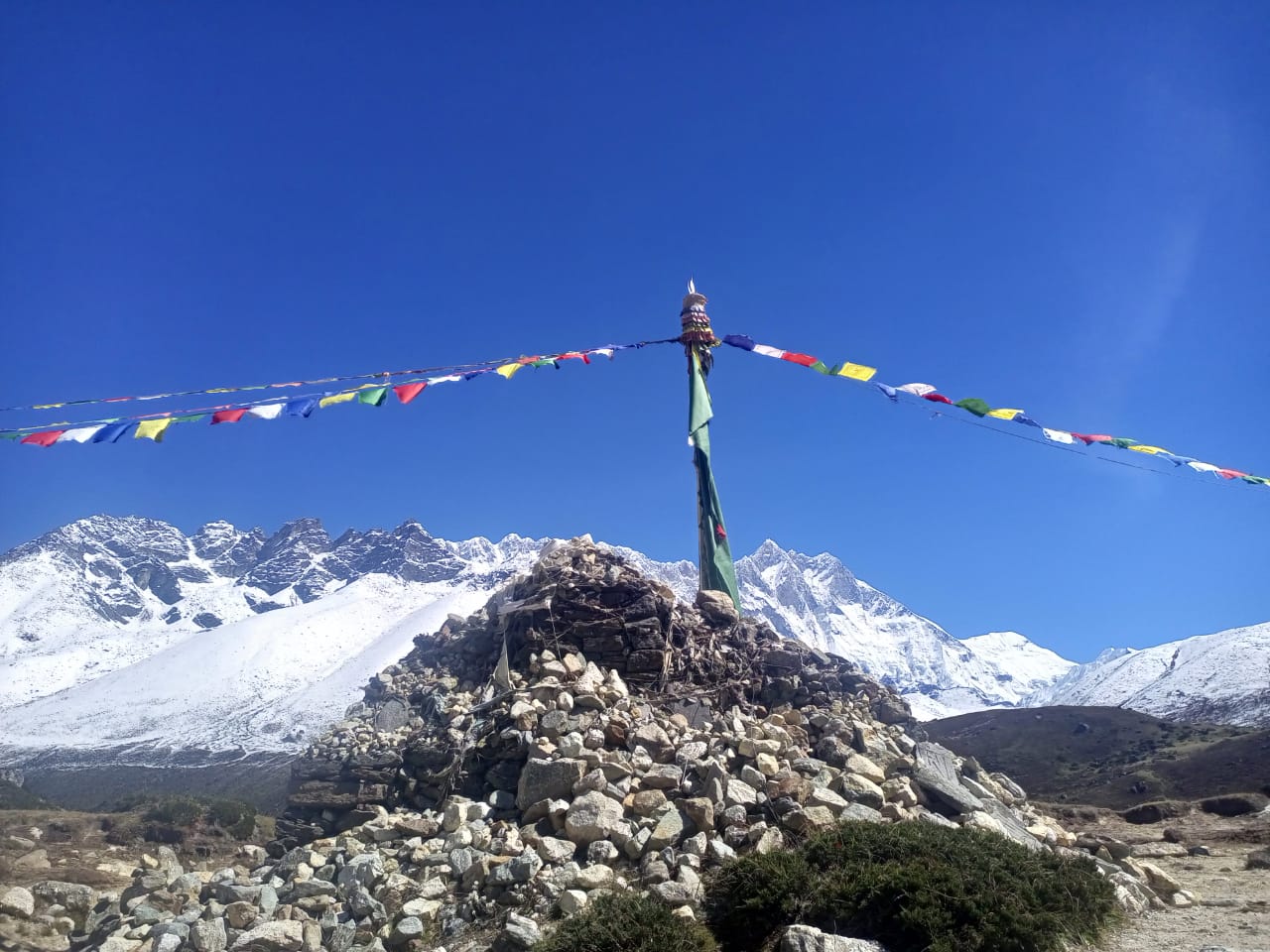
- Trekking down to the old Tengboche Monastery with remarkable mani walls, colored prayer flags and prayer wheels in full life forms, spiritual Himalaya rituals. Explore more about its fascinating spirituality.
- Days of rest in Namche Bazaar and Dingboche to get acquainted with the altitude and prevent yourselves from falling into altitude sickness.
- Reach the base camp of the world's tallest mountain – at 5,364m high, it stands proud amidst gigantic icefalls, towering seracs and famous expedition camps.
- Kala Patthar Trek (5,555 m) is an awesome place with incredible viewings of Everest, which offers some amazing sights that you can capture on camera. You will enjoy one of nature’s finest sights here – the golden sunrise over Mount Everest.
- Unforgettable experience as we get 360 degree panoramic views from here of Mt Everest, Lhotse, Nuptse, Pumori, Ama Dablam and high altitude sky.
- An impressive trek through the great Khumbu glacier including crossing of transverse moraines as well as climbing of the freezing ice spikes and the wonderful high-altitude tundras.
- Our premier Himalayan trekking adventure offers the very best combination of ancient cultural experiences, traditional Sherpa hospitality, unforgettable high-mountain trails.
15 Days Everest Base Camp Trek Itinerary
The start of your journey unfolds through a peaceful arrival at Kathmandu during the morning hours when you receive an individual transfer to your accommodation. The elevation reaches its peak across the entire valley basin at 1,350 meters which represents the highest point for altitude effects of the day. The city drive shows you market streets full of life together with historic neighborhood shrines and busy traffic junctions. The downtown café serves lunch through its menu of fresh local ingredients while the hotel serves dinner with authentic Nepali dal bhat dishes. People should watch street dogs and urban pigeons and monkey groups which wander through busy streets and temple grounds in the city.
The team will start their day with breakfast and morning tea before they begin their complete exploration of Kathmandu Valley. The path will lead you through ancient stupas which stand beside medieval palace squares and busy artisan streets and peaceful monastic spaces. The meal experience begins with lunch at a garden rooftop restaurant which offers city views and concludes with dinner at a traditional space where guests can enjoy cultural shows. You will see street cattle sleeping along road edges while rhesus macaque monkeys interact with historical stone structures and pigeons distribute themselves throughout the surrounding historical square areas during your city exploration.
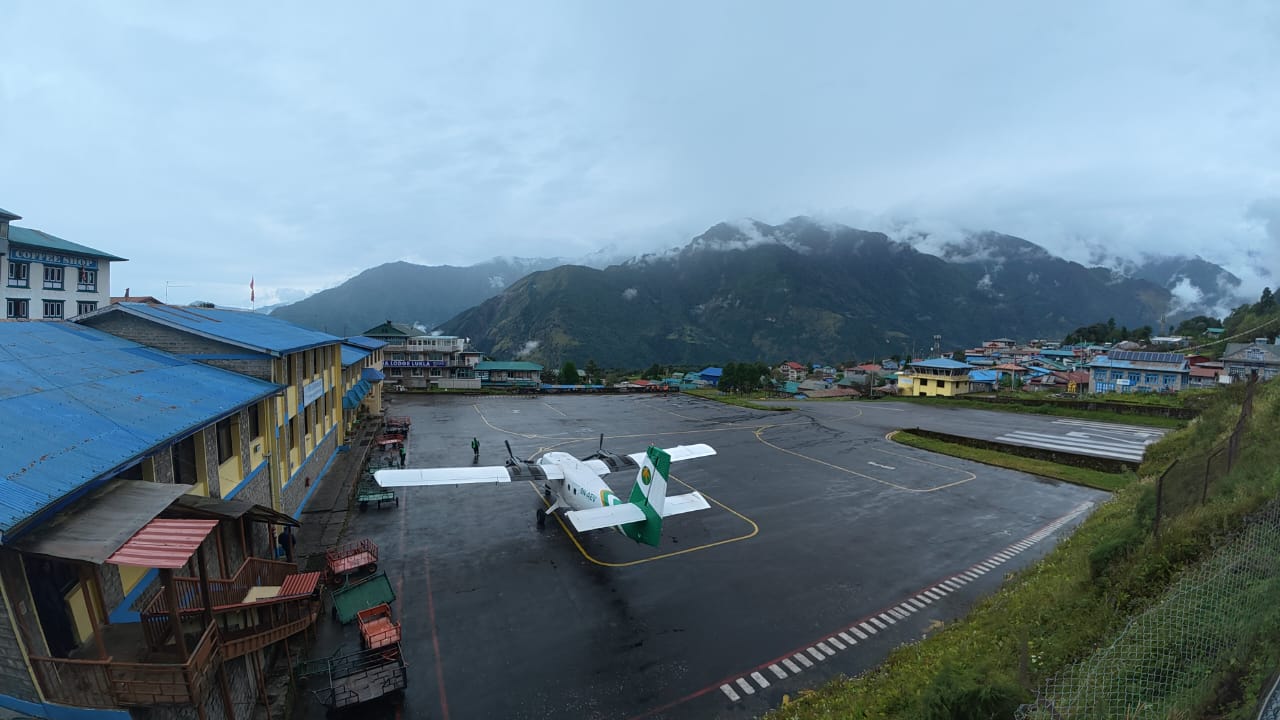
Your exciting adventure begins with an awesome flight to Lukla to find yourself at the highest point in landing on this fantastic adventure – 2,860 metres (9,384ft). After landing on this marvelous mountain airstrip, your foot walk from there descends slowly towards a forest area along the pine nature path before arriving at Chheplung village with its uniquely built mani stones and suspension bridge, before finding the delights of a peaceful river lodge in Ghat at lunchtime and the delights of your wonderful Phakding overnight cozy accommodation. Today on your twisting mountain trail you will cross paths with Zopkyo pack animals heavily burdened by climbing equipment, colorful high altitude butterflies and the goats of rural communities grazing free range.
In the early morning, trekkers take the route by the Dudh Koshi River, up to 3,440m by ascending steep hills toward the renowned village on the slope, Namche Bazaar, through Monjo (gateway to Sagarmatha National Park) and the highly suspended Hillary Suspension Bridge.
Lunch is at a log fire shelter on the trail in Jorsalle, followed by the further strenuous climb to the high point of the trekking.
Dinner is in a comfortable, wood-fueled room in a lodge at Namche; the trail continues steeply upward through slow yaks, horse pack animals, very nimble tahr on rocks far above in the high mountains, and colorful pheasants.
Your day begins with a peaceful breakfast time at the start of the day while you watch the massive snow-covered mountains. The highest point of altitude sickness occurs at 3,880 meters when you stay at Hotel Everest View before descending to Khumjung village. The path takes you past airstrips which operate at high altitudes and Sherpa houses made from stone and old monasteries that protect their cultural treasures. The outdoor hotel terrace serves lunch with mountain views which guests can enjoy before they return to their lodge in Namche for dinner. The high alpine ridges together with village borders serve as habitats for yaks which graze there while Himalayan tahr climb steep cliffs and bearded vultures fly above and local dogs follow along the paths.
Your day begins on panoramic ridges, with spectacular views of Everest and Ama Dablam. High altitude sickness tends to be most strongly felt upon arrival at Tengboche (3,870 m) and the route passes through Kyangjuma, several Buddhist chortens, then descends on to the Imja Khola suspension bridge in Phunki Thenga. Lunch today might be enjoyed at an attractive riverside teahouse in Phunki Thenga right before undertaking the long and steep foray into the forested uplands. Evening’s meal awaits us at a nearby monastery, close to the more celebrated Tengboche Monastery. Along the way, amble down the slopes watching shaggy yaks laden with gear slowly trudging by while timid little musk deer scurry off into rhododendron thickets where bright color flashes – blood pheasants and Himalayan monals flit about amongst the trees too.
Your day is highlighted by stunning morning light on the massive Ama Dablam peak. You are at 4,410m and you really feel the effects of altitude as you emerge into Dingboche's breezy, exposed, alpine valley. You'll pass Pangboche Monastery, some stone potato gardens, and desolate alpine scrub lands.
You can have lunch at a cozy tea shop at the edge of the forest in Somare and a more hearty meal in a warmed guesthouse on your last night in Dingboche.
The trees gradually disappear completely, you'll spot hairy yaks in stony corrals, tiny, quick pikas skitting around rocky faces, and high-flying Himalayan snow-cocks cawing from the rocky, exposed side of the hills.
The mandatory acclimatization day begins with an early and steep climb immediately above the valley at the very highest point, 5,083 meters above Nangkartshang Peak. You then come over a ridge decorated with flags, then to stone cairns, then on to a spectacular view over the deeper glacial ravines. Lunch is taken back at your base, Dingboche, on your return, where dinner is also at the same lodge in the evening.
You could see, on the lofty barren slopes, Himalayan marmots appearing out of burrow holes in the ground, golden eagles soaring in high thermals, and yaks grazing on sparse high altitude grass in the valley.
The start of the journey takes us through the vast mountain valley in a slow and steady rise. A sense of altitude sets in as we slowly ascend to Lobuche (4,910m), above the Dughla yak field and Everest Climbers' Memorial situated at Thukla Pass.
After lunch we reach Dughla, the next village. Here we have a simple lunch at the teahouse and then began ascending up steep moraine walls to reach Lobuche. At the dinner hall Lobuche we enjoy our dinner and overnight stay. Among the trekking party moving along this tough terrain are sturdy pack yaks loaded down with expedition gear, high altitude red-billed choughs floating high into the winds, and demure snowcocks walking across the icy field.
The trip begins at dawn, navigating the moraine fields en route to Gorak Shep. Altitude became a significant concern at the site of EBC (5,364m), nestled next to the icefall. You'll pass through the tiny settlement of Gorak Shep and skirt glacial lake remains as well as enormous spires of ice in the Khumbu Glacier, stopping at EBC for a lunchtime look around before returning to your Gorak Shep lodge (5,180m) for dinner. Up on the ice, high up and around Base Camp, expect to meet rugged, toughly built expedition yaks, red-billed choughs (akin to ravens) skittering around the expedition camps looking for scraps, and Himalayan snowcocks balanced on cold rocky moraine borders.
Well before early daylight commences, a climb on Kala Patthar, an infamous rocky summit (5,555m/18,225ft), holds the finest perch in the Everest region for a spectacular sunrise over the majestic Everest. After an equally rigorous hike down on this hard-to-walk trail over rugged ice-crusted rocks past Lobuche village, you are hosted to some lunch in a cozy teahouse within the Pheriche Valley & later you will have dinner at another enjoyable trek lodge in Pangboche (3,900m/12,795ft). Descending to the vegetation level, you'll sight yaks grazing alongside icy riverbeds, rugged tahr goats ascending towering rocks while colorful small birds dance in the green leaves of juniper bushes beside the valley trail.
Today your trek starts with the wonderful walk down through rhododendron and pine forests. Acclimatisation is felt most strongly at the initial point in Pangboche, at 3,900m altitude, and further along it goes down towards the lower terrain of the mountain. You will see Tengboche Monastery along the trek on your way, crossing the Phunki Tenga River and peaceful Sherpa villages along the side.
Lunch is at some teahouse along the track on the way, and again you have dinner and an overnight stay at the same lodge in Namche Bazaar, at 3,440m altitude. You encounter steady pack mules, descending yaks fully loaded, shy musk deer between the pine trees and lots of songbirds chirping in the trees.
Start with a last downhill section out of Sherpa land: most of the altitude effect is felt only at the beginning near Namche Bazaar (3,440 meters), which then goes downhill into the valley reducing the altitude effects as well. This trail descends below a Sherpa village, past the Monjo park entrance, Hillary Suspension Bridge & then Phakding village. Lunch is given near the river in Phakding and dinner in a teahouse in Lukla (2,860 meters).
The day opens in the early morning at the mountain airstrip, awaiting our flight to Kathmandu. We will navigate our way around mountain valleys during our time in the air then once we have landed on solid ground again we'll be navigating through some pretty busy roads as we find our feet around this big city. As we travel all over and around the Kathmandu area we may spot street dogs snoozing in sunspots or maybe get to see some friendly-looking pigeons mingle around in the market or even watch some peace-loving cows stroll past along our neighborhood's tree-lined streets.
On the final day we head for a leisurely breakfast at your hotel in Kathmandu. We traverse the vibrant bazaars of the cities, craft shops (for remembrance of family back home), the monuments, and head on towards Tribhuvan International Airport for you to get some local lunch/small refreshments served in a local cafe/airport terminal lounge before we set off. Your dinner will be served on your international journey for your home ahead. You'll catch a final glimpse of tired street dogs, and flocking city pigeons around the airport road and city ingress roads.
Nepal Everest Trek Package Include and Exclude
Package Include
- Airport pick up & private car/ jeep transfer to hotel
- Private Airport Transfer (or Manthali – Lukla – Manthali private transfer)
- Full Day private guided tour of Kathmandu Valley by private car in Kathmandu.
- Arrangement for rescue helicopter evacuation service as required. However, your actual expenses would be reimbursed to you through your personal travel insurance.
- 3 nights twin sharing basic room accommodation in Kathmandu including breakfast with bed and breakfast
- Teahouse lodge accommodation throughout the duration of the trek.
- 3 complete meals, i.e. breakfast, lunch & dinner, all meals will be fresh, on a menu basis
- Fresh fruits each night after dinner.
- 1 experienced and licensed trekking guide; fully licensed, English-speaking, government experienced, friendly with good knowledge of the cultures, routes and nature, highly educated, well equipped with first aid kit, satellite telephone, solar charger
- 1 experienced, strong and fit porter Sherpa per person to carry luggage.
- Insurance (staff only), salary, accommodation, transportation for all staff.
- An assistant to lead for groups of eight plus.
- All the trekking permits: Sagarmatha National Park fee and any other local city entrance fee
- All govt. taxes, service charges & visa fee.
- Fully equipped first aid kit carried along during trek.
- Duffel bag, trekking poles, high altitude sleeping bag, down jacket available for guests to hire (returned after trek), this service is available free of cost.
- Souvenir Sherpa Trekking and Expedition T-shirt.
- Official trip completion certificate.
- Twice a day health monitoring by pulse oximeter to measure heart rate and saturation.
Package Exclude
- Food expenses in Kathmandu - Food budget Kathmandu lunch and dinner.
- Nepal entry visa fee: Nepal entry visa fee applicable in Tribhuvan International Airport ($30 US for 15 days, $50 US for 30 days and $125 US for 90 days visa)
- Monument entrance fees - monument visit fees in Kathmandu ($30 USD approx. per person)
- Insurance - personal travel, accident, medical, and high altitude rescue insurance.
- International Airfares - return international airfares to/from Nepal.
- Personal expenditure - your personal spending money for shopping, phone bills, laundry etc.
- Bar bill, extra food/snacks, drinks & dessert/sweets - including drinks such as hot soup, tea, coffee, hot chocolate, cocoa, bottled/mineral water etc, and food, extra snacks, dessert or sweets (pie, cake, puddings, chocolates etc), as well as the costs you might add for food along the trail, tea shops, or within mountain lodgings or teashops, on top of your usual full board meal arrangement
- Additional services for mountain hotel - additional charges in mountain lodging for extra comforts like extra heat during lunch, extra fuel on the cook-stove, hot shower, etc.
- Tipping for the Sherpas/porters and guides - it is traditional to offer tips to the locals for their service. This varies according to trekking region and duration of trek.
- Fees for extra bags - baggage fees over and above the usual allowable excess baggage of 10kg for the Lukla internal flight.
note - All payments for your flight to Kathmandu, the stay in a hotel in Kathmandu, room in the mountain lodges and all meal payments for this entire trek would be NON-REFUNDABLE in case of early return for any medical reasons or emergency. All other additional expenses in Kathmandu would remain the same for you.
Altitude Chart
Tour Dates
Every departure listed below is 100% Guaranteed — once you book, your trip will run as scheduled regardless of group size.
Loading departure dates…
Want your own personalized tour?
11 Days EBC Trek Overview
The Everest Base Camp trek lasting for 11 days is a specially designed trekking-only EBC adventure especially for independent travelers who are present already in Nepal. This program is without Kathmandu logistics hence not including unnecessary city accommodations like airport ride services and hotel bookings. Therefore, it is a programme for people on a second and future trip to Nepal, for adventure lovers who are already present in Kathmandu, or for trekkers who have already made their accommodation reservations in Kathmandu before and after their trek.
The 11-day Everest Base Camp trek does not include airport- and Kathmandu city transfers; this programme only includes the trek itself, i.e., the trekking-only package. This package is a superb value for money choice for trekkers interested in a shorter EBC, but high-altitude trekking opportunity, that ensures a lot of time on the trail, whilst still adequately including required stops in order to get acclimatized on the Everest Base Camp trek. It also offers the perfect logistical framework for solo Nepal travel, bundling a professionally trained Sherpa guide service and accommodation in a teahouse, permits for the Sagarmatha National Park together with the round trip flights.
Everest Base Camp Trek 11 Days trail is different, and it leads to a smart route for returning, which includes the Dingboche skip & Dingboche bypass path from Pheriche. The trip leads via a flight to Lukla, from where your trek is initiated through Phakding, across the Dudh Koshi River, and further towards the famous Sherpa 'capital city', Namche Bazaar, for the primary Namche acclimatization. There you take time adjusting to the lower oxygen with a fantastic overview of peaks like Ama Dablam, Lhotse, Everest, etc. You advance via Tengboche Monastery and through Dingboche. The trip further continues through Thukla Pass, further to Lobuche, Gorak Shep until the trip lands at the top of the trekking zone which is Everest Base Camp (5,364m) next to Everest Khumbu Icefall. Then start earlier from Base Camp and climb to Kala Patthar (5,550 meters) for an awesome sunrise panoramic view of Everest, on return, it avoids Dingboche for a quick descent from Gorak Shep and Lobuche to Pheriche. This clever detour allows trekkers to spend an extra night at the lower, more oxygenated air at Pheriche, a quicker return from the valley and through Tengboche, Namche Bazaar, Phakding to Lukla, returning back to Kathmandu by flight, covering all aspects of an excellent Everest Base Camp trek package.
Evaluating whether the trek is suitable for your preferred traveling style and the logistics involved and ensuring that it matches your fitness level is the most essential step prior to booking. This trek is definitely not suitable for first-time travelers to Nepal who require fully arranged logistics, or for any type of traveler who might require transferring to/from the airport or expected Kathmandu hotels in the EBC package. Furthermore, this accurate route does not fit someone who is searching for a lengthy itinerary with many rest days or for travelers searching for high-altitude challenges or those that are trying to eliminate obligatory safety stops.
11 Days Everest Base Camp Trek Highlights
- Soaring to lukla: Take the adventure of a scenic mountain flight over the valleys of green fields and terraces up to the Tenzing-Hillary Airport, the very doorway into the Khumbu – the mountain heartland.
- Trekking across the Sagarmatha National Park (the Everest Conservation Area) over narrow suspension bridges crossing the river and into the dense pine forests in order to greet some animals.
- Marveling at constant snow-capped Himalayan mountain views – Experience never-ending, unobstructed, elevated Himalayan peaks, including Ama Dablam, Lhotse, Nuptse, Thamserku, and Kantega throughout the duration of your trail journey.
- Understanding Namche Bazaar & the Sherpa Culture - Visit the incredible amphitheater–like a marketplace; immerse yourself into Sherpa culture at museums; indulge in delicious alpine treats from bakeries and delight in genuine mountain accommodations.
- Discovering traditional Tibetan culture and monastery along with sacred mani stones and prayer flags, also the story behind visiting the amazing Tengboche Monastery.
- Experiencing Mount Everest and Everest Base Camp experience, viewing the amazing Khumbu Icefall from EBC and a hike on Kala Patthar for the fantastic summit view of Mount Everest.
Everest Base Camp Trek 11 Days Itinerary
It's a bright, early morning after breakfast in your Kathmandu hotel you are transferred to the airport for a spectacular flight to Lukla - the gateway to Everest. After landing, our crew waits to greet you and handle your trekking equipment, then we commence trekking to the Khumbu region through a gentle descent through picturesque villages and settlements like Chheplung and Ghat, along the Dudh Koshi River, crossing various high suspension bridges with prayer flags, and have lunch at a trailside lodge in Thado Koshi or Ghat. Then walk up to the peaceful river bank village of Phakding, where we take tea with splendid scenery and views. Check in to your lodge and enjoy dinner, with an overnight stay in Phakding.
We continue with our amazing breakfast in Phakding, followed by some beautiful scenic views along the Dudh Koshi River Valley through pine & rhododendron forests. We will be crossing several high suspension bridges (like the famous Hillary Suspension Bridge) on this route, which leads us through some small Sherpa villages such as Monjo, and we'll clear our Sagarmatha National Park entry checkpoint. After lunch we enjoy our time in Jorsalle at a local lodge before heading towards the most famous trailhead on the mountain – the famed steep climb through pine-forested mountains to Namche Bazaar. With every meter climbed above 3,000m, you start feeling some mild altitude effects – perhaps a little shortness of breath or light-headedness. We finish our day arriving in Namche Bazaar after sunset, for dinner & overnight at our lodge.
Start relaxing in the morning after having breakfast at a teahouse in Namche. Following the "Climb High & Sleep Low" strategy, you will embark on this very active day exploring the area around your accommodation. Today you will be going on one of two hikes - either heading towards the Everest View Hotel, which provides awesome panoramic views over Mount Everest, Ama Dablam, Lhotse and Thamserku, or alternatively we can arrange a hike to visit some of the Sherpa cultural villages such as Khumjung and Khunde. You might get the chance to spot some Himalayan Monal (Danphe), which live amongst the cliffs, or Himalayan tahr, which graze the higher slopes above the tree line. Lunch will be in either Namche or along the way if you choose to go on the hike to the Everest View Hotel. Free time today would be perfect for visiting some of the great bakeries & cafes in Namche, or perhaps taking a trip down to the local Sherpa Museum, where they tell fascinating stories about the history of the people of Nepal and their culture. Dinner and overnight stay at a teahouse in Namche.
Wake up in the morning after an early morning breakfast, watching the horseshoe shaped theatre of Namche. Trek around a scenic contour above the Imja Khola river with great views of the world giants of Everest, Lhotse & Ama Dablam and through rhododendron forest till you reach on the riverside at Phunki Thenga where we can have lunch. After lunch we ascend again steep upward through the pine forests until we reached a ridge village of Tengboche that is the highest at 3,867m on our trekking day. You may feel tiredness, headache or loss of appetite etc from now. There’s always a chance of altitude sickness along this hike so make sure you’re a bit well rested before heading down to Tengboche Monastery in the afternoon. Dinner, lunch and overnight stay in a lodge in Tengboche.
We begin with breakfast in front of spectacular views of Ama Dablam while at Tengboche. Descending back through the beautiful birch and rhododendron forest all the way to Deboche, you continue down across the suspension bridge above the Imja Khola valley. Our slow climb continues upward to beyond the tree line into sparse alpine shrubs, followed by pasturelands. We go down to Pangboche, where we have lunch and time to experience the old stone monastery along with Ama Dablam vistas. Moving on from Shomare, you find yourself in the wind-blown Imja valley towards the stone fields of Dingboche, which is just beyond 4,000m. You will need to go slowly and drink a large amount of water due to the high altitude effects of crossing 4,000m to Dingboche valley. Have dinner and stay overnight at your lodge.
After a generous breakfast in Dingboche, you traverse wide valleys to reach Dughla, where you walk beside alpine tundra with grazers. Lunch is an earlier affair, either at the roadside teahouse in Dughla. Following your lunch, you begin a steep uphill via a traverse through the terminal moraine of Khumbu Glacier to Thukla Pass, with many important memorials for the fallen Everest Climbing crew. Around nearly 5,000 m, your ascent will be with an increased level of discomfort due to altitude, with headaches and breathlessness and light headed feel being very common, with severe limitation on oxygen intake; you are to remain under the very strict guidance of your leader, who will take vital readings such as your pulse and oxygen level closely. You then continue along the moraines with your onward journey to Lobuche, where you are to take your supper and spend the night.
Today is the day that caps your expedition. After a morning’s breakfast at Lobuche you will be on the move, ascending alongside the lateral moraine of the Khumbu Glacier to Gorak Shep, dropping your big gear along with having a substantial meal at the Lodge as well.
It would be wrong to call this trek ‘easy’ – it is the most physically demanding day during our journey – but if you keep a mindful pace and rhythm on the trail you’ll get through without too much difficulty. Once you reach the base camp area under the infamous, intimidating Khumbu Icefall among a sea of colorful tents and huge mountains, you can go back again all the way to Gorak Shep. Tonight we’re having dinner and overnight here.
You begin your day long before the sunrise, at about 4:30 AM, have a hot drink before tackling the steep ascent of Kala Patthar at 5,550m. Reaching this high peak yields nothing less than, in our experience, the world's absolute best sunrise, over Mount Everest, Nuptse and Changtse. You'll be breathing heavily as you move slowly at high altitude. Drop back down to Gorak Shep for breakfast, and pack. Then trek back down to Lobuche and Dughla. Stay overnight at a teahouse in Pheriche (lunch stop at Dughla or Pheriche), which results in a tremendous drop in altitude and sudden betterment. Have dinner at the teahouse.
You have a good hearty breakfast in Pheriche. After a consistent, excellent slope downhill, you proceed through the valley and descend through Orsho and Pangboche. You are once more amongst the pine and rhododendron forests at Tengboche. This trail leads downhill again and you stop at a riverside tea-house at Phunki Thenga to have a lunch tea house meal. Afterwards the trail leads you uphill on a zig-zag trail to Kyangjuma. After this, you are on the level contour path and make your way back into Namche Bazaar. You are breathing a lot easier down here at the reduced altitude of 3,440 meters, and with a hot shower, a good meal and a night's rest in Namche, you get to reward your high-altitude trek accomplishment.
The last morning trek will be after an early breakfast at your trekking lodge at Namche. It starts with a steep downhill trek towards Hillary Suspension Bridge and will mostly continue along the Dudh Koshi River, passing through Monjo and Phakding, and taking a lunch break in either a local lodge in Phakding or at Ghat. After walking uphill after the gradual ascent, passing through villages of Sherpa people with Mani stones and Prayer wheels, you reach back at Lukla late in the afternoon, which is going to be the end of your trek. At last, you share a farewell meal with your guide and porter in Lukla. Stay at the hotel for a night.
Have breakfast at your Lukla teahouse in the morning; later, walk down to the Tenzing-Hillary Airport. After that, you get on an amazing short flight of just 35 min back to Kathmandu with amazing last glimpses of the snow Himalaya range. Free day today; you are on leisure, can get a massage, and do some souvenir shopping in the shopping area of Thamel. Reach at TIA (Tribhuvan International Airport) 3 hours before your flight with our representative.
Services
Package Includes
Flight and Transfers
- Domestic flights between Nepal and Lukla on round trips, including local airport taxes.
- Private vehicle for airport transfer in and out.
Accommodation and Food
- Accommodation in the finest lodge that’s standard and best along the trekking trail.
- Three daily delicious and healthy meals (Breakfast, lunch, dinner) in local teahouses. Food consists of local cuisines and International varieties on the trek.
- Seasonal fresh fruit in the afternoon after dinner.
Permits and Fees
- All necessary trekking permit fees.
- All necessary government official fees and local municipal fees.
- Entry fee in Sagarmatha National Park.
- Trekking Information Management Systems card.
Porter and Guide Team
- Professional, experienced, and strong licensed local Sherpa guide, who helps with all-round assistance with your travel during trekking.
- Strong Sherpa porters, there will be 1 porter for two people, with the load up to 25 kgs for both.
- Walking poles and all other essential gear are carried by porters.
Health, Safety and Emergency Support
- All the required gear you will need, such as a four-season sleeping bag, a warm down jacket, trekking sticks or walking sticks, and a duffel bag, is provided for you.
- Free company T-shirt.
- Award of a Certificate of Achievement to the trekkers from the team.
- Oxygen for checking and for AMS altitude problems of the participant.
Package Excludes
- City Accommodation and Meals
- Hotel accommodation in Kathmandu at the beginning and end of the trekking.
- Lunch and Dinner in Kathmandu.
- Extra meals and/or hotel nights in Kathmandu due to cancellation or pre-return of flights.
Visas and International Travel
- All airfares on international routes to and from Nepal.
- Visa fee for entry to Nepal. The visa fees for entry to Nepal are payable on your arrival at Tribhuvan International Airport (TIA),
- Kathmandu, in Nepalese Rupees based on your visa duration: $30 USD for 15 days, $50 USD for 30 days or $125 for 90 days.
Insurance
- Personal medical and travel insurance with high-altitude trekking cover.
- Personal medical expenses.
- Private emergency helicopter evacuation service of a patient up to the elevation of 5,550m.
Beverages, Extra Foods and Teahouse Extras
- Alcoholic and non-alcoholic drinks such as tea, coffee, hot chocolate, bottled mineral water, fizzy drinks and soft drinks.
- Snacks, extra food and dessert while on the route.
- Extras like hot water shower, Wi-Fi access, charging phone and camera, etc.
- Additional clothes washing service.
Personal Items and Trekking Gear
- All personal walking equipment, walking shoes and clothes which are not specified in the trekking gear list.
- Any personal expenses such as telephone costs, phone cards, gifts, shopping and excess luggage allowance on Lukla flights (as stated, $15 for each kg above 15 kg).
Emergency and Extra Costs
- Extra costs caused by any circumstances such as flight cancellation and delay, natural calamity, strikes, policy changes in government, health condition of guest or early exit from trail.
- Tips to guides, porters and drivers. Tipping the guide, porter and driver is customary in Nepal if their service is good.
Tour Dates
Every departure listed below is 100% Guaranteed — once you book, your trip will run as scheduled regardless of group size.
Loading departure dates…
Want your own personalized tour?
12 Days Everest Base Camp Trek Overview
This 12-day Everest Base Camp Trek is perfect for all those international trekkers who already have Nepal travel arrangements or don’t have much time and want to do the Everest Base Camp trek in a short period. So why wait? Go for our short Everest Base Camp Trek that includes all necessary highlights and excludes arrival/departure day in Nepal. Our short Everest Base Camp Trek has two acclimatization periods in Everest Region, which will help you to adapt slowly to higher altitudes without getting altitude sickness.
The trek starts with the great flight to Lukla, then make up way down to the Dudh Kosi River (milk river), then continues down to the Everest region through Phakding and Monjo and leads to Namche Bazaar, the central region, to witness the natural beauty of the Everest region of Nepal. From Namche Bazaar we hike to admire the majestic beauty of world's highest ranges through the diverse landscape within the heart of the Himalayas including the beautiful forests of rhododendron, magnolia, pine trees, suspension bridges across deep gorge, charming villages of ethnic Sherpas such as Khumjung village, Syangboche, Kenjuma, Tengboche, Pangboche, Dingboche, and Pheriche etc. You will get an excellent opportunity to view Buddhist monuments at Tengboche, Sherpa culture and Tibetan Buddhism artifacts & culture, and also you could see various Buddhist stupas all along your trekking way. You also get an option for an additional acclimatization trek around Chhukung and Nagarjuna Peak (Nagarzhang Peak) along with magnificent viewpoints of the famous Changri glacier and glacial moraines.
Next, we hike across the Khumbu Valley inside Sagarmatha National Park and continue toward Gorak Shep and Everest Base Camp. At last, you see the best viewpoint of the mighty snow-capped mountain called “Kala Patthar” (Sunrise Viewpoint of Mount Everest, Lhotse, Nuptse and Pumori). It’s said to be the steps to Heaven because of their high Himalayan panorama. SoIf you already have your Nepal travel arrangements and want a shorter Everest Base Camp trekking experience without sacrificing acclimatization, then this trekking tour package will make your dream come true.
This 12-day itinerary offers the right balance between time efficiency and high-altitude preparation
Short Everest Base Camp Trek Highlights
- Experience the world's highest peak, Mt. Everest, and its mighty surrounding Himalaya range of the Everest region.
- See some of the most recognized panorama's of Mt Everest (Lhotse, Nuptse, Pumori) from the renowned “Kala Patthar View point” during Sunrise / Sunset.
- Experience and witness the tradition of the Sherpa people by visiting their village monasteries and participating in prayers and see their daily life.
- Trekking and visiting the most celebrated Sherpa town called Namche Bazaar, a busy trading place and an important central meeting area between great high mountains.
- Take a scenic Lukla flight; the dramatic aviation preview of the Everest range before getting to Lukla.
- Hike through narrow icy gorges and rhododendron forests on the trail, and as the altitude rises, so does the nature of the vegetation and land.
- Enjoy a high mountain view with an awesome overview of Everest, Makalu, Ama Dablam & Thamserku at the elevation throughout the trekking path.
- Have planned an itinerary for adequate acclimatization so as to acclimatize at moderate altitude while resting in convenient trekking hotels or teahouses.
- Make the trek experience easygoing and effortless with a guide and supporter who knows the local track altitude and its residents well enough, with proper mountain techniques.
- Witness alpine lakes and their mirror-like glacial and rocky landscapes along the altitude hike.
Everest Base Camp Trek 12 Days Itineraries
The early morning light reveals the spectacular green hills and thin air outside of your plane to Lukla. You have to walk downhill after the very short landing; through pinewood forest and tiny villages of Sherpa. This path goes along the Dodkosi river with suspension bridges, and many stones with carved prayers; after resting for lunch with a cup of tea and then start hiking down toward Phakding. This walk lets you see the majestic mountains.
This morning we start our hike by going upstream through the river valley and into Sagarmatha National Park. This means that we’ll be passing by the official National Park checkpoint at Monjo before crossing the imposing Hillary Suspension Bridge (suspended over the noisy river gorge).
From there we climb a lovely, but steadily steep trail surrounded by fragrant pine/fir forests. If you’re patient when cresting the switchbacks you can get your first panoramic view of Everest itself. In the evening we end our journey in the theatrical amphitheater shaped town of Namche Bazaar – an energetic Sherpa village filled with colorful market places, bakeries & lodges clinging to the sides of the valley.
On the third day you will be acclimatising at Namche Bazaar (3,440 m) where your body will slowly get accustomed to the increase in altitude before you carry on to even higher altitudes. The short walk takes you to the Everest View Hotel at the top of the Namche Bazaar from which you would have the best viewpoint of the famous Peak Mount Everest and other surrounding Himalayan ranges that can be captured in the photos that day.
The trekking path also offers you good vantage points to watch the local communities of the Sherpa people and the scenery of the valley Khumbu. Another place to see is the Sherpa Museum which tells you the story of Sherpa people, mountains climbing, and cultural aspects connected to the Himalayas through the eyes of the people living there. The day has a light walk and people see it as a good exercise without any excessive stress for the body. After this day of rest and light exercise, you'll start going up from Namche and finally reach Tengboche on the fourth day of your journey.
Once you set out from Namche, the trek ascends further through another beautiful balcony track which overlooks Mount Everest and Ama Dablam, and this hike is a real feast for your eyes. Then, you head down towards the Imja Khola River valley, from where you halt for your lunch, and then further hike up towards the cool shades of rhododendron forest. This hard work gets compensated at the point of reaching Tengboche, which is considered the holy place of the Khumbu region. Atop the elevated lands stands the huge Tengboche Monastery, along the chain of mighty mountains, where there is ample time; you can attend a prayer and witness the monks' chants.
Morning sun gleams on the peaks while you descend through birch and pine into the valley at Deboche. This is the start of the hike down into less and less forest, and into more raw scrub. Over the wooden crossing over a frozen river, you carry on through the mani stone rock sculptures and chortens, into the upper Imja Valley, passing potential mountain goats to be seen scattered across the high rocky hillsides. As you are going up towards 4,000 m, there is a definite difference in altitude, trees thin out, and you can also reach Dingboche, an attractive farming village, which is surrounded by stone walls to keep the winds at bay and prevent damage to the fields of crops.
It’s time for your second mandatory acclimatization day. First things first – we start our climb early this morning towards Nangkartsang Peak (5,083m), located above the village. While this may sound difficult at times, there's no way around it because watching from its peak, the top being decorated with beautiful prayer flags and getting incredible 360-degree views of the surrounding peaks, including mighty Makalu and Lhotse, as well as majestic Cho Oyu & the impressive face of Ama Dablam makes it all worthwhile. After having lunch in Dingboche, we give ourselves some time to recover and prepare for the next challenge.
We’re now on a steep incline – and there are some great views to look forward to. As we progress along this windswept ridgeline, you’ll enjoy excellent vistas of the high valley floor below. Once we’ve had a little break at Thukla, we set off on what’s called a ‘steep scramble’ along the Thukla Pass (which ends with a memorial site). At the top of the pass are thousands of rock cairns that serve as a tribute to the many people who lost their lives while trying to climb Everest. From here, we make our way down through very rough glacier moraine until eventually we get onto the windswept village of Lobuche.
Today is the day we are going to reach our ultimate destination. We will go through all those rough and rocky terrains which consist of glacial debris while heading towards our next location that is Gorakshep which happens to be the last teahouse available on this way. Once we reach here, we drop our heavy luggage and grab ourselves some lunch before proceeding further.
We can easily see many mountains like Nuptse, Pumori, Lhotse, Partially Mount Everest etc, from this spot which stands high at an elevation of 5,364 meters. It's going to be quite exciting as we have reached our target spot where everyone would love to click their pictures with prayer flags, and other things around us. We also get to witness how big the Khumbu Icefall is. At last we trek back again towards Gorakshep to enjoy our dinner and rest tonight.
Today we wake up much earlier for our trekking to the highest point of our whole trip. All our climb is upwards all the way up until we reach Kala Patthar, ‘black rock’; it is also its original name. At 5,555 m above sea level, it is the top of all trekking on the Everest Base Camp trek. Reach on time, and we will see the sunlight on top of Everest giving us an amazing sunrise view among the Everest. The glacier and the surroundings have their own natural beauty which can’t be seen anywhere. After seeing the beauty of nature, we have to come down and grab some breakfast again at Gorakshep, then pack our bags to go for the longest journey down till the end, where we will be staying overnight at Pheriche because of the thin air at high altitude. So after this whole long hike, we get to relax our body and mind here.
The hike from Pheriche (4371 m) to Namche Bazaar (3440 m) takes between 5 to 6 hours. The path follows much the same way as before, downhill along the same way used while going up the lower Khumbu Valley, from the pass through meadows into forests that become more common with the descent in altitude. Descend through Pangboche to Tengboche before making the descent to the river Dudh Kosi, climb once again toward Namche Bazaar. As you descend you will come across the views that will look to be more green and have warmer air. Upon arrival at Namche you will soon be in one Sherpa capital of the Everest Region.
Today is your last day of trek where you trek down from Namche Bazaar. Mostly you will descend but the trail drops to the lower Khumbu Valley where you will be walking through forest, passing Sherpa village and suspension bridges and in parts following the river. You pass Monjo, further along the path goes toward Phakding before it reclaims the trail leading back to Lukla.
The overall elevation is downwards but it is one very long trail with ups and down which necessitates keeping your pacing steady. After reaching Lukla you can enjoy some time there and also share last evening with your whole crew members. Stay at Lodge Lukla Overnight.
After having enjoyed your stay at the tea house lodge of Lukla, we will take you on our last trip today, that would be departing back towards our base town, Kathmandu via air.
The approximate duration of this flight is around 30-35 minutes only. It really depends upon various factors such as weather and its operating conditions.
On returning to our base town, Kathmandu, your Short Everest Base Camp Trek ends here. Trekkers can now proceed accordingly as per their own itinerary planning and schedule.
Short EBC Trek Package and Inclusion
Package Include
Transportation
- Pickup and drop off to your hotel from and to Tribhuvan International Airport via private car or bus (depending upon the group size).
- Airport transfer: Airport transfer for you to a helicopter or plane to get you on the flight of your choice to Lukla from Kathmandu (Tribhuvan International Airport).
- Flight ticket arrangement either Kathmandu-Lukla-Kathmandu or Ramechhap-Lukla-Ramechhap based on the operation and the season.
- Emergency helicopter services for any emergency, with your own helicopter evacuation plan for such circumstances.
Accommodation
- Best quality & comfortable teahouses during your whole trekking tour.
Meal
- Delicious and standard three meals a day (Breakfast, Lunch, Dinner).
- Fresh fruit and nuts the night before dinner.
Guide & Porter
- Knowledgeable, Gov. licensed, friendly and experienced English speaking guide.
- Highly skillful and qualified Sherpa porter with an in depth knowledge of the trails. He is a good friend and helper during your expedition.
- Guide's and porter's lodge, food, beverage, transportation and their insurance have to be borne by the company.
- An assistant guide for more than 8 persons.
Trekking Permit
- Sagarmatha National Park area permit fees.
- Khumbu Pasang Lhamu Rural Municipality entry fees.
- Other Expenses
- All Government taxes
- Company's service charges.
Benefits
- Basic First Aid Kit
- One duffel bag, walking poles, one sleeping bag and one down jacket (this must be returned after the trip ends).
- One T-shirt with 'Sherpa Expedition and Trekking' name for free.
- Trip Completion Certificate.
- One Oximeter to check your pulse and O2 in your blood during the day and night.
What's not included in the package
- Hotel in Kathmandu and Breakfast in your hotels at Kathmandu (major meals are available on request).
- Cost of Nepal entry visa fees. 30 USD/- for 15 days' tourist visas, 50 USD/- for 30 days', and 125 USD/- for 90 days' visas. (You can also obtain an arrival visa for Nepal at Kathmandu, even at the Airport).
- Personal medication
- Travel insurance
- International flight cost
- Alcoholic beverages (Beers, cokes, etc), non-alcoholic beverages such as tea, coffee, hot chocolate, etc & mineral water during the trek.
- Charges for charging your electronic device at teahouses and the hot water facilities at trekking lodges are borne on your own.
- Personal gear of the trekker.
- Tips for your guide, porter and driver.
- Entrance fees of UNESCO's World Heritage USD $23 to 25/- per person.
- You will have an extra 10 kg baggage allowance on the Lukla flight you might be carrying.
The amount you have paid in advance for booking your flight, hotel, mountain rooms, food, etc is non-refundable. Also not refundable if you return from the trek earlier. In such cases you have to pay for hotel and food, etc in Kathmandu.
Tour Dates
Every departure listed below is 100% Guaranteed — once you book, your trip will run as scheduled regardless of group size.
Loading departure dates…
Want your own personalized tour?
10 Days Everest Base Camp Trek Introduction
This Fast EBC trek is intended for highly fit hikers and those with time constraints who desire an amazing climb toward the heart of the Himalayas also called the steps to heaven. This trip itinerary is ideal for trekkers with outstanding health and prior exposure to higher elevation, with the understanding how the high-elevation trekking works. This trek follows a compressed itinerary with a faster pace, long daily walking hours, consecutive days as well as very limited recovery and rest days and requires that trekkers can cope with reduced acclimatization. The most significant variable to note, however, is that it includes no acclimatization at both Dingboche and Namche Bazaar.
Your journey begins with a spectacular flight into Lukla followed by an easy trek from Lukla to Phakding introducing you to the Everest region. This trail into Sagarmatha National Park, featuring abundant beautiful trees of magnolia flowers, rhododendron, pine etc., is particularly enchanting as you walk. You'll be crossing a number of swaying suspension bridges of the Dudh Kosi river aka River of Milk as you trek, traversing Monjo before a rather challenging incline up to Namche Bazaar. At Syangboche you have marvelous vantage points, or can visit Sherpa villages like Khumjung, or Kenjuma with its typically high-lying gompas, for outstanding panoramic views.
Traveling deeper down the Khumbu Valley exposes you to rich Sherpa culture with numerous peaceful Buddhist monuments/structures in each village. You cross ancient halts such as Tengboche, Pangboche, Pheriche, and Dingboche; and further explore some trails to Chhukung or a climb to Nagarjuna Peak (also Nagarzhang Peak), then back to your original path through rugged, glaciated moraines, near the bank of the Changri Glacier. Completing your expedition to the high post of Gorak Shep, eventually at the Base camp and then to the summit of Kala Patthar (sunrise viewpoint of Mount Everest, Lhotse, Nuptse, and Pumori ), you’ll have achieved a remarkable accomplishment.
10 Days Everest Base Camp Trek Highlights
- Get Mount Everest up close to view the globe's highest summit, at elevations of 8,848.86 metres above the harsh, rugged Himalayan highlands, making the Mount Everest treks a high-altitude mountain experience.
- Behold a spectacular all-around vista of Mount Everest, Lhotse, Nuptse & Pumori at dawn and sunset from the Kala Patthar viewpoint, an admirable Everest viewpoint.
- Discover genuine Sherpa culture within the ethnic settlements, Buddhist traditions, Gompas and mountain peoples lifestyles along the trek.
- Discover Namche Bazaar, the ancient Sherpa trading-post and the main point of preparation for Everest or other Himalaya summit expeditions.
- Journey through a scenic mountain flight to Lukla, the entry point of the Everest Region and an amazing trek through Dudh Kosi valley.
- Walk through glacier valleys, alpine or rhododendron jungles with a wide range of vegetation up in high Himalayas, which do not grow in lower valleys.
- Experience fantastic mountain views from Everest to Ama Dablam, Makalu to Thamserku along with seeing glaciers, valleys and mountainscapes of the Everest region.
- Travel with an experienced Everest guide and porter whose knowledge of trekking routes in the Everest region is high. They provide details of altitudes, local flora and fauna, behavior of Himalayas, climate conditions etc.
- Traverse alpine lakes and other high Himalayan terrains for added natural uniqueness along the mountain trek.
Fast Everest Base Camp Trek Itinerary – 10 Days
Take an early morning picturesque flight up to Lukla, lasting about 30-40 mins, with magnificent views across the Himalayas. Once you land at Lukla, a representative will meet and accompany you to a teahouse, and we will have an introductory trek briefing followed by breakfast.
Once everyone's packed, we start to descend following the trail to Phakding past tiny Sherpa settlements of Chheplung and Thado Koshikora before we stop for lunch in Ghat along the bank of the Dudh Kosi. After we have had lunch, we make our way past a pine forest where we will cross a suspension bridge, then pass the village of Toktok to reach Phakding. Here we check in to our teahouse and get to rest after our first day trekking in the Everest region.
A moderate day begins, leaving Phakding by following the river up past the villages of Bengkar, then we go through the check-in to the world renown Sagarmatha National Park at the Monjo entrance. We then continue past Jorsalle for some rest, and we head along the well-forested path of pine and rhododendron to become immersed in the vibrancy of trekking mecca: Namche Bazaar. We check into our hotel, dine in the teahouse and wander through bakeries and the market.
The first section of the trek leads us high above the Imja Khola to Kenjuma, which rewards us with sightings of Mt. Ama Dablam, Mt. Everest and Mt. Lhotse. Later descend through beautiful forest towards a riverside settlement Phunki Tenga, which is also where you will have your lunch and you can have a hot sweet tea for refreshment. Then we ascend a high gain up and away from the river and walk through a shaded trail through pine for a few more hours then after we arrive in a superb small monastery place of Tengboche. We will check in at our teahouse, you will have an option to visit Tengboche Monastery, one of the famous monasteries. Dinner and ready for your next day trip.
From Tengboche start the journey back down along the trail through the birch/rhododendron forest to where you cross the Imja Khola suspension bridge heading towards the traditional stone-wall village of Pangboche. After enjoying views of Ama Dablam you make your way past Somare, stopping here for lunch with views across to the emerging alpine scenery. The trail goes through Shomare, and into higher pastureland as you enter the wind-swept valley of Dingboche. After checking into your teahouse and having a hot meal for the evening, you sleep, and acclimatise to the distinctly higher altitude.
You have your breakfast and you leave on foot towards a trail leading above Dusa, heading first towards the small valley village of Dughla (also called Thokla). You'll have lunch there.
From there, you continue your journey upwards through an extremely difficult hike which brings you to the pass known as Thokla Pass - marked by memorials of previous unfortunate climbers. Afterwards the trail takes you right to the isolated little mountain village of Lobuche. You will eat your dinner in a warm teahouse here, then return to bed ready for another day towards the big push to get you into base camp.
After breakfast you trek past the vast Changri and Khumbu glaciers on rough and rocky ground to Gorak Shep where you dump packs, eat lunch and retrace, walking up the glacial moraines, to Everest Base Camp. Standing here, at the foot of the great Icefall you may take celebration photos. Then take a long, arduous trek back along the glacial moraine to Gorak Shep. There we have a celebratory dinner in the dining room, and then a comfortable night's rest at the highest teahouse available.
An early pre-dawn mission up Kala Patthar (Sunrise view point of Mount Everest, Lhotse, Nuptse, and Pumori) provides with sensational views of the world’s loftiest peaks at dawn. Upon descent to Gorak Shep, you’ll have a filling breakfast, and will be packing up for your trek back into the valley through Lobuche to reach at Dughla for a leisurely lunch. Going down into the valley you traverse down to the lower river basin to reach Pheriche for a hot dinner and your stay. The air down is thicker.
Leave Pheriche and head down to the valleys, where you'll find yourself breathing easier and walking on less challenging terrain as we continue our trek toward the Orsho and Pangboche areas.
Our plan today includes crossing the valley bridge that spans across the Imja Khola river, taking us back uphill along the way from the valley floor to the high alpine regions of Pangboche and Phunki Tenga, close to the village of Tengboche (you'll pass monastery here).
We're looking forward to having some lunch together too. At the very beginning of the hike, it's quite steep going up, but eventually you begin heading more gradually alongside the side of the cliff itself until finally reaching the lower altitude region of Namche.
After that we start our journey for steeper descent towards Lukla. We cross the famous Hillary suspension bridge enroute. Today you are going through the Jorsalle & Monjo and have lunch in Phakding. After this hike you pass by a few small villages such as Toktok & Ghat on the way to Lukla and finally reach the last destination “Lukla” and enjoy your last supper with your guide and porters.
Wake up for a quick breakfast and then a scenic and exciting flight back to the city of Kathmandu airport from Lukla. Our representatives will meet you there and transfer you to your hotel, where you have the remainder of your day and overnight for some warm showering, a delicious dinner, relaxing rest, or a stroll to the Thamel shopping district to buy gifts.
Short EBC Trek package and Inclusion
Package Include
Transportation
- Airport pick-up and drop by car/jeep for domestic flight.
- Kathmandu – Lukla – Kathmandu domestic round flight / Manthali – Lukla – Manthali domestic round flight is extra to the budget.
Food & Lodgings
- Accommodations with lodges during trek.
- 3 meals per day during trek (breakfast, lunch, dinner).
- Fresh fruits every night.
Permits & Documentation
- All required trekking permits such as Khumbu Pasang Lhamu Rural Municipality Entrance Fee, Sagarmatha National Park Entry Permit are managed.
Guide & Porter Services
- An experienced, government-licensed guide with fully covered cost of salary, meals, accommodation, transportation and insurance.
- A strong Sherpa porter (one porter shared for two trekkers) with full cover of salary, meals, accommodation, gear and insurance.
- An assistant guide will be provided for a group of more than 8 trekkers.
Trekking Gear Provided by Company
- Sleeping bag, down jacket, duffel bag and trekking poles will be provided free of cost if needed, it must be returned after trekking.
- A complimentary Sherpa Expedition & Trekking T-shirt.
Health & Safety
- A first aid kit for safety purposes will be accompanied by the guide.
- Monitoring of oxygen saturation and heart rate twice daily by pulse oximeter will be arranged in order to detect symptoms of Acute Mountain Sickness (AMS), should they occur.
- Arrangement of trip aviation rescue on call, with additional cost for private insurance.
Taxes & Extras
- Official permits and government taxes.
- Accomplishment trip certificate will be awarded at the end of the trip.
Package Exclude
- Accommodations & Meals when you are in Kathmandu
- Visa fee for traveling to Nepal (easily procured on arrival at Tribhuvan International Airport – Kathmandu). It will cost you starting from USD 30 for 15 days up to USD 125 for 90 days.
- Personal expenses on traveling insurance and travel medical insurance.
- International flights.
- Personal expenses on trek.
- Food and beverages (non-alcoholic or alcoholic) which are provided on the trek by the tea house.
- Expenses of hot shower, batteries charging etc during the trek, at the tea house.
- Gratuities for guide, porter, and driver.
- Additional charge over and above 10kg limit of Lukla flight baggage.
- NB travelers will not be refunded if coming back early from trek due to illness or other reasons.
Altitude Chart
Tour Dates
Every departure listed below is 100% Guaranteed — once you book, your trip will run as scheduled regardless of group size.
Loading departure dates…
Want your own personalized tour?
9 Days Everest Base Camp Trek Overview
The Everest Base Camp Trek 9 Days - Rapid EBC Trek is developed to satisfy the energetic travelers who wish for a fast paced exploration into the Everest region Himalayas. Who is this trek not recommended for? This trek is not at all recommended for you if you are a beginner to high altitude trekking, or if you are just here for a laidback trek. If one wants considerable sightseeing/rest days or is only searching for an average EBC itinerary with acclimatization, choose a different route. This rapidly ascending EBC itinerary, as the name suggests, relies on a fast ascent with a limited schedule, thus it is strictly recommended for fit trekkers and knowledgeable high altitude trekkers who can bear up a tightly squeezed schedule.
Our trip commences with spectacular views from the airplane as we embark on a high mountain flight which carries us to Lukla, from which our voyage commences with an easy hike along the path with the Dudh Koshi River and crossing a few spectacular high suspension bridges to reach Phakding. Then after we make a descent from Sagarmatha National Park, walking down past the number of traditional Sherpa villages with affluent Sherpa culture and old Buddhist monasteries. Though this isn't the end of your journey, rather steep climbs to Namche Bazaar, a popularly bustling trade center and trek town, then up through the blessed Khumbu valley; into the holy villages of Tengboche and Pangboche, up to Pheriche, against a wall of mountains like Ama Dablam, etc etc, creating an everlasting picture of mountains.
Move off the tree-line and stroll on glacial moraines that rise and fall near the massive Khumbu Glacier as you approach Gorak Shep and Everest Base Camp. The finale is the summit of Kala Patthar. Here the Himalayan scenery that awaits you across the greatest mountain range are incomparable, direct vistas of Mount Everest, Lhotse, Nuptse, and Pumori are yours for the watching. Designed as high-action for serious mountaineers, the 9 Days Everest Base Camp Trek, or the Rapid Everest Base Camp Trek as it is commonly referred to, combines all the glory of the highest Mountains of Nepal in one awesome trek.
Rapid Everest Base Camp Trek Highlights
- Come experience the thrill of reaching the Basecamp of the World's Highest Peak in our fast and packed Everest Base Camp trekking itinerary full of amazing adventures. Best for the experienced trekkers craving a rushed mountain escape.
- Scale Kala Patthar for an incredible panoramic view of the mighty giants that dominate the Himalayan sky: Mount Everest, Lhotse, Nuptse, Pumori - all shining in golden high-altitude sunlight.
- Embark upon your trekking journey into this scenic beauty by trekking through the valley towards the popular trekker’s town of Namche Bazaar – home to the famous Sherpas.
- Fly into Lukla and then fly out of Lukla with a sensational mountain flight including amazing wide and panoramic views over some huge snowy Himalayas.
- Visit and experience real Sherpa villages on your route to see what authentic Sherpa life is like as well as having stunning views over very ancient and beautifully sited Buddhist monasteries such as the outstanding Tengboche.
- Trek through and over glacial moraines adjacent to the vast Khumbu Glacier until you reach the remote mountain village of Gorak Shep and Everest Base Camp.
- You will constantly have awesome mountain scenery surrounding you with Ama Dablam being spectacularly nearby.
- Cross hiking over the rushing Dudh Koshi River through deep alpine valleys with spectacular flag-adorned high suspension bridges.
- Direct high altitude trail crossing Pangboche & Pheriche, which is specially made to be walked by physically fit people having a compressed itinerary and less time.
9 Days Everest Base Camp Trek Itinerary
Get a ride on the exciting flight to Lukla and meet your trekking crew at a teahouse so that you can get your equipment set up. You are now on a walk downhill on a path, crossing small Sherpa villages like Chheplung and Thado Koshi Kharka.
Next, you will eat a locally prepared meal at Ghat near the river. Across several pretty suspension bridges, through the pine forest setting, cross rivers to a nearby village like Toktok and head toward Phakding. Once in Phakding, find the cozy beautiful teahouse where you'll be eating and spending the night.
You leave Phakding after breakfast then travel along the banks of the river till you reach a village called Bengkar. Here you enter Sagarmatha National Park and arrive in Monjo.
Then you pass through the village of Jorsalle. It's time to have our lunch here to give strength for climbing today's trek. Thereafter we cross over the renowned high suspension bridge, named Hillary Suspension Bridge, that takes us on an upright climbing trek, following through the graceful pines and rhododendrons on the way. We get our first view of the enormous Everest mountain at the midpoint of the dense forest from a clear spot. We continue onwards till we reach the horseshoe-shaped town of Namche Bazaar and check in to our teahouse there. We can also eat our delicious dinner as well as visit local bakeries & markets there.
Our trek today starts the same way – as we trek again along the high cliffside trails until we head all the way down to forest tracks leading us to the teahouses area for lunch at Phunki Tenga. Later our trip continues to the ascent towards Tengboche as we trek through wonderful forests, where we witness the famous Tengboche Monastery, and again rejoin the trail for a while and walk back towards the old village with the stone walls – Pangboche at 3,930m altitude. We shall again check ourselves into a local guest house where you can experience a Nepali home style meal.
Today we start the day's journey from Pangboche and walk across some ancient mani walls and tiny little chortens till we hit more alpine territory.
We'll pass by the settlement of Somare where we can take a break for lunch and look up close at the beautiful view of the mighty Ama Dablam peak and other nearby ones. Then we begin ascending the hillsides through the fields of Dingboche pastures towards the glacier moraine of the Khumbu Glacier before continuing all the way up the valley winds till reaching the small settlement called Thukla (Dughla).
Here, we will be settled in the local teahouse enjoying a hearty dinner in their communal dining hall, after which most people try to rest as much as possible to acclimatise better to these elevations.
The morning will begin with a steep climb upwards through Thukla Pass, where we'll see some poignant stone memorials dedicated to those unfortunate climbers who lost their lives during their expedition on Everest. The path now is set against the backdrop of the rocky moraines of the famous Khumbu Glacier heading towards our destination of Gorak Shep. We then leave behind our heavy packs and enjoy a quick lunch before heading right onto EBC.
This next leg includes hiking across some incredible boulder fields and ice paths that lead all the way up to the base camp itself at 5,364m. Taking pictures among the amazing Khumbu Icefall, you can take some time to absorb just how incredible this area really is. Then when done, simply retrace your steps across the glacial moraine to get back down to Gorak Shep for some much needed dinner and an overnight stay.
A pre-dawn start takes us to Kala Patthar (sunrise viewpoint of Mount Everest, Lhotse, Nuptse and Pumori) which provides breathtaking views of these snow covered giants rising majestically above everything else in sight. Once satisfied with what's been captured, we descend back down towards Gorak Shep for another hearty breakfast while getting ready for a fun day ahead of us.
Later we pack our stuff and get ready to leave, we are now heading down to the valley below until we once again end up in the Lobuche village, for some food under shady trees and to admire the beauty of the area until we leave for Thukla village again, except this time we will be stopping half way between here and Pheriche village.
From there we start hiking towards our next stop – Orsho. We keep descending from higher altitudes, which lets us breathe more easily.
After crossing the river, we go up again all the way till we reach the Tengboche area once again, but this time going downwards till we hit the Phunki Tenga area for a nice and satisfying lunch break.
The path gets quite tough now as it goes back in an upward direction all the way to the Kenjuma point, where things get relatively easy and smooth along the contours until reaching the main market of Namche Bazaar.
Once arriving in town, check in at the lodge, have some fun taking hot showers followed by ordering fresh baked goods at a local cafe, eat a hearty dinner and finally, celebrate your return to the land of low altitudes.
On this, your last full trekking day, you descend steeply from Namche Bazaar, with several high suspension bridge crossings over the Dudh Koshi River in the direction of Jorsalle and Monjo. You eat lunch in Phakding; after such a quick adventure, you will definitely pause and think about the high adventure you have been through today. Continue passing through Toktok, Ghat, and Chheplung, with a final gentle climb up into Lukla town. We have a special farewell dinner with you and your Sherpa team tonight; you may like to give some tips to your porter and guides team, as this will be your last day in the Everest region.
After waking up early, catch your morning flight (from Lukla Airport) to return to Kathmandu. As your small twin otter plane departs from the mountain’s runway, you’ll be able to see all the beauty of the Himalayan range from above with this panoramic view. When you arrive back in Kathmandu, our team will meet you at the airport terminal and transfer you to your hotel. The remainder of the day is free for you to do whatever you’d like – take that hot shower you’ve been waiting for, shop for souvenirs in Thamel or just celebrate the successful completion of your 9-day rapid Everest Base Camp trek.
9 Days Everest Base Camp Trek Package Inclusion & Exclusion
Costs Included
Transportation
- Private car/jeep service from airport pick-up to drop-off.
- Fly Kathmandu-Lukla-Kathmandu or Lukla - Ramechhap - Lukla with private airport transport & domestic airfare
Accommodation & Meals
- Accommodation at trekking lodge (tea house) for all of the trek.
- Three-time meals (breakfast, lunch & dinner) at tea houses throughout the trek.
- Fresh fruits are served daily after dinner.
Permits & Documentation
- All required paperwork including Sagarmatha National Park entry permit and Khumbu Pasang Lhamu Rural Municipality entry permits.
Guide and Porter Services
- Experienced, co-operative & knowledgeable, amicable, English-speaking, government-licensed guide, with full payment for salary, meals, drinks, lodging, travel and insurance.
- Very powerful & helpful Sherpa porters fully equipped with safety walking gear with full payment for wages, food, lodging & insurance, 1 porter for 2 trekkers.
- Assistant guide services for trekking groups of 8 or more people.
Trekking Equipment provided by the company
- Sleeping bag, down jacket, duffel bag and trekking poles (will be provided if you don't possess the given equipment and will have to be returned after the trek concludes)
- Sherpa Expedition and Trekking T-shirt (this you can take back home)
Health and Safety
- Complete first aid box throughout the trekking.
- Pulse oximeter (oxygen meter) checks for oxygen saturation and heart rate two times a day for monitoring of any AMS symptoms.
- Arrangement for helicopter emergency evacuation service (which will be carried out by your travel insurance company)
Tax and Extra
- Government taxes and official expenditures.
- Trip achievement certificate (upon completion of the trip)
Excludes
- Kathmandu hotel accommodation
- Meals as per the package while in Kathmandu (lunch and dinner)
- Nepal Visa fee on arrival at Tribhuvan International Airport, Kathmandu (you can also obtain it prior by contacting your country's respective Nepalese embassy to your location in case you feel like avoiding waiting in the queue at the airport) - $30 (15 days), $50 (30 days) and $125 (90 days).
- Personal travel insurance, medical insurance.
- Your international airfare.
- Personal expenses of any nature.
- All alcoholic and cold, hot drinks, tea & coffee on trek (any extras that you may decide to order)
- Any desserts and sweets like chocolate, cake, pie and pudding
- Hot showers and battery charging expenses at teahouse
- Tips to guide, porter, and driver
- Charges for excess baggage over the limit of 10 kg on flights to Lukla.
If trekkers turn back from the mountain prior to the scheduled time for any reason, such as illness or any other problem, including the mountain environment, the payment made towards the airfares, trekking permit fee, and any other related expenditure, such as hotel bills, meals, and other expenses in Kathmandu, will not be reimbursed.
Tour Dates
Every departure listed below is 100% Guaranteed — once you book, your trip will run as scheduled regardless of group size.
Loading departure dates…
Want your own personalized tour?
Everest Base Camp Trek 5 Days Trip Overview
The 5-Day Everest Base Camp Trek is an extreme EBC trek, geared solely for the world's most elite ultra-fit athletes, such as serious marathon runners, serious trail runners, endurance athletes and those who are serious about high-altitude challenges. This ultra-fast EBC Trek reaches great heights in a short time thus making it one of the most demanding, ultra-fast-speed Everest treks.
Combined with a high-pace foot travel to EBC is a scenic helicopter flight out from Pheriche, the fastest helicopter return trekking to maximize your challenge. It will be the best ultra-fast Himalayan trekking experience and is considered only for extreme high-performance and very experienced trekkers who want maximum achievements possible in minimum time. It would offer a phenomenal high-speed performance adventure on your legs.
Who is this trip for? Our extreme 5,000m Everest Base Camp trek is intended specifically for seasoned, highly experienced trekking veterans with great fitness; trekkers with prior Everest or other 5,000m plus altitude climbing experience; and high motivation athletes wanting extreme expedition success, travelers who understand rapid altitude gain challenges and finally those trekkers who mainly prioritize speed and quick achievement over the standard/ traditional trekking in Everest. Every foot step of the trail pushes physical limits over technical mountain passes; across rocky and icy glacial moraines; and through windswept valleys - with no multi-day recovery along the way.
Who is this journey not for? This is an extreme Everest Base Camp Trek, and it is absolutely not for beginners, novice trekkers to Everest or regular vacationers. This tour is utterly not for lazy/slow-paced trekking fans or people with no high altitude climbing experience requiring phased vertical ascending profiles, flexible walks or multiple acclimatization days.
Since this Elite adventure experience has an aggressive ascent and poses serious altitude and physiological stress all because of rapid altitude gain, participants must have verified previous 5000m experience/activity with an extensive endurance trekking and hiking background. You begin this amazing experience with an exciting Lukla mountain flight from Kathmandu, plunging upward and in through rugged Himalayan landscapes, mountainous scenery, authentic Sherpa hubs with rich Sherpa culture. This skips the overnight stops of usual traditional EBC trek route all to take you near the Mount Everest views as well as some of the most imposing high altitude peaks, such as Everest, Ama Dablam, Pumori, Nuptse and Lhotse, at their best from above your high-altitude vantage at our famous high altitude viewing point at Kala Patthar. And skip any days and harsh decline via a helicopter flight in comfort back to Lukla.
We strongly ask you to carefully assess both your experience of high altitude environments and your physical capabilities before booking this express expedition. This fast-paced itinerary is definitely not intended for new trekkers, novice Everest trekkers and for a common tourist expecting to relax on holiday. In addition, this expedition is absolutely inappropriate for trekkers seeking a slow-paced journey or for those with no high altitude experience; the abbreviated itinerary does not incorporate rest days for acclimatization to slow progress. Trekking at high altitudes and climbing to extremely high points continuously and at a very high tempo can result in serious risk of extremely severe altitude sickness or exhaustion to those who attempt such a trekking journey without proper conditioning and acclimatization.
5 Days Everest Base Camp Trek Highlights
- Super-fast and high-powered mountain adventure that quickly takes off from Lukla and ascends to the height of 5,364 meters and Everest Base Camp, full of quick and high tempo and opportunities for intense challenges.
- Designed exclusively for experienced marathon runners, high-performance athletes, and seasoned mountaineers with greatest forms of physical endurance and superior capabilities.
- The trek takes place in the UNESCO World Heritage site traversed by fast-flowing icy rivers, high suspension bridges, and wonderful nature with amazing pine and rhododendron forests along the way.
- Designed specifically for seasoned high altitude trekking participants with successful previous ascents above 5,000 meters and demonstrated tolerance for rapid ascent in altitude.
- Pre-dawn views of your destination; enjoyed from one of the highest luxury hotels, with full 360-degree views of Mt. Everest and surrounds.
- A steep pre-dawn climb to 5,555m/18,225ft for an overview of the first golden rays on Mount Everest, Lhotse, Nuptse and the surrounding Himalayan giants.
- An exhilarating "mountaintop landing" into the Lukla on a fixed-wing aircraft providing access for a dramatic flight over the deeper valleys & Himalayan giants.
- Walking literally alongside the highest glacier in the world - huge lateral moraines, ice fields, towers and high altitude desert all in close proximity.
- Unrivaled, unobstructed, face-on views of the most spectacular world class summits: Everest, Lhotse, Nuptse, Pumori, Ama Dablam, etc. on a daily basis during the hike.
- A fully comprehensive, perfectly blended program, with dynamic uphill walking and an incredibly luxury, shared helicopter flight out of Gorak Shep back to Lukla.
Altitude Chart
Itinerary
Get an early start on this hike to get a vantage point for some of the Himalayas before making your way to the airport in Kathmandu for the awe-inspiring flight above the mountains that will take you directly to Tenzing-Hillary Airport in Lukla. You will have to meet the porters upon arrival and then a tasty breakfast in a tea house before hiking along a boulder-strewn but clearly marked trail.
As you go down you'll travel alongside the rushing waters of the Dudh Koshi river, and pass by tranquil little Sherpa hamlets such as Chheplung, Ghat and Phakding. There are also a few beautiful suspension bridges that span across ravines - they're adorned with colorful prayer flags and sometimes have small shrines attached. You'll probably get an opportunity to catch sight of various pack animals transporting loads over treacherous trails too - these include dzos (a cross between yak and cow) and mules. After taking in all the beauty you can take part in an activity offered during your time here if you're interested.
Lunchtime rolls around quickly. Take advantage of fresh food as you make your way toward Monjo where there's a nice lodge right beside the road that serves excellent lunches. Then continue hiking through Sagarmatha National Park amidst the pine trees to reach Toktok, and then our overnight stay destination Jorsalle.
Starting your day in Jorsalle with a filling breakfast, you embark on your day by crossing the great Hillary Suspension Bridge over a wide, deep river gorge. Onward, you begin the steep and tedious trek through the pine forests toward Namche Bazaar for lunch and a bit of rest, where you get to see Mount Everest. Continue your walk along the cliffside through Kyanjoma. It goes downhill to the floor of the valley to Phunki Tenga, and you can see the water-driven prayer wheels. Your strenuous afternoon consists of a continued steep uphill to Tengboche ridge through a rhododendron forest. You reach and see Tengboche Monastery along with great views of Ama Dablam and retire at your lodge for soundful sleep.
Enjoy your hearty breakfast while the sun rays touch the high mountain top of the Himalayas at first light of your day. You will then leave Tengboche village passing by the Gompa of the previous day, and the forested areas on the trail of the rhododendron and birch forest, to descend down to the river on the swinging suspension wooden bridge not far from Debuche. From Debuche, you ascend gradually towards the alpine zone, where you will reach the famous stone-walled village of Pangboche, and above you can get spectacular views of Ama Dablam. You proceed along passing by a little village called Somare and halt for a hot energetic lunch. You continue walking, crossing the high windy pastures, stony riverbeds and keep heading uphill on rocky trails toward steep faces and high mountain slopes where in the late afternoon you reach a village named Thukla. Here you check in at the teahouse and enjoy a night's stay and a hot dinner.
Today is the big day – it's an early high-calorie breakfast, a steep, demanding, well-earned trek to the rocky Thukla Pass where various monuments honor climbers who lost their lives in the Everest expedition. Then you hike across the rugged, rocky lateral moraines bordering the vast Khumbu Glacier and reach the desolate plain of Gorakshep, which is also known as the last teahouse in the EBC trek route. Leave your pack at the teahouse and munch down some lunch and continue onward to Everest Base Camp: this day you're crossing the icy surface and the jumble of the terminal moraines towards Everest Base Camp. Stand at 5,364m beside the massive Khumbu icefall, taking pictures in the famous atmosphere; then hike back over the moraines to an early hot dinner in Gorakshep.
Starting at first thing, you set off on a bracing trek up the steep stony trail towards the top of Kala Patthar (5,555m) for stunning views as the sun lights up the glorious surrounding mountains. From the top, a breathtaking 360-degree view of the “big four”; Everest, Lhotse, Nuptse and Pumori unfold before your very eyes. When the show is over head back to Gorakshep to enjoy a hot breakfast in your teahouse and make your way to the helicopter pad to take your shared charter flight departing from the highest place in Khumbu. After landing you again take a flight back to your take-off point back into Kathmandu. We then transfer you from Kathmandu's airport to the comfort of your hotel in the city which officially ends the epic and fast Everest traverse.
EBC Trekking for 5 Days Package Cost Inclusion & Exclusions
Package Includes
- Private airport transfers and hotel transfers with private car/jeep, pickups and drop-off at the domestic airport.
- Meals: Breakfast, Lunch and dinner three times a day during trekking. Fruit - Extra fresh fruit will be served every evening after dinner.
- Teahouse/Lodge accommodation during the trek.
- Shared Helicopter from Gorakshep to Lukla.
- One porter for every 2 clients with proper safety and walking equipment.
- All the wages, food, drinks, insurance, accommodation and transport for the Porters and the Guide will be covered.
- English-speaking, government-licensed, highly experienced, friendly and knowledgeable guide with all expenses, food, drinking, accommodation, trekking transportation and personal insurance.
- All government taxes and work fees.
- All government formalities.
- One group First Aid Kit with all necessary medical items.
- Emergency service; helicopter rescue service and arrangements, at the cost of your travel insurance policy.
- A good quality duffel bag, sleeping bag, down jacket and walking pole for use during the trek. You can keep the duffel bag.
- Sherpa Expedition Teams T-shirt.
- Certificate awarded upon trek completion.
- Health monitoring: Our guides will check your pulse, oxygen saturation level and heart rate twice a day to diagnose Acute Mountain Sickness (AMS) by using a pulse oximeter.
- Assisted porter for groups of 8 and over trekking people.
Package Excludes
- Meals in Kathmandu – for your Lunch and Dinner while in Kathmandu.
- Hotel accommodation in Kathmandu - Hotel in Kathmandu before and after trekking.
- The Nepal entry visa can be obtained on arrival at Tribhuvan International Airport (Kathmandu), Nepal. You can get an entry visa at $30 USD per 15 days, $50 USD per 30 days, $125 USD per 90 days.
- Airfare – Your round-trip tickets to Nepal.
- Personal Expenses - Your own personal spending for tips, alcoholic or non**-alcoholic** beverages, shopping or laundry.
- Alcoholic or non-alcoholic drinks – Including tea, coffee, hot chocolate and cocoa, fresh fruit juice, hot soups, hot water, etc also with your hot chocolate/fresh coffee/tea, snacks and puddings, such as chocolate, cake, pie, pudding, etc you'll be ordering along with lunch and dinner at teahouse – which are often costly.
- Hot Shower and Charging – Fees charged for charging camera battery, cell phone at each teahouse, also payment fee for use of hot shower services.
- Tips - Gratuities for your guide, Sherpa guide and for carrying your equipment by a Sherpa in the mountains.
- Any Excess baggage – Charges if you have more than 10 kg of luggage with your bag in flight to Lukla.
If you have any reason to turn back to return early at your wish, such as due to any illness, an emergency, accident, or any reason beyond your plan, then we don't cover it. The cost, including flight ticket and unused accommodation costs, costs for unused meals, and costs for unused accommodation at the mountain, are all non-refundable, and all of your additional costs will be paid by yourself, i.e., additional hotel and meal costs in Kathmandu, flights, etc.
Tour Dates
Every departure listed below is 100% Guaranteed — once you book, your trip will run as scheduled regardless of group size.
Loading departure dates…
Want your own personalized tour?
6 Days Everest Base Camp Trek Overview
The 6-Day Everest Base Camp Trek is an extreme EBC Trek designed for seasoned/experienced trekkers wanting to experience the intensity of the EBC Trek in extremely short days. Given limited trekking days in a short timeframe, the time sensitive people would find their feet in the EBC, with physically active trekkers finding their way efficiently back down via an exhilarating helicopter descent ride back to Lukla.
Who is it not for? This fast paced trek is definitely not for first time trekkers and beginners, not for those travelers who do not have altitude acclimatization. Not at all suitable for the budget travelers, for the slow acclimatization trekkers, for the normal Everest Base camp trek travelers.
This trip is all about our highly demanding shortcut and rapid itinerary. There will be no overnight acclimatization stays; we skip Dingboche entirely so we continue relentlessly upward. With the pace so aggressive, a traveller must have pre-existing experience more helpful with previous 4,500m+ experience and considerable high altitude trekking experience to manage the steep rise. This is a unique arrangement, which is a super premium adventure experience for elite adventurers only.
Your hike will begin with an exhilarating mountain flight landing at Lukla and proceed without stopping through Sagarmatha National Park and into Jorsalle. Hike up the hill to Namche Bazaar and onto the iconic Everest View Hotel which offers majestic Mount Everest views; trek onwards to Kyanjoma and Tengboche; you’ll get a feel of Sherpa culture with short stops in the upper Khumbu region. Jump ahead of usual EBC trek routes and proceed through Thukla to Lobuche.
Trek across the wild glacial moraines to the great Khumbu Glacier and reach the main destination, Everest Base Camp via Gorak Shep, triumphantly. Rise to the peak of Kala Patthar the next morning and witness a glorious sight of other Himalayan giant peaks. Cut a day or two of walking back and your limited time adventure concludes with a Helicopter return trek offering best high-altitude experience but for those with adequate previous altitude experience.
6 Day EBC Trek Highlights
- After trekking, take a thrilling helicopter flight out of the Everest region that will give you breathtaking aerial views of the Khumbu Valley & glaciers and also villages and other Himalayan mountains and ranges.
- Morning tea enjoyment with fantastic panoramic Himalayan views of Mt. Everest, Ama Dablam, Lhotse, Nuptse and many more surrounding peaks with the backdrop of snowy Himalayas at the legendary Everest View Hotel situated atop the village.
- The ultimate opportunity for a bird's eye view of Everest from the incredibly close range via the trek into Kala Patthar for sunrise with outstanding mountain vistas including Everest, Lhotse, Nuptse, Pumori with Everest's closest terrain of highest mountain.
- Enjoy the thrilling Kathmandu to Lukla flight, where the adventure begins and ends; have a most adventurous airplane trip through tiny airplanes navigating over the narrowed and deep valley of the mountains. Wonderful vistas with many of Everest's closest neighboring peaks and verdant valleys lie there on the way to Lukla.
- Explore the lifestyle & culture of the ethnic Sherpa people during an exhilarating trip to Namche Bazaar – blend within the Buddhist customs, enjoy unique architecture and revel in the vibrancy & hustle at this famous trading hub of Khumbu.
- Encounter the spectacular Khumbu Glacier, mountainous terrains, imposing snow-capped Himalayan summits and the adventurous trekking trails intimately.
- Get lost amidst one of the finest mountain sceneries on the planet - Everest, Lhotse, Nuptse, Ama Dablam, Pumori and many more while exploring various trekking routes & panoramic vantage points of the Everest Region.
- Revel in the alpine forests, suspension bridges, mountain villages, glacial valleys and protected Himalayan scenery within the Sagarmatha National Park.
- Trekking to Everest's high altitudes, followed by a helicopter descent from Everest, will be an experience out of the ordinary in the Everest region. Take a hike up to Everest and a flight back down.
Altitude Chart
6 Days Everest Base Camp Trek Itinerary
The day starts with a morning transfer to Kathmandu's domestic airport for an exciting, scenic flight high into the mountains landing at the unique 'Tenzing – Hillary Airport' located at Lukla. We greet our porters after which our first and authentic Nepali breakfast is enjoyed in a teahouse in Lukla before trekking down a rocky trail along the raging, white water of the Dudh Koshi River. You pass small Sherpa villages like Cheplung and Phakding, traverse over many high and colourful prayer flag hung suspension bridges, whilst being accompanied by heavily laden mules and dzos. A delicious lunch is served at a trailside lodge at Monjo, after which you will officially enter into Sagarmatha National Park and continue trek on a pine-scented trail past Jorsalle and settle into your teahouse for dinner & overnight stay.
A hearty breakfast is served before heading out on an early start from Jorsalle, you will trek across another impressive bridge the "Hillary Suspension Bridge" much higher above the raging river gorge. Prepare for steep sections, as the track winds zigzagging way up to Namche Bazaar. Along your pine-filled trek you can get your first sighting, in clear weather conditions, of the tallest mountain in the world, Mt. Everest, a vista may be further adorned with views of tahr or passing yaks along the trail. Once we are into "The Sherpa Capital" called 'Namche Bazaar' we will stop for lunch. Then proceed up just a little more towards the Everest View Hotel where there are some exceptional panoramic views available before dropping down to sleep happily on our feet at this delightful teahouse in Kyanjoma.
As you wake up, a filling breakfast will be waiting for you at your Pangboche lodge. The trail follows the cliff edge at an easy enough pace that we can enjoy the scenery throughout the whole day’s trek – as well as taking in other nearby peaks such as Ama Dablam, Lhotse and Thamserku. You may have the luck to see beautiful Danphe pheasants, graceful mountain goats, on brush covered cliffs. You will pass some quaint alpine villages and on the way will cross over the Dudh Koshi on a suspension bridge.
Stop for a break for lunch on your journey down through rhododendron trees to Tengboche and from there walk through gently sloping moraine. Finally, arrive in the historic small village of Pangboche for your warm evening meal and overnight rest.
Your day will start with an early breakfast, and the landscape will change from this stage to a more barren mountain desert. You are walking past age-old stone fields and Mani stone walls, now looking out to the vast giants of the Himalayas! Fauna is rare, but high altitude bird-life can be observed such as the chough on thermals soaring way up above. You may witness very few wild animals on this trail, but watch out for the birds mentioned above.
You will journey through small hamlets such as the one of Somare and continue across a wide, windy river bank, where you have your lunch. As you ascend and stay closer to the river bottom, you will see the landscape becoming progressively rockier, more of a rocky ascent to the base of the Thukla valley, as you are taken to our cozy rustic teahouse for an overnight sleep after a delicious meal.
Your biggest day begins with a high energy breakfast and then you start climbing the grueling and steep incline of Thukla Pass, passing poignant stone memorials dedicated to climbers.
From here, we can relax as the track heads to flatten slightly through this harsh landscape, traversing alongside a boulder strewed glacial moraine towards the mighty Khumbu Glacier.
After reaching Gorakshep, you may drop your heavy gear & have lunch quickly. Then you begin trekking over ice & rock towards your destination, Everest Base Camp. You’ll triumphantly stand at the base of the highest point in the entire globe while looking down onto the dramatic icefall, before retracing your steps across the freezing environment back to your hotel in Gorakshep, where you can enjoy an evening meal & spend the night there.
It's our final day which begins well before dawn with a frigid, lung-burning trek up the sheer, gravel-strewn slopes of Kala Patthar. You arrive on the summit, a jumble of rocks, exactly as dawn cracks over the horizon and your suffering is rewarded with a phenomenal sunrise vista in all directions, bathed in gold light, over the highest peaks on earth - Everest, Nuptse, Pumori. Back at your lodge, you can get a hearty cooked breakfast to warm you from the inside out. Take an easy walk from your lodging in Gorakshep to get to the helicopter pad to be sure to take a brief hop across to our private helicopter flight. Ride up higher above the Khumbu Valley to Lukla then capture a fast plane ride to Kathmandu, providing you with spectacular views as you soar aloft into the country's capital city.
EBC Trekking for 6 Days Package Cost Inclusion & Exclusions
Package Includes
- Private Domestic Airport Transfer – From and to the domestic airport by private car/jeep
- Meals – 3 nutritious meals per day (Breakfast, Lunch & Dinner) during trek
- Fresh fruits – Fresh fruits during trekking, once every day in the evening after dinner
- Accommodation – Trekking lodge (teahouse) lodging during the trek
- Helicopter Ride – Shared helicopter flight from Gorakshep to Lukla
- Permits and fees – The required Sagarmatha National Park entry permit and Khumbu Pasang Lhamu Rural Municipality entry fees.
- Flight and transfers – Both-way airplane flight tickets Kathmandu – Lukla – Kathmandu on fixed-wing and then private transfers on both sides with domestic airport fees.
- Experienced and Professional Guide – A knowledgeable, friendly, English-speaking, government-licensed, best and professional tour trekking guide who is going to be with you for the entire trek and his whole trip and salary, food, drinks, accommodation, transport and insurance would be covered by the company.
- Medical equipment – A standard group first aid equipment with a comprehensive medical kit as well as a basic medical kit for guide and porters throughout trekking
- Sherpa Support – Hard-working, helpful and reliable Sherpa porters with full equipment for safety and for ease of walking; porter fee, food allowance, lodging and insurance are all covered by the company (one porter for every two persons)
- Emergency Service – The company would facilitate the use of a helicopter for emergency evacuation if necessary. Your travel insurance company should bear your emergency medical bills.
- Trekking Gear – The sleeping bag, duffel bag, down jacket and walking poles (can be made available on request and should be returned after use).
- Souvenir – Sherpa Expedition Teams T-shirt (which you can take home with you).
- Government Taxes – all government taxes and administrative expenditures.
- Trip Achievement Certificate – Receive a trip accomplishment certificate from the company at the end of a successful trek.
- Health Monitors – Use of an oxygen meter (pulse oximeter) to monitor blood oxygen, blood pulse and heart rate twice on daily routine to see AMS condition.
- Assistant Guide – For groups of 8 pax and above.
Package Excludes
- All three meals (breakfast/lunch/dinner) while you’re staying in Kathmandu. Company provides full board meals during the trek only.
- Your accommodation in Kathmandu before and after the Everest trek.
- Entry Visa to Nepal: All guests have to get this upon arrival at TIA, Kathmandu airport. It costs USD 30 for 15 days, USD 50 for 30 days and USD 125 for 90 days stay.
- Travel and medical insurance: Personal travel and high altitude medical insurance.
- International airfare: International flight tickets to and from Nepal.
- Personal charges: Money required for personal use, e.g. Shopping, laundry services, personal souvenirs, etc.
- Alcoholic and non-alcoholic drinks/beverages: All alcoholic and non-alcoholic drinks consumed (hot soup, tea, coffee, hot chocolate, cocoa, and bottled/mineral water), as well as extra snacks and dessert items (chocolate bars, cake, pie and pudding, etc.) taken on the trekking days.
- Charges of hot shower and battery charging services in teahouse: hot showers and battery charging fee will be borne by the travellers themselves.
- Tip for guide, porter and driver, etc: This is customary in mountain culture, so the clients will bear it.
- Excess weight charges for Lukla flight: Charges are levied for additional weight for the Lukla flight if clients' luggage exceeds 10kg.
If clients turn back from trekking midway due to sickness, unexpected conditions or personal causes, then flight, hotel, mountain room and food expenses incurred unused would be non-returnable, while the client would bear additional expenses such as Kathmandu hotel and food charges etc.
Tour Dates
Every departure listed below is 100% Guaranteed — once you book, your trip will run as scheduled regardless of group size.
Loading departure dates…
Want your own personalized tour?
7 Days Everest Base Camp Trek - EBC Helicopter Trek
Everest Base Camp 7-Day trek allows tourists to visit the famous Everest Base Camp route in a short duration of time and catch a helicopter back. The Premium EBC Experience allows luxury adventure, High budget users, and time-sensitive travelers to enjoy the time-saving option and enjoy stunning and iconic views of Mt Everest without trekking back down from Everest Base Camp. Who is this not for? This is not for budget trekkers, or trekkers who wish to compare the cheapest trek packages, travelers who want the traditional way of completing the EBC trek, beginners, travelers who like it slow and are wanting to hike in slow acclimation and pace, or trekkers who wish for a simple trek.
Your fast Short Himalayan excursion Experience begins with an awesome short mountain flight into Lukla, then you trek through the green valley into Phakding, where you enter Sagarmatha National Park & trek sharply upward into the high altitude Sherpa capital of Namche Bazaar to mingle amongst the authentic Sherpa way of life and Sherpa culture. Farther into Khumbu region you go – past the ancient Tengboche Monastery at Tengboche, across alpine pastures at Dingboche or Pheriche, and ascend toward Lobuche.
Follow a tough path along jumbled moraine alongside massive Khumbu Glacier and proceed toward the last teahouse, Gorak Shep, prior to arriving at Everest Base Camp triumphantly. The culmination of your trip is on your last morning. Get up very early to climb to Kala Patthar for 360° panoramic Himalayan scenery. But then, you don't go the long way back via trekking at all. You make a dramatic final Gorak Shep helicopter flight, taking you back by helicopter over awesome mountains to Lukla, then onto your next destination in Kathmandu.
Everest Base Camp Trek 7 Days Highlights
- Return in a helicopter from the Everest region while witnessing splendid aerial views of the Khumbu valley thereby minimizing time for the return trek.
- Strike one off your bucket list by visiting the base camp of Everest that sits at an impressive 5,364m (17,598ft) upon the Khumbu Glacier, offering an excellent view across the valley to the plains below Mount Everest.
- Hike up to the viewpoint for Kala Patthar (black rock) very early on and enjoy stunning views. This is the point for an outstanding vantage of Everest, Lhotse, Nuptse and also Pumori, standing prior to the dramatic scenery of the Himalayas.
- Morning mountain flight ride from Kathmandu to Lukla, along with fantastic mountain and narrow valley views.
- Take a walk through local Sherpa villages witnessing hospitality, Buddhist traditions, monasteries and overall culture of the Everest region.
- Visit Sagarmatha National Park and pass through beautiful alpine forests and hiking trails along with beautiful landscapes of high altitude.
- Experience the view of Khumbu glacier with its surrounding geography along with valleys, moraines, ice forms, and high mountains.
- Witness phenomenal views of Everest, Lhotse, Nuptse and Pumori from the hiking route itinerary as well from the Everest base camp and Kala Patthar.
- Balance out the hiking trek in high altitude with a helicopter ride from the Everest region while exploring the region on foot and from the air.
Itinerary
On day one, in the early morning hours, take up your fascinating experience through an enjoyable domestic air flight from Kathmandu to Lukla on a mountain landing strip. On landing, have a preliminary group meeting with your mountain guide, trekking team as well as porters. At the start, we arrange all your belongings in your lodge in the local lodge house, then embark on an introductory trek by heading downward beside the Dudh Koshi River banks.
Moving toward some very small Sherpa villages like Chheplung as well as Thado Koshi Kharka, seeing Kusum Kanguru, we visit a local teahouse in Ghat where we savor an awesome freshly made lunch.
Move forward via pine forest, cross some beautiful bridges that may surprise you, pass through Toktok, and arrive at our accommodation lodge for lunch and overnight stay at Phakding.
Start the day after a warm breakfast and hike along the river, later passing Bengkar village, and crossing the gateway at Monjo, you enter Sagarmatha National Park. Go past the village of Jorsalle afterwards. If time allows for some rest and nourishment after your hike, this will be the perfect spot to take a break and eat.
You then cross Hillary Suspension Bridge to wend your way through this delightful pine and rhododendron land. By half way up the hill you first get the first view of Everest. Keep on going uphill towards Namche Bazaar; the mountain is town on high altitude. Dine on your local food, have a look at local bakeries and go to sleep in your lodging facility for the night.
Following a breakfast at Namche begins another day of trekking out of town with the most amazing mountain panoramas, looking out over such peaks as Ama Dablam, Lhotse and Everest. As you pass down and over spectacular ledges, walk round the pretty Kenjuma settlement. Descend down into steep forests then to the riverside settlement of Phunki Tenga. Here you stop for a robust meal whilst water turned spins go round, then onwards and uphill on a regular incline up through scattered pine trees and rhododendron forested ridges to finally arrive on high ground with a memorable view, and visit the old Gompa for afternoon prayers then an evening meal in a basic teahouse.
Another delightful trek downhill today from the Gompa through birch trees, rhododendrons and down a swinging log-bridge to reach the waters of the Imja Khola which you cross as you ascend towards Pangboche, at the foot of spectacular Ama Dablam. Further ascent along the head of the valley to Somare for a tasty lunch amidst breathtaking scenery before you cross an enormous alpine valley floor to the barren plains of Dingboche where a warm, welcome meal awaits you back at your teahouse.
You'll ascend the high village pastures of Dusa on the morning walk, which leads to the small village of Thukla (Dughla), where you stop for a welcome hot lunch before ascending steeply to Thukla Pass, which is dedicated to mountain climbers lost on their path. After a deeply moving visit, you will trek along the Khumbu Glacier's lateral moraine through a stone-strewn vista of extraordinarily high-altitude views of Lingtren and Pumori to the remotest of high-altitude outposts, Lobuche. Here, you will check in to your lodge, and after a substantial hot meal, get to sleep early so that you have the strength for the walk to Everest Base Camp tomorrow.
Your longest day of the trek starts early with a challenging walk alongside the Khumbu Glacier, with extremely rocky, steep and bumpy glacial moraine terrain, over to Everest Base Camp. You'll ascend this high mountain region in thin air and reach the extremely basic outpost of Gorak Shep, where you will drop your main luggage and re-energize with a quick, hot lunch. Once you get energized, it's a trek over ice paths and rocky moraines directly towards Everest Base Camp at an altitude of 5,364 meters. You can take photographs by the Khumbu Icefall and enjoy the magnificent and historic atmosphere before you return across the glacial moraine back to Gorak Shep for a welcome, hot meal and a relaxing sleep in the highest lodge on your trek.
You will then rise early in the morning before sunrise and make the ascent up the steep and iced Kala Patthar trail which will provide you with golden morning light on Everest, Nuptse and Lhotse during a truly wonderful sunrise. After taking in all of the surrounding views you will make the descent down to Gorak Shep where you will enjoy a hot breakfast at the lodge, and from here you will take a private charter helicopter flight over the Khumbu Valley to the landing strip in Lukla. You will then transfer from here onto our domestic fixed-wing flight back to Kathmandu, and an onward transfer to the hotel to have a well deserved hot shower and drink after your trek.
Package Includes & Excludes
Includes
- Domestic Airport pickup & drop off by private car/jeep
- 3 meals a day (B/L/D) during trek
- Daily fruits after dinner in the evening.
- Accommodation at the teahouse trekking lodges while on the trek.
- Shared helicopter hire from Gorep to Lukla.
- Park Permit - Sagarmatha National Park Entrance Permit and Khumbu Pasang Lhamu Rural Municipality Permit.
- Flights from Kathmandu to Lukla and from Lukla to Kathmandu include private transport at Kathmandu airport and domestic air fare fee.
- Experienced, friendly, knowledgeable, helpful, english-speaking, government licensed guide with all his/her salary, food, drinks, accommodation, transport and insurance covered
- Full first aid kit available throughout the trip
- Strong and helpful Sherpa porters, with proper walking equipment & all walking gear, working in good health, with salary, food, accommodation & insurance covered (1 porter for 2 trekkers)
- Emergency helicopter assistance arranged (paid by your travel insurance company)
- Sleeping bag, warm jacket, travelling bag ( walking stick available if you do not come with one: delivered at the end) and Sherpa Expedition Teams T-Shirt.
- Government taxes and official charges
- Trip achievement certificate after a trip is done.
- Oximeter for monitoring pulse and oxygen saturation along with heart rate twice daily (extremely helpful for monitoring AMS)
- Assistant guide for groups above 8 trekkers
Package Exclude
- Kathmandu hotel: accommodation
- Meals in Kathmandu: lunch and dinner
- Nepal entry visa cost. (Visa cost could easily be obtained upon arrival at the Tribhuvan International Airport of Kathmandu)
- (Cost of visa per head: 15 days $30, 30 days $50 and 90 days visa $125)
- Your own travel & medical insurance.
- International flight from/to your country to Kathmandu.
- Your personal expenses.
- All kinds of soft and hard drinks (tea & coffee), cold or hot, which you want to drink along with your hike and in the evening at the teahouse also (at your own expense).
- Sweets/desserts (ice-creams, pudding, cake, pie/chocolate), fees of hot showers, batteries, etc. at teahouses on trek.
- Tips for guide, porter and driver (tipping expected from each client).
- Overweight baggage for the Lukla flights over 10 kg.
- Note: The payment is not refundable if you return earlier from the trek for health or other reasons, and extra expenses will be yours, like accommodation and food in Kathmandu.
Tour Dates
Every departure listed below is 100% Guaranteed — once you book, your trip will run as scheduled regardless of group size.
Loading departure dates…
Want your own personalized tour?
13 Days Everest Base Camp Trek
The 13-day Everest Base Camp trek is a fully comprehensive, end-to-end Nepal trekking package designed especially for international, first-time visitors who fly to Nepal for high altitude Himalayan experience. The trip is designed with full Kathmandu logistics arrangements; therefore, each and every aspect of traveling matters from the moment you arrive to the very day of departure will be well handled by the guided Everest Base Camp trek. Avoiding independent arrangements of mountain transfers and Kathmandu logistics, the entire trekking tour includes airport pickup and airport drop-off transfers and Kathmandu accommodation before and after the trek. It’s an all-in-one trip package that suits first-time EBC trekkers.
The trek to Everest Base Camp that spans over a period of 13 days has been specifically constructed for individuals visiting Nepal solely for this trek. This is intended for people who enjoy the convenience of the complete EBC package since everything has been organized for them, from Kathmandu accommodation to Kathmandu logistics. The trip suits people who wish to receive comprehensive airport services like airport pickup and airport drop-off and not have to worry about getting to their accommodation in Kathmandu. The trek also applies to trekkers who want to proper Namche acclimatization and to those who do not mind following a short EBC itinerary including Dingboche bypass.
As a unique feature for the Everest Base Camp trek, 13 days includes end to end in-city arrangements in Kathmandu with the smart mountain route that can follow the Dingboche bypass schedule from the main trek path. After your scheduled arrival at Tribhuvan International Airport (TIA), you make the seamless transition into the Khumbu region through a stunning short flight from Kathmandu Airport to Lukla. From here you trek upwards to Namche Bazaar to facilitate mandatory acclimatisation – a health-safe measure that gives the body time to get used to the scarce air whilst taking in astounding vistas. You ascend past Tengboche on the hike towards Lobuche and Gorak Shep, the road to summit Everest Base Camp- your epic dream and later hike Kala Patthar for superb sunrise views of the iconic Mount Everest before descending back down the trail via a shortcut passing through Pheriche for a time-efficient global class Himalayan adventure.
This 13-day package is absolutely not for and unable to cater to clients who are already in Nepal or already have their own arrangements for accommodation and logistics in Kathmandu (because this trek package comes with a fixed itinerary which already includes integrated Kathmandu city logistics). Nor does it cater for those looking for just a trek (and want to exclude hotels in the city), nor the ultra-fast paced seek to shave off necessary security stops at the trail.
EBC Trek 13 Days Highlights
- Flying above the green terraced hillsides and the depths of wide valleys with a thrilling landing at the legendary mountain hub - the Tenzing-Hillary Airport, the starting gateway to the enchanting Khumbu Region.
- Come and see how the Sherpas live, observing their traditional communities which reveal their culture, customs and the traditions. You will stay at family-operated teahouses while making your way through the higher sections of your climbing route.
- Walk on suspension bridges festooned with Tibetan prayer flags and overlooking the fast course of the Dudh Koshi.
- Bask in the sights of Everest and other peaks like Everest, Lhotse, Nuptse, Ama Dablam and Island Peak Views all of which will be seen in 360 degrees throughout your hike.
- Walking up the classic Hillary & Tenzing Norgay Everest Base Camp Trail, tracing paths of all the legends of the Himalayas in Sagarmatha.
- Taking in the Kala Patthar Sunrise and Everest panorama after an early morning 5,550m trek for a stunning, golden hour view of Mount Everest’s summit and its neighboring peaks.
- Have an expert local guide and an experienced Sherpa support ensuring safety, navigation, health and baggage handling, all managed by licensed professionals only.
- Ensuring utmost safety with two acclimatization phases allowing active recovery and rest in Namche Bazaar before continuing to higher ground.
13 Days Everest Base Camp Trek Itinerary
Your Everest trek officially begins as soon as you land at Tribhuvan International Airport in Kathmandu, our friendly representative greets and welcomes you and awaits to take you to your pre-booked hotel, right in the Thamel region. Once you check in, you get your day started off with a traditional Nepali breakfast or lunch at your chosen restaurant, according to the time of arrival.
Dedicate your afternoon to relaxing or take your time wandering through historic Kathmandu city that unveils to you carved wooden temples along with vivacious street markets in the town.
Get yourself indulged in a pre trek talk information session by our trek leader followed by dinner at your chosen restaurant. Stay in a comfortable hotel in the city.
An early start for breakfast, and then fly across the mountains by plane, a trip of around 33 minutes over to Tenzing-Hillary Airport, the airport that was named after the Mount Everest first sumitters.Meet your Sherpa guide and get a last check in regarding trekking facilities you set off. You then descend via an alp-styled terrain where you also get to visit rural Sherpa villages such as those of Chheplung, Ghat, and Thado Koshi. After taking a well-deserved lunch break on the trail at one of these tranquil teahouses in Ghat, proceed on a short walk along the pine forest, where you might notice the brilliantly colored Himalayan Monal along with Yellow-Throated Martens that play hide and seek among trees. Cross suspension bridges traversing the beautiful green colored Dudh Kosi River, before you finally reach your destination. Have dinner followed by an overnight stay in a teahouse in Phakding.
Starting on an early morning from Phakding, trek to Namche Bazaar along the Dudh Koshi River, crossing suspension bridges, and entering the Sagarmatha Park at the Monjo checkpoint. Enjoying the stunning village of Jorsalle would take a break with the trail lunch to continue the way towards the famous Namche Hill while crossing the double suspension Hillary Bridge on the way. Photographs can be taken due to various beautiful views from rhododendron and pine trees along the path, where there is also a chance to spot Himalayan Tahr on the cliffs or deer among the bushes. Then finally getting to Namche Bazaar, the Town of Sherpas, to spend the night.
Spend your acclimatisation day enjoying your usual relaxed breakfast by viewing the mountain amphitheatre before an energetic and refreshing ascent from Syangboche airstrip to the Everest View Hotel. From this point you get unparalleled vistas of Mount Everest, Ama Dablam and Lhotse, and there is also the possibility of visiting the cultural and mountain museum in Namche or the authentic village of Khumjung, all while enjoying your lunch on either up at Everest View or once you’ve trekked back down at the more cosmopolitan Namche Bazaar. The high alpine meadows are good spotting territories for the Golden Eagle that floats above, and the acrobatic Red-billed choughs dive and roll near these areas before a concluding stroll around Namche market, dinner and your last night in Namche.
After breakfast, we will start our day's trek on the picturesque balcony trail over the Imja Khola Valley. We gradually descend into the beautiful pine forest where we come across the small but lovely riverside village of Phunki Thenga – this is our mid-day lunch spot.
From there, we head up again steadily towards the ridge, passing through dense areas of rhododendron and fir woodlands. Our walk will take us searching for elusive species of bird such as the Blood Pheasant at tree level while we are on the lookout for the elusive Tahr on the rock faces and by late afternoon we should reach the well-known monastery village of Tengboche. There’s time to explore their famed historical monastery set back from the mighty peak of Ama Dablam. We enjoy our night together with a delicious meal followed by relaxing dinner & overnighting in one of the local Tengboche teahouses.
After an invigorating morning watching sunrise views over the majestic Ama Dablam, we will have a sumptuous breakfast and head back down towards the tranquil beauty of the birch forest of Debuche.
We will cross through a rushing gorge on our way across the Imja Khola, passing under a suspension bridge en route to the stone walled Sherpa village of Pangboche which offers stunning views of several lofty peaks as well as some time for a lunch. As we continue upward we enter high altitude scrubland covered in windswept grassy pastures that give shelter to the elusive Himalayan Pikas.
Somewhere along the trailway, we’ll come upon a lovely little village called Somare with small creatures known as “Himalayan Pikas” darting around the boulder field. After climbing all day, we arrive in the high altitude settlement of Dingboche which has protective stone walls surrounding its buildings. We’ll enjoy a nourishing dinner at the teahouse before retreating for the night.
Breakfast in Dingboche, then head back along the ridge above Pheriche Valley towards the increasingly rugged landscape of the Dughla/Dingboche ridge, which is dominated by high alpine yak pastures. We’ll reach the village of Dughla/Thokla (altitude 3920m) for an early lunch break here to fuel up for what promises to be a very challenging ascent up Thokla pass, where there are several poignant stone memorials dedicated to those who died climbing Everest. Look out for some Tibetan Snowcocks and Himalayan Marmots as we travel across this desolate environment. As we proceed upwards alongside the glacial moraine of the Khumbu Glacier, we come across the little village of Lobuche, which will provide us with tonight’s dinner and an overnight stay at our teahouse.
Fuel yourself with a quick but hearty breakfast before your brisk walking trip towards the Khumbu Glacier's lateral moraines, which are scattered with ice and landslides, to the tiny village of Gorak Shep. Check in and fuel up while having lunch to save your energy for one of the most demanding but quick yet final hikes to EBC (Everest Base Camp). You'll climb up through glacier and over slate trails, traversing to the Base Camp area at 5,364 metres, which nestles below the sheer cliff of the Khumbu Icefall.
There's high altitude bird life here, including Yellow-billed choughs catching warm updrafts as they spiral far above the tree line.
Once photos and selfies are completed at Everest Base Camp, you’ll descend again over the lateral moraine to Gorak Shep, to enjoy some much-earned evening supper and another night at the highest teahouse of the EBC trail.
After a very early start, we will make our way towards the highest points of the trek i.e. Kala Patthar, from which the famous view of the mighty peaks surrounding Everest, including Nuptse & Changtse, can be seen. We will then descend back to Gorak Shep for a hot breakfast before packing up & heading down valley again.
On this journey we retrace much of yesterday’s route, taking us once more past Lobuche & Thokla. Afternoon brings us to a stop for lunch at the windswept little village of Pheriche – where the air gets thicker (and the chances are higher that you’ll spot some local alpine wildlife).
As we continue our descent, the landscape changes again & soon all signs of human habitation disappear entirely. Alpine vegetation thrives here & there are always the best opportunities for spotting the local grazers (Yak Herd) & birds while hiking these scenic riverside meadowlands. This stretch also leads us into the lovely ancient village of Pangboche for your evening meal & overnight stay in one of their many teahouses.
The descent starts right away from Pangboche. You’ll head down past the rhododendrons towards Debuche and up once again to the famous Tengboche Monastery before heading back down quickly with a sharp drop into Phunki Thenga on the banks of the River.
You have a good lunch around the Phunki Thenga, then you start moving onward to the lively Namche Bazaar for some food with friends at your guest house. You will visit the nice village of Kyanjuma among lovely green hills for yet another excellent trek for spotting wildlife and have a hot shower after a long day, and then relax in a fine hotel in Namche.
After breakfast, we'll descend down the hill towards our final destination. We will cross the high Hillary Suspension bridge that looks over the Dudh Koshi River and head back toward Jorsale, Monjo, finally ending up in Phakding where we can grab a bite for lunch.
We will then continue trekking through some of the smaller Sherpa hamlets such as Ghat & Chheplung while also catching a last glance of the Musk Deer, which roam free in the forested areas and make our way uphill towards Lukla. We will celebrate this completion of our trek during dinner with the crew & enjoy an overnight teahouse stay in Lukla.
Have your early breakfast in a Lukla teahouse, then go for an early hike to Tenzing–Hillary Airport for a picturesque 33-minutes scenic flight to Kathmandu. View the mighty Himalaya range around you. Upon reaching Kathmandu, you will be picked up by our attendant, who will transfer you to your city hotel in Thamel. Free time in the afternoon for relaxation/souvenirs/or even a spa time. Stay overnight at city hotel Kathmandu.
Start your final day with breakfast at your hotel (depending upon your flight schedule). You’ll have some additional free time in Kathmandu to buy souvenirs or relax in Thamel’s tranquil garden cafes before our airport transport picks you up from your hotel to Tribhuvan International Airport for your onward international flight home. Thus, your amazing 13-day Everest Base Camp journey concludes officially.
EBC Trek Package Inclusion for 13 Days
Package Inclusions
Airport & City Transfers
- Transfers at the airport upon your arrival and departure using private vehicles.
- Kathmandu & Lukla airfare (round trip with applicable airport departure tax).
Accommodation
- Standard Twin/Double accommodation in 2 Nights 3-star hotel with B/B in Kathmandu.
- Lodging in a trekking lodge/teahouse during the trek.
- Meals & Refreshments:
- 3 Full Meals a Day ( Breakfast, Lunch & Dinner – Main Course )
- Seasonally available fresh fruits every evening after dinner
Professional Support Staff
- One highly experienced Sherpa guide to accompany you throughout the trek, with their meals, flight, insurance, accommodation, and equipment covered. The guide will be a government-licensed and English-speaking local guide.
- A strong, helpful, and well-equipped porter for every two trekkers, designated to carry their luggage. The porters will be properly fitted with appropriate gear and walking equipment, along with salary, food, accommodation, and insurance.
- An assistant guide will be included in groups of 8 trekkers or more.
Permits & Official Documentation
- Entry fees for Sagarmatha National Park.
- TIMS (Trekkers' Information Management System) card.
- All government and local taxes and official company service costs.
Safety, Medical & Gear Support
- Oximeter available to check for high-altitude symptoms (AMS) and monitor oxygen and pulse levels during the trek in the mountains.
- Assistance offered to arrange emergency rescue operations if required (funded by your travel insurance), only if complex problems arise.
Complimentary Perks & Souvenirs
- A certificate of appreciation from Sherpa Teams upon trip completion.
- A complimentary hiking T-shirt from Sherpa Teams.
Package Exclusion
Visas & International Travel:
- Apply for a visa to enter Nepal (at Tribhuvan International Airport: USD $30 for 15 days / USD $50 for 30 days / USD $125 for 90 days).
- International arrival in Nepal and departure from Nepal by Airline.
Extra City Stay & Meals:
- Additional Foods and lodging in Kathmandu: If you stay extra time at Kathmandu extra charge has to be paid for food and additional nights in the hotel.
Travel Insurance
- Mandatory travel insurance to cover at least helicopter evacuation and related emergency high-altitude medical facilities.
Personal Expenses & Teahouse Amenities
- Any personal expenses like shopping, additional porter charges, and laundry, etc.
- All hot and cold drinks: cocoa, hard/soft alcoholic beverages, coffee, Coca-Cola, etc. Hot water, tea, and all other beverages you request.
- Dessert and other food such as puddings, soups, pie, etc., and additional portions of food during the main meals.
- Teahouse lodge comforts: charging phone batteries and other electronic gadgets, Wi-Fi facilities, hot showers, and much more.
Personal Gear & Equipment
- Individual walking/trekking and sleeping bags, clothing and sleeping clothes, along with required individual trekking accessories.
Unforeseen Expenses & Delays
- Additional expenses that can arise if there is a need to change the itinerary due to reasons beyond reasonable control, such as weather and climatic conditions, disease, government policy, strikes, physical condition, etc.
Gratuities
Thanksgiving or tips are not part of the trip; nevertheless, they are highly recommended by Nepali culture and heritage. (The tip amount can be decided by you for our guide and the trekking team.)
Other Unspecified Expenses
- All other costs not mentioned in the Cost Included in Your Package column.
On early return If you come back early from trekking for any reason, such as sickness or personal reasons, the costs incurred towards flights, hotels, mountain rooms, food, and trekking services cannot be refunded. You have to bear all the extra accommodation costs and charges in Kathmandu on your own.
Altitude Chart
Tour Dates
Every departure listed below is 100% Guaranteed — once you book, your trip will run as scheduled regardless of group size.
Loading departure dates…
Want your own personalized tour?