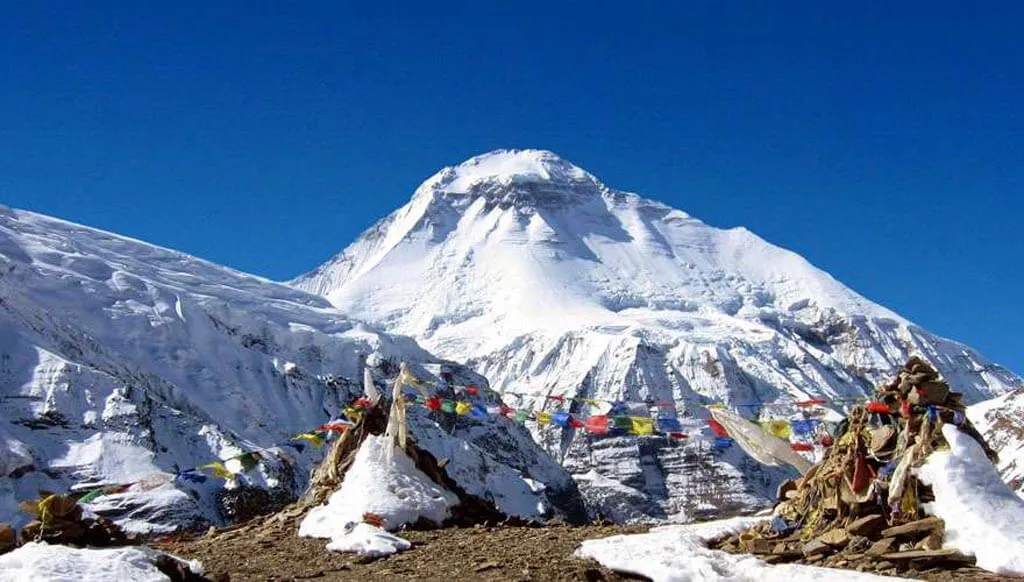
DHAULAGIRI BASE CAMP TREK
DHAULAGIRI BASE CAMP TREK
Choose your Itinerary
Overview
The Dhaulagiri Base Camp Trek is a thrilling adventure that takes you to the base camp of Mount Dhaulagiri, one of the world's highest peaks. Here is some detailed information about the trek:
Duration: The Dhaulagiri Base Camp Trek typically takes around 14-16 days to complete. This includes trekking days and acclimatization/rest days. However, the duration can vary depending on your fitness level and the itinerary you choose.
Difficulty: This trek is considered to be challenging and is suitable for experienced trekkers. It involves steep ascents and descents, crossing high passes, and trekking at high altitudes. Previous trekking experience and a good level of fitness are recommended.
Best Time to Trek: The best time to do the Dhaulagiri Base Camp Trek is during the spring (March to May) and autumn (September to November) seasons. These months offer stable weather conditions, clear skies, and moderate temperatures, making it ideal for trekking. However, it is important to check the weather forecast and be prepared for changing weather conditions in the mountains.
Permits: To trek to Dhaulagiri Base Camp, you need a special trekking permit called the "Restricted Area Permit." Additionally, you will also need the Annapurna Conservation Area Permit (ACAP) and the TIMS (Trekkers' Information Management System) card. These permits can be obtained through a registered trekking agency in Nepal.
Guide and Porter: While it is not mandatory, it is highly recommended to hire a guide and porter for the Dhaulagiri Base Camp Trek. A guide can provide valuable information about the route, ensure your safety, and assist with navigation. A porter can help carry your heavy backpack, allowing you to trek more comfortably.
Accommodation: Along the Dhaulagiri Base Camp Trek route, there are teahouses and lodges available for accommodation. However, the availability of these facilities may be limited in some remote areas. It is advisable to carry some cash for accommodation and meals, as credit card facilities may not be available.
Essential Equipment: You will need to pack essential trekking gear such as a good quality backpack, trekking boots, warm clothing layers, a sleeping bag, a trekking pole, a headlamp, and a first aid kit. It is also recommended to bring a good quality map or hire a guide for navigation.
Altitude Sickness: Altitude sickness can be a concern on the Dhaulagiri Base Camp Trek, as you will be trekking at high altitudes. It is important to acclimatize properly, stay hydrated, and ascend gradually to minimize the risk of altitude sickness. It is advisable to consult with a doctor before the trek and be aware of the symptoms of altitude sickness.
Solo Trekking: It is possible to do the Dhaulagiri Base Camp Trek solo. However, it is recommended to have previous trekking experience, good navigation skills, and knowledge of high-altitude trekking. Hiring a guide or joining a trekking group can enhance your safety and overall trekking experience.
The Dhaulagiri Base Camp Trek offers a unique and rewarding experience for adventure enthusiasts. It allows you to immerse yourself in the stunning beauty of the Dhaulagiri mountain range and witness the majestic Mount Dhaulagiri up close. Prepare well, choose the right time, and embark on this unforgettable journey.
Altitude Chart
Itinerary
On your arrival at Kathmandu Tribhuvan International Airport you will be met by Sherpa Expedition and trekking staff and transferred to your respective hotels followed by a briefing regarding Dhaulagiri Base Camp trek.
We take private jeep drive for 10 hours down into the Kali Gandaki Valley and up the tributary of the Myagdi Khola valley until we reach Darbang where we will stay the night.
The trek continues as you make your way to Dharapani. The trail goes through terraced fields, small villages, and lush forests. You will spend the night in Dharapani.
The trek continues as you make your way to Jugepani. The trail goes through terraced fields, small villages, and lush forests. You will spend the night in Jugapani.
We start our day by ascending to the ridge and then descending to Juge Pani where we stop for a lunch break. After lunch we ascend along a steep trail and then find ourselves high above the valley. The trail follows along a cliff edge and after about an hour we reach Boghara Village where we camp for the night.
The trail today begins as we head through cultivated fields while ascending to the ridge. The trail becomes a little less tiring and then we reach Lipshe Village where we stop for lunch. We then trek through dense forest for about two to three hours until we reach Dobang Village where we camp for the night.
Today is another day of gaining altitude as we continue through forests and grazing lands around Dobang. After a lunch break we continue on to Sallaghari where we make camp for the night.
Today we need to remain focused as the trail is less defined and you will need to watch your balance as some of the trails can be dangerous. We follow the wild Myagdi Khola (river), stepping over logs and using your limbs to scramble up the more uneven areas of the track. We then ascend through bamboo and other untouched forests. Along the trail you may see Langur monkeys scrambling about the treetops. After another three to four hours on the trail we reach Dobhan and then Sallaghari where we will stop for lunch. After lunch we continue to climb up through prickly aeglea brush (broom bush). Two to three hours later we finally reach Italy Base Camp previously used by Italian explorers prior to the ascent of Dhaulagiri. Tonight we camp at Italy Base Camp.
Today is a short trek of four to five hours before we reach Japnese Base Camp. Along the trail, after leaving Italy Base Camp you will pass several memorials of climbers who perished while attempting to climb Dhaulagiri, which includes three Chinese climbers who died in 2010. Previous trekkers have left a fixed rope making the descent less risky. We then cross the moraine to the Japnese Base Camp where there is a single hut. We set up camp here for the night.
Today’s trek is about seven to eight hours. We follow a trail across the Dhaulagiri moraine below the glacier until we reach Dhaulagiri Base Camp which will hopefully be before lunch if we leave early enough in the morning. Our camp here tonight is surrounded by Himalayan peaks – a breathtaking experience.
We will cross the french pass takes 7-8 hours to reach hidden valley. For those who wish to climb Dhampus Peak (6,060m) there will be an early start at around 3 am. The climb to Dhampus Peak and return to Yak Kharka will take about 10 hours. Tonight we set up camp at Hidden Valley.
The trek today has some memorable views of Dhaulagiri Peak in the southwest, Annapurna and Nilgiri in the east, and far off Mustang in the north as well as the deepest gorge on earth - the Kali Gandaki Valley. The trail is fairly easy going until we get nearer to Yak Kharka when it descends rapidly to Marpha Village where we can stop for lunch. After lunch we continue to Jomsom where we stay the night in a lodge.
on Day 13, after a fulfilling trekking experience in the Dhaulagiri Circuit, you will embark on a scenic drive from Marpha to Pokhara. Leaving the charming village of Marpha behind, you will be surrounded by stunning views of the Annapurna and Dhaulagiri mountain ranges as you descend along the Kali Gandaki River Valley. The drive takes you through picturesque landscapes, passing through small traditional villages, terraced fields, and lush green forests.
Today we head back to Kathmandu, either by bus or private vehicle depending on the size of the group. Upon arrival at Kathmandu, you will be taken to your respective hotels situated close to the main tourist hub – Thamel.
Your adventure comes to an end today – but your memories will last a lifetime! Our company representative will take you to the airport approximately 3 hours before your scheduled flight. On your way home you'll have plenty of time to plan your next adventure and explore the most magnificent mountains of Nepal.
Services
Costs Included In Your Package
- Airport picks up and transports by private Car/Jeep.
- Two Night's hotel accommodation In Kathmandu with breakfast (3 star Hotel)
- One Night hotel accommodation In Pokhara with breakfast (3 star Hotel)
- Transportation from Marpha to Pokhara by Public Bus.
- Pokhara to Kathmandu transportation by Tourist Bus.
- All standard meals - 3 meals a day (lunch, dinners & breakfast) during the trek.
- Twin sharing tented accommodation during the trek (after Itilian Base camp to Yak Kharka)
- Trekking equipment (two men tent, dining tent, kitchen tent, table with chairs, kitchen utensils, and other necessary equipment during the trek)
- Best possible teahouses, lodge accommodation (generally twin share rooms)- during the trek
- Government licensed holder English speaking trek leader (10 or more trekkers an assistant guide) and porter to help carry your luggage.
- Strong, helpful Sherpa porters with proper safety equipment and walking equipment, his salary, food, accommodation, and insurance (one porter for two people).
- Guides and porters provided by Sherpa Trekking & Expeditions, including their meals, insurance, salary, lodging, transportation, and other necessary equipment
- All the required permits and paper works( Annapurna Conservation area Permit, TIMS etc)
- All government, local taxes, and official expenses
- Assistance in arranging rescue operations in case of complicated health conditions such as altitude sickness (funded by travel insurance)
- Souvenir - Sherpa Trekking & Expeditions t-shirt
- Use of sleeping bag, down jacket, duffel bag, and walking poles (if you don’t have your own, to be returned after the trip is completed).
- Sherpa Expedition and Trekking’s certificate of appreciation & completion after the successful trek
- Oxygen meter to check your pulse and oxygen saturation and heart rate twice daily (Very useful to check Altitude Mountain Sickness(AMS) symptoms) which will ensure your health during the trek.
Costs Exclude
- International airfares
- Nepal entry visa fee (easy to obtain the visa on arrival at Tribhuvan International Airport – Kathmandu). $30 USD for 15-day, $50 USD for 30 Days, and $125 USD for 90 Days visa.
- Extra night’s accommodation in Kathmandu due to early arrival or late departure or early return from the trek.
- All the alcoholic and nonalcoholic, soup, tea, coffee, hot chocolate, cocoa, mineral water, extra food, cold and hot drinks on trek ( i.e. those you choose to purchase along the way and during evenings in the tea houses)
- All desserts & sweet things like chocolate, cake, pie, pudding.
- Hot shower and battery charging at the tea houses.
- Lunch and dinner in Kathmandu & Pokhara
- Personal clothing and gear
- Travel insurance which has to cover emergency high-altitude rescue and evacuation (compulsory)
- Tips for guide and porters (recommended in our culture – and well deserved too!)
- Additional costs or delays caused by events beyond our control, for example, landslides, severe weather conditions, itinerary modification due to safety concerns, illness, change of government policies & strikes.
- All the costs and expenses which are not listed in "costs include" will be counted as exclusions.
Equipments
The following information will give you some idea about what you need to bring for the trek. It is important you do not forget the essential items, as this will determine your comfort and safety on the trek. Equally important is that you do not burden yourself with unnecessary equipment on the trek.
- Sleeping Bag (Sherpa Teams will provide but need to return after completing the trip)
- Duffel Bag (Sherpa Teams will provide but need to return after completing the trip)
- Fleece jacket or pullover
- Waterproof windbreaker or windcheater
- Thermal underclothes
- Rain poncho
- Down jacket (Sherpa Teams will provide but need to return after completing the trip)
- Fleece or wool trousers
- Sun hat or scarf
- Trekking pants (two pairs)
- Mittens or woolen gloves
- Hiking socks (several pairs)
- Moisture-wicking shirts, including t-shirts
- Trekking shoes or boots with spare laces
- Flip-flops or sandals for relaxing in the evenings
- Underwear (several pairs)
- Swimsuit or swimming costume
- Sunglasses
- Headlamp or flashlight/torch
- Sleeping bag (Sherpa Teams can provide this for you)
- Trekking poles (if desired)
- Hiking backpack with a capacity of at least 40 liters
- Small lock for your backpack
- Reusable water bottles (at least two liters)
- Water purification tablets or filtration device
- Wash towel
- Basic first aid kit
Toiletries (tissues, toilet paper, moisturizer, lip balm, sunscreen, sanitary pads, hand sanitizer, nail clippers, a small mirror, toothbrush, toothpaste, glasses, contacts, etc.)
Good to Know
Accommodation
You will be accommodated in 3-star hotels in Kathmandu. During the trek, we will be staying at lodges/ teahouses. You may not find comfortable and better quality teahouses -During the trek, We sleep in the very simple tea house/tent and our guides will pick the best Camping site with a nice view of the Himalaya.
Meals during the trek
In Kathmandu your hotel includes breakfast, whereas all meals (breakfast, lunch, and dinner) will be provided during the trek. A staple food of these mountain regions are potatoes, oats, buckwheat, Sherpa stew and Tibetan bread. Sherpas started farming potatoes when the first seeds were introduced to the region in the early 90s. There is a limited choice of food at higher elevations and except many potato dishes. Potatoes are high in carbohydrates – an excellent source of energy needed at high altitudes.
Transportation
We use a private car for sightseeing and for the airport to hotel pick and drop off. We do not have to use public transportation or local buses during the trek. Our only flights are from Kathmandu, Jomson and Pokhara.
Physical fitness
Dhaulagiri is a challenging trek where you often have to walk 6-7 hours a day. You need past experience of hiking or trekking but if you have done any kind of trekking activities then it is always a plus!. We have met people from all walks of life, shapes and sizes who have completed the trek. The only difficult part is when altitude sickness strikes and the effect that it can have on your body. Before leaving for Nepal it is good if you can prepare yourself physically by increasing your stamina and oxygen intake.
Remember – The better prepared – the more enjoyable your trek!
Gallery

Tour Dates
Every departure listed below is 100% Guaranteed — once you book, your trip will run as scheduled regardless of group size.
Loading departure dates…
Want your own personalized tour?
FAQS
Others
The Dhaulagiri Base Camp Trek is a trekking route that takes you to the base camp of Mount Dhaulagiri, the seventh highest mountain in the world. It offers breathtaking views of the Dhaulagiri mountain range and takes you through diverse landscapes, including forests, terraced fields, and high-altitude passes.
The Dhaulagiri Base Camp Trek typically takes around 14-18 days to complete. This includes trekking days and acclimatization/rest days. However, the duration can vary depending on your fitness level and the itinerary you choose.
Yes, the Dhaulagiri Base Camp Trek is considered to be a challenging trek. It involves steep ascents and descents, crossing high passes, and trekking at high altitudes. Previous trekking experience and a good level of fitness are recommended.
The best time to do the Dhaulagiri Base Camp Trek is during the spring (March to May) and autumn (September to November) seasons. These months offer stable weather conditions, clear skies, and moderate temperatures, making it ideal for trekking. However, it is important to check the weather forecast and be prepared for changing weather conditions in the mountains.
Yes, you need a special trekking permit called the "Restricted Area Permit" to do the Dhaulagiri Base Camp Trek. Additionally, you will also need the Annapurna Conservation Area Permit (ACAP) and the TIMS (Trekkers' Information Management System) card. These permits can be obtained through a registered trekking agency in Nepal.
While it is not mandatory to hire a guide or porter for the Dhaulagiri Base Camp Trek, it is highly recommended. A guide can provide valuable information about the route, ensure your safety, and assist with navigation. A porter can help carry your heavy backpack, allowing you to trek more comfortably.
Yes, there are teahouses and lodges available along the Dhaulagiri Base Camp Trek route. However, the availability of these facilities may be limited in some remote areas. It is advisable to carry some cash for accommodation and meals, as credit card facilities may not be available.
You will need to pack essential trekking gear such as a good quality backpack, trekking boots, warm clothing layers, a sleeping bag, a trekking pole, a headlamp, and a first aid kit. It is also recommended to bring a good quality map or hire a guide for navigation.
Yes, altitude sickness can be a concern on the Dhaulagiri Base Camp Trek, as you will be trekking at high altitudes. It is important to acclimatize properly, stay hydrated, and ascend gradually to minimize the risk of altitude sickness. It is advisable to consult with a doctor before the trek and be aware of the symptoms of altitude sickness.
Yes, it is possible to do the Dhaulagiri Base Camp Trek solo. However, it is recommended to have previous trekking experience, good navigation skills, and knowledge of high-altitude trekking. Hiring a guide or joining a trekking group can enhance your safety and overall trekking experience.
Reviews
Overview
The Dhaulagiri Base Camp Trek, also known as the Dhaulagiri Pass Trek, is a challenging and exhilarating trekking adventure in the heart of the Himalayas. Situated in the western region of Nepal, the Dhaulagiri mountain range is the seventh highest mountain in the world, standing tall at 8,167 meters (26,795 feet).
The trek begins with a scenic drive from Kathmandu to Beni, the starting point of the trek. From here, we follow the Myagdi Khola river gorge, passing through terraced fields, quaint villages, and lush forests. The trail gradually ascends, offering breathtaking views of the surrounding landscapes.
As we continue our journey, we reach the Italian Base Camp, where we take a well-deserved rest and acclimatize to the high altitude. From here, the trail becomes more challenging as we make our way to the Dhaulagiri Base Camp, located at an altitude of 4,740 meters (15,550 feet). This is a truly awe-inspiring location, surrounded by towering peaks and glaciers.
The highlight of the trek is crossing the challenging Dhaulagiri Pass, also known as the French Pass, which stands at an elevation of 5,360 meters (17,585 feet). This section requires some technical climbing skills and is not recommended for novice trekkers. However, for experienced climbers, it offers a thrilling and rewarding experience.
After crossing the pass, we descend into the hidden valley and continue our trek to the beautiful village of Marpha, famous for its apple orchards and traditional architecture. From here, we make our way back to Jomsom, where we catch a scenic flight back to Pokhara.
The Dhaulagiri Base Camp Trek is a physically demanding trek that requires a good level of fitness and previous trekking experience. The weather and trail conditions can be unpredictable, so it is important to be well-prepared with proper gear and equipment.
This trek not only offers stunning views of the Dhaulagiri mountain range but also provides an opportunity to immerse yourself in the unique culture and traditions of the local communities. The warm hospitality of the villagers, coupled with the pristine beauty of the Himalayas, makes this trek a truly unforgettable experience.
So, if you are up for a challenging adventure and want to explore the hidden gems of the Himalayas, the Dhaulagiri Base Camp Trek is the perfect choice for you. Embark on this journey and create memories that will last a lifetime.
Itinerary
Upon your arrival at Tribhuvan International Airport in Kathmandu, our representative will greet you and transfer you to your hotel. You can spend the rest of the day exploring the vibrant streets of Kathmandu or simply relax and prepare for the trek.
We first fly to Pokhara and then drive down into the Kali Gandaki Valley and up the tributary of the Myagdi Khola valley until we reach Darbang where we will stay the night.
Today we follow the trail for six to seven hours, passing several villages until we reach Dharapani that is situated on top of a ridge. We have lunch here and then continue through several villages and pass Takam Village before reaching Sibang where we stay the night.
Today we take the trail to the village of Muri where we stop for lunch and then continue our ascent of the Myagdi Khola Valley to Naura Bhir where we stay the night.
Our trek today is of about seven to eight hours following the Myagdi Khola (river) until we reach Baghara Village. We descend down to the river before ascending to a herder’s camp at Lapche Kharka where we stay the night.
Today is another day of gaining altitude as we continue through forests and grazing lands around Dobang. After a lunch break we continue on to Sallaghari where we make camp for the night.
Today we trek for four to five hours and pass through and across a moraine until we reach the Italian Base Camp where we camp below the awesome west face of Dhaulagiri.
Today we again ascend up the Myagdi Khola (river) with a steep ascent to Japanese Camp, also known as Chhonbardan Glacier Camp where we have incredible views of the numerous Dhaulagiri peaks. We will camp here the night.
Today’s trek is about seven to eight hours. We follow a trail across the Dhaulagiri moraine below the glacier until we reach Dhaulagiri Base Camp which will hopefully be before lunch if we leave early enough in the morning. Our camp here tonight is surrounded by Himalayan peaks – a breathtaking experience.
It is essential that we take a break here and again acclimatize. Again, it is advisable to remain as active as possible.
A six to seven hour trek is ahead of us today, and due to the higher altitude will be physically more demanding. We begin by crossing a moraine and then reach a ridge that heads up to the snowy slopes heading up to French Pass. We cross the pass and head into the Hidden Valley on the other side of Dhaulagiri where we make camp for the night.
Today we ascend back to the height of French Pass at the other end of the valley and then trek at this higher altitude to the slightly lower Dhampus Pass. Once through the pass we begin our descent to our overnight camp at Yak Kharka.
Today the trail descends for about 1000 meters to the Kali Gandaki Valley and the attractive village of Marpha (2667m) that is on the Annapurna Circuit trekking trail.. After a short trek we reach Jomsom where we stay in a lodge for the night.
We fly above the mountainous terrain and head back on a scenic flight to Pokhara and check in to our hotel. We can either put our feet up and rest or stroll around the city shopping area, or alternatively sit beside Phew Tal (lake) and admire the distant Annapurna Mountains.
Our morning flight takes us back to Kathmandu where we will check-in at our hotel and then have time to wonder around the tourist area of Thamel catching up on some last-minute shopping.
Your adventure comes to an end today – but your memories will last a lifetime! Our company representative will take you to the airport approximately 3 hours before your scheduled flight. On your way home you'll have plenty of time to plan your next adventure and explore the most magnificent mountains of Nepal.
Services
Costs Included In Your Package
- Airport picks up and transports by private Car/Jeep.
- Two Night's hotel accommodation In Kathmandu with breakfast (3 star Hotel)
- Transportation from Pokhara to Darbang by Local Jeep
- Kathmandu-Pokhara-Kathmandu flight with private airport transfer and domestic airport tax.
- Jomsom to Pokhara flight with private airport transfer and domestic airport tax.
- One Night hotel accommodation In Kathmandu with breakfast (3 star Hotel)
- All standard meals (lunch, dinners & breakfast) during the trek.
- Tent camp accommodation & food during the trek
- Best possible teahouses, lodge accommodation (generally twin share rooms)- during the trek
- Government licensed holder English speaking trek leader (10 or more trekkers an assistant guide) and porter to help carry your luggage.
- Strong, helpful Sherpa porters with proper safety equipment and walking equipment, his salary, food, accommodation, and insurance (one porter for two people).
- Guides and porters provided by Sherpa Trekking & Expeditions, including their meals, insurance, salary, lodging, transportation, and other necessary equipment
- All the required permits and paper works( Annapurna Conservation area Permit, TIMS etc)
- All government, local taxes, and official expenses
- Assistance in arranging rescue operations in case of complicated health conditions such as altitude sickness (funded by travel insurance)
- Souvenir - Sherpa Trekking & Expeditions t-shirt
- Use of sleeping bag, down jacket, duffel bag, and walking poles (if you don’t have your own, to be returned after the trip is completed).
- Sherpa Expedition and Trekking’s certificate of appreciation & completion after the successful trek
- Oxygen meter to check your pulse and oxygen saturation and heart rate twice daily (Very useful to check Altitude Mountain Sickness(AMS) symptoms) which will ensure your health during the trek.
Costs Exclude
- International airfares
- Nepal entry visa fee (easy to obtain the visa on arrival at Tribhuvan International Airport – Kathmandu). $30 USD for 15-day, $50 USD for 30 Days, and $125 USD for 90 Days visa.
- Extra night’s accommodation in Kathmandu due to early arrival or late departure or early return from the trek.
- All the alcoholic and nonalcoholic, soup, tea, coffee, hot chocolate, cocoa, mineral water, extra food, cold and hot drinks on trek ( i.e. those you choose to purchase along the way and during evenings in the tea houses)
- All desserts & sweet things like chocolate, cake, pie, pudding.
- Hot shower and battery charging at the tea houses.
- Lunch and dinner in Kathmandu & Pokhara
- Personal clothing and gear
- Travel insurance which has to cover emergency high-altitude rescue and evacuation (compulsory)
- Tips for guide and porters (recommended in our culture – and well deserved too!)
- Additional costs or delays caused by events beyond our control, for example, landslides, severe weather conditions, itinerary modification due to safety concerns, illness, change of government policies & strikes.
- All the costs and expenses which are not listed in "costs include" will be counted as exclusions.
Tour Dates
Every departure listed below is 100% Guaranteed — once you book, your trip will run as scheduled regardless of group size.
Loading departure dates…
Want your own personalized tour?
Overview
If you are looking for a more physically challenging adventure into the wild - then this may be just what you are looking for.
The Dhaulagiri Circuit Trek is rated as “high-advanced” ascending to 5100 meters and heads to some far-off and isolated regions crossing high altitude passes and follows a trail around the Dhaulagiri Massif. Mt. Dhaulagiri (8167m) is known as "The white mountain" and is the world's seventh-highest peak.
We take trails through Hidden Valley set among white snow-covered mountains and sparse desolate terrain. The Hidden Valley is bordered on one side by the Boudha Himal and Himal Chuli in the west, Ganesh Himal in the south and Sringi Himal in the North. This area has remained unchanged for centuries due to it being isolated from the southern lowlands by yawning gorges and rivers and from Tibet in the north by snow-covered passes.
The Mt. Dhaulagiri (8167m) trek is not for beginners for you will be required to head through the French Pass at 5360 meters that will be a test of your endurance, but with well planned prior acclimatization it will not be so difficult.
The name Dhaulagiri derives from the Sanskrit word (dhawala) that means dazzling, white, beautiful and (giri) meaning mountain. Dhaulagiri 1 is also the highest peak in the Gandaki river basin area.
Annapurna I (8091m) lies only 34 km to the east of Dhaulagiri. The Kali Gandaki River flows between the two in the Kaligandaki Gorge and is said to be the world's deepest gorge. The town of Pokhara is south of the Annapurnas and is an important starting point for treks in this region.
The trek starts as you head up the slopes of terraced farmlands and through forests in a region populated by the Magar people, a caste with more than 20 sub-castes. The trail will take you across moraines and close to Dhaulagiri, across French Pass (5360m) and to Hidden Valley. At this stage of the trek we may choose to climb Dhampus Peak (6060m). The trail continues over Dhampus Pass (5240m) and finally heads down to Jomsom where the trek ends.
The Dhaulagiri Circuit Trek is more physically demanding than the Annapurna Circuit Trek or the Manaslu Circuit Trek and requires that you are physical fit and able to endure several days trekking across barren gravel and stone moraines at the base of mountain glaciers.
Sherpa Expedition Teams (Est.1977) have had more than 40 years taking trekkers to the Himalayan Mountains and will take care of all the preparation and paperwork, such as permits, as well as meals and accommodation on the trek. We have an excellent reputation for safety and taking care of our clients.
Itinerary
On your arrival at Kathmandu Tribhuvan International Airport, you will be met by Sherpa Expedition and trekking staff and transferred to your respective hotels followed by a briefing regarding Dhaulagiri trek.
We take private jeep drive for 10 hours down into the Kali Gandaki Valley and up the tributary of the Myagdi Khola valley until we reach Darbang where we will stay the night.
The trek continues as you make your way to Dharapani. The trail goes through terraced fields, small villages, and lush forests. You will spend the night in Dharapani.
The trek continues as you make your way to Jugepani. The trail goes through terraced fields, small villages, and lush forests. You will spend the night in Jugapani.
We start our day by ascending to the ridge and then descending to Juge Pani where we stop for a lunch break. After lunch we ascend along a steep trail and then find ourselves high above the valley. The trail follows along a cliff edge and after about an hour we reach Boghara Village where we camp for the night.
The trail today begins as we head through cultivated fields while ascending to the ridge. The trail becomes a little less tiring and then we reach Lipshe Village where we stop for lunch. We then trek through dense forest for about two to three hours until we reach Dobang Village where we camp for the night.
Today is another day of gaining altitude as we continue through forests and grazing lands around Dobang. After a lunch break we continue on to Sallaghari where we make camp for the night.
Today we need to remain focused as the trail is less defined and you will need to watch your balance as some of the trails can be dangerous. We follow the wild Myagdi Khola (river), stepping over logs and using your limbs to scramble up the more uneven areas of the track. We then ascend through bamboo and other untouched forests. Along the trail you may see Langur monkeys scrambling about the treetops. After another three to four hours on the trail we reach Dobhan and then Sallaghari where we will stop for lunch. After lunch we continue to climb up through prickly aeglea brush (broom bush). Two to three hours later we finally reach Italy Base Camp previously used by Italian explorers prior to the ascent of Dhaulagiri. Tonight we camp at Italy Base Camp.
Acclimatization is important for your safety before heading to higher elevations. Medical professionals recommend that you stay active during the day, We can do small hiking.
Today is a short trek of four to five hours before we reach Japnese Base Camp. Along the trail, after leaving Italy Base Camp you will pass several memorials of climbers who perished while attempting to climb Dhaulagiri, which includes three Chinese climbers who died in 2010. Previous trekkers have left a fixed rope making the descent less risky. We then cross the moraine to the Japnese Base Camp where there is a single hut. We set up camp here for the night.
Today’s trek is about seven to eight hours. We follow a trail across the Dhaulagiri moraine below the glacier until we reach Dhaulagiri Base Camp which will hopefully be before lunch if we leave early enough in the morning. Our camp here tonight is surrounded by Himalayan peaks – a breathtaking experience.
For those who wish to climb Dhampus Peak (6,060m) there will be an early start at around 3 am. The climb to Dhampus Peak and return to Yak Kharka will take about 10 hours. Tonight we set up camp at Yak Kharka.
The trek today has some memorable views of Dhaulagiri Peak in the southwest, Annapurna and Nilgiri in the east, and far off Mustang in the north as well as the deepest gorge on earth - the Kali Gandaki Valley. The trail is fairly easy going until we get nearer to Yak Kharka when it descends rapidly to Marpha Village where we can stop for lunch. After lunch we continue to Jomsom where we stay the night in a lodge.
The trek today has some memorable views of Dhaulagiri Peak in the southwest, Annapurna and Nilgiri in the east, and far off Mustang in the north as well as the deepest gorge on earth - the Kali Gandaki Valley. The trail is fairly easy going until we get nearer to Yak Kharka when it descends rapidly to Marpha Village where we can stop for overnight. we will stay at teahouse.
On Day 15, after a fulfilling trekking experience in the Dhaulagiri Circuit, you will embark on a scenic drive from Marpha to Pokhara. Leaving the charming village of Marpha behind, you will be surrounded by stunning views of the Annapurna and Dhaulagiri mountain ranges as you descend along the Kali Gandaki River Valley. The drive takes you through picturesque landscapes, passing through small traditional villages, terraced fields, and lush green forests.
Today we head back to Kathmandu, either by bus or private vehicle depending on the size of the group. Upon arrival at Kathmandu, you will be taken to your respective hotels situated close to the main tourist hub – Thamel.
Your adventure comes to an end today – but your memories will last a lifetime! Our company representative will take you to the airport approximately 3 hours before your scheduled flight. On your way home you'll have plenty of time to plan your next adventure and explore the most magnificent mountains of Nepal.
Services
Costs Included In Your Package
- Airport picks up and transports by private Car/Jeep.
- Two Night's hotel accommodation In Kathmandu with breakfast (3 star Hotel)
- One Night hotel accommodation In Pokhara with breakfast (3 star Hotel)
- Transportation from Marpha to Pokhara by Public Bus.
- Pokhara to Kathmandu transportation by Tourist Bus.
- All standard meals - 3 meals a day (lunch, dinners & breakfast) during the trek.
- Twin sharing tented accommodation during the trek (after Itilian Base camp to Yak Kharka)
- Trekking equipment (two men tent, dining tent, kitchen tent, table with chairs, kitchen utensils, and other necessary equipment during the trek)
- Best possible teahouses, lodge accommodation (generally twin share rooms)- during the trek
- Government licensed holder English speaking trek leader (10 or more trekkers an assistant guide) and porter to help carry your luggage.
- Strong, helpful Sherpa porters with proper safety equipment and walking equipment, his salary, food, accommodation, and insurance (one porter for two people).
- Guides and porters provided by Sherpa Trekking & Expeditions, including their meals, insurance, salary, lodging, transportation, and other necessary equipment
- All the required permits and paper works( Annapurna Conservation area Permit, TIMS etc)
- All government, local taxes, and official expenses
- Assistance in arranging rescue operations in case of complicated health conditions such as altitude sickness (funded by travel insurance)
- Souvenir - Sherpa Trekking & Expeditions t-shirt
- Use of sleeping bag, down jacket, duffel bag, and walking poles (if you don’t have your own, to be returned after the trip is completed).
- Sherpa Expedition and Trekking’s certificate of appreciation & completion after the successful trek
- Oxygen meter to check your pulse and oxygen saturation and heart rate twice daily (Very useful to check Altitude Mountain Sickness(AMS) symptoms) which will ensure your health during the trek.
Costs Exclude
- International airfares
- Nepal entry visa fee (easy to obtain the visa on arrival at Tribhuvan International Airport – Kathmandu). $30 USD for 15-day, $50 USD for 30 Days, and $125 USD for 90 Days visa.
- Extra night’s accommodation in Kathmandu due to early arrival or late departure or early return from the trek.
- All the alcoholic and nonalcoholic, soup, tea, coffee, hot chocolate, cocoa, mineral water, extra food, cold and hot drinks on trek ( i.e. those you choose to purchase along the way and during evenings in the tea houses)
- All desserts & sweet things like chocolate, cake, pie, pudding.
- Hot shower and battery charging at the tea houses.
- Lunch and dinner in Kathmandu & Pokhara
- Personal clothing and gear
- Travel insurance which has to cover emergency high-altitude rescue and evacuation (compulsory)
- Tips for guide and porters (recommended in our culture – and well deserved too!)
- Additional costs or delays caused by events beyond our control, for example, landslides, severe weather conditions, itinerary modification due to safety concerns, illness, change of government policies & strikes.
- All the costs and expenses which are not listed in "costs include" will be counted as exclusions.
Tour Dates
Every departure listed below is 100% Guaranteed — once you book, your trip will run as scheduled regardless of group size.
Loading departure dates…
Want your own personalized tour?